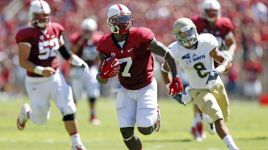
9/13 Stanford 35, Army 0

1. Perspective1410656483003-2014-09-13 Stanford-Army

Rarely is there drama at the end of a 35-0 game, but Stanford’s second team defense was put to a rousing test late in the 4th quarter. At its two yard-line, Stanford stuffed Army on 2nd and 1, 3rd and 1, and 4th and 1. On the 4th and 1, Stanford cornerback Ronnie Harris snuck in from the corner of the end zone, leaving the receiver completely uncovered, and took away the pitchman. Linebacker Peter Kalambayi pushed his blocker backwards to crowd the area, and safety Dallas Lloyd rushed in to make the tackle. It was a perfect example of scheme, power, and teamwork, and it secured the second shutout of the season.

There have been many statistical streaks since Stanford football arrived a few years back. Stanford lost its longest active home winning streak a couple weeks ago, but there always seems to be another feat ongoing. Stanford has held opponents to under 30 points for 26 consecutive games, the longest such streak in the nation. It also has 6 shutouts going back to 2010. Is it the best defense in the country in that time span? No, Alabama has 11 shutouts since 2010, and a couple of national championships. But, Stanford has a strong claim to second best. As for the 2014 season, Stanford is currently #1 in the country in scoring defense (4.3 pts/game) and total defense (204.3 yds/game).

Historically, this is a new identity for Stanford. The teams of the 1980’s and 1990’s were usually known for having a more reliable offense. When our defense took the field, it was an opportunity to down your Lutticken’s sandwich and pick wood splinters out of your shorts. There were good defenses, and great players—Dave Wyman, Jono Tunney, Toi Cook, Ron George, John Lynch—but there were no dominant defenses. In 226 games in the 1980’s and 1990’s the defense recorded only one shutout. Nowadays, the Stanford defense is primary identity of the team.

2. Offense: Still Searching For Mike’s Groove 

It is harder to say what the identity of Mike Bloomgren’s offense is this year. In recent years, we were a run first team. So far this year, Stanford has dropped back to pass on 47 of 88 1st downs. That is 53.4% passing plays. Last season, Stanford passed on 105 of 380 1st downs, or 27.6%. (The data from last season counts QB scrambles and sacks as runs, so the actual percentage of intended passing plays is probably in the 30’s.) I don’t know what to make of this yet. After watching Boston College pound USC for 452 rushing yards on Saturday, it is tempting to think we should have run the ball more against USC, but I’m not sure that is the right conclusion. Penalties and negative plays put us in a lot of passing situations in that game. Also, we did run the ball a fair amount: 38 attempts. At this point, it is difficult to predict if we will be able to dominate games by rushing the ball like we did against Oregon last year. The short answer might be no, but in the 3rd quarter against Army we gained 88 yards on five consecutive running plays, mostly using the Jumbo package. The jury is still out.

Hogan started the game 6-6 until Austin Hooper dropped his first pass of the year. Hogan missed a few throws in the 1st half which contributed to some stalled drives, but again finished the day with good numbers: 20-28, 216 yards, 4 TDs, 0 INTs. It always shocks me to walk around the stadium and the tailgates and hear the Stanford fans who are Hogan complainers. I’m not sure if they are recent fans who only know and expect the Andrew Luck show, or if they just don’t bother to consider the facts. Hogan is 18th in the nation with 9.5 yards/attempt—perhaps the most important simple passing statistic. He is 6th in completion percentage, and 9th according to ESPN Quarterback Rating. He has a higher rating than Cody Kessler, Taylor Kelley, Brett Hundley—even Jameis Winston. In 2013, he was 13th in yards/attempt, ahead of Aaron Murray, Connor Shaw, Brett Hundley, Cody Kessler, and Braxton Miller. Still, Hogan virtually never gets discussed as a great player.

Slightly less shocking are the Jordan Williamson haters. Yes, he has had multiple misses in two key games: the Fiesta Bowl a couple years ago and against USC a couple weeks ago. But he also made a huge overtime kick to beat Oregon two years ago and later the same year made the go-ahead 4th quarter field goal against UCLA to send Stanford to the Rose Bowl. Last year, he made 18/22 kicks and was clearly an above-average college kicker. However, his career field goal percentage is 68%, which puts him somewhere around the 40th percentile of college kickers, meaning he’s generally about the 4th best kicker out of a group of 10. He is one of the better kickoff kickers in the country, often placing the kick right at the goal line near one side of the field. Stanford has been ranked in the top-20 in kick coverage for the past few years, partly because of his well-placed kicks. On the flip side, he does kick some out of bounds every now and again. What does it all add up to? In my opinion, Williamson is an average kicker. He is not bad enough to be disparaged, but not good enough for Shaw to send him onto the field as much as he does. On 4th and 3 from the opponent’s 20 yard line, let’s run the ball or let Hogan roll out. Now that I think of it, I don’t think we’ve seen Hogan on a designed rollout all year. Ironically, the rollout was the play designed for him when he would take a snap during the Josh Nunes games. I’d love to see Hogan rolling out occasionally with Hooper or Montgomery drifting ahead.

Actually, I don’t even care much who Hogan targets anymore. All of Stanford’s receivers and tight ends have excellent hands. In the 4th quarter, Jeff Trojan hauled in an errant Hogan pass for a clutch first down. Trojan rarely plays, but he has the best hands on the team, and he is the central guy on our “hands team” for onside kicks. Later in the same drive, McCaffrey caught a 3rd down pass like he had been a receiver his entire life. We are so deep at receiver that Kodi Whitfield, who last year made one of the greatest touchdown catches in the history of football, was switched to defense!

3. Defense: Backwards Down the Number Line

The defense blanked an Army team that had scored in every game for the past six years. Army didn’t really even get into field goal position until the last drive of the game. It is an impressive improvement from last year’s Army game, when Army scored 20 points.

Is this year’s defense better than last year’s? Is that even possible? Shaw certainly thought it was possible. Heading into the year, he said he thought it might be better than last year. No one believed him then. But maybe he was seeing reality—he would know better than anyone else. Nose tackle David Parry is really the linchpin. He is often demands two blockers, opening up gaps for other guys to make plays.

Cornerback Alex Carter is sharing time this year, but he seems to be playing much better. At the end of the first half, he blitzed from the corner and caused the Army fumble that reignited Stanford. Stanford hasn’t blitzed much this year. The defense has been getting things done with the front seven, while two deep safeties have so far completely eliminated the threat of a deep pass—Stanford is 1st in the nation in pass defense. This year, the party isn’t quite in the backfield, but the defense is still partying.

4. Coaching: We’ve Got It Simple

Contrary to my warnings of eminent play-calling doom, both the Jumbo package and the one Wildcat play were very effective last Saturday. But the Jumbo wasn’t used until the 3rd quarter and so had a surprise factor. It wasn’t 3rd and 1 with the ball headed right up the gut. So Shaw was catching the defense off-guard a bit. Also, Shaw decided to run the ball on a 3rd and 7, which I also occasionally think is a good idea. He gave the ball to Skov, who I think of more as a 3rd and 2 guy. Nonetheless, I like seeing some surprise elements from Shaw.

Still, Shaw decided to punt twice more from the opponent’s territory, both times in a tight game in the first half. At the end of the second quarter, after four consecutive stalled drives, the camera caught Hogan yelling, “No!” as Shaw sent the punt team onto the field on 4th and 7 from the Army 45. I feel bad for Hogan that his coach continues to make cautious decisions.

5. Cause They Can See Through the Lines: a Taste of Cutcliffe and Petrino

A friend asked me yesterday, “Are there teams that do clearly use a more aggressive 4th down strategy?” Short answer: there is not a single coach at the NCAA level who is consistently applying statistics to gain a competitive advantage on 4th down situations. No coach is willing to risk the fallout of contrarian thinking that is doomed by the risk inherent in a small sample size. In other words, if the first few “strange” decisions don’t yield good results, the coach will be ridiculed. But there are some coaches who are dabbling. While Shaw is near the conservative end of the spectrum—through three games, Stanford still has not converted a 4th down attempt—two FBS coaches stand out so far this year in terms of 4th down aggression.

First, coach David Cutcliffe from Duke. Duke has the most 4th down attempts of any team in the country: 11. If you knew the game of football, but hadn’t paid attention to Duke in the past two years, you might think that Duke was forced to try 4th down conversions because it was losing games. Not the case. Duke is 3-0 this season, has converted 73% of those 4th down attempts, and is usually very aggressive on 4th down in its opponent’s territory. In a tight game against Troy, Duke went for it on 4th and 10 from the opponent’s 35, and 4th and 2 from the 40. Against Elon, Duke ran the ball on 4th and 1 from its own 40 and again from its opponent’s 46. And this isn’t just a case of thinking they can overpower the likes of Troy or Elon. Against Texas A&M in last year’s bowl game, Duke attempted four 4th down conversions (and recovered an onside kick—while leading in the first half).

Cutcliffe isn’t so extreme though. He isn’t well-known nationally as a coach with an unusual philosophy or strategy. And he still ignores the math and kicks too many short field goals.

There is only one other team with a winning record that has at least 8 attempts on 4th down: Louisville. Early in the 2nd quarter of a tied game against Miami, Louisville coach Bobby Petrino went for it on 4th and 1 from his own 20. From 2008-2011, Petrino coached at Arkansas. I’m guessing he has spoken with this high school coach from Arkansas (http://grantland.com/features/grantland-channel-coach-never-punts/), and that he knows that is pays off to be aggressive. (Make sure you click that link if you aren’t familiar with this coach.)

But Petrino still isn’t aggressive enough, even when the game is on the line. Last Saturday, Louisville was down by two and faced 4th and 20 from its own 3 with two minutes remaining and only one timeout. It punted. Wrong decision, and Louisville never got the ball back. (I know, Louisville was doomed either way, but still.)

6. Up Next: Washington

Washington (3-0) finally put together a more complete performance against Illinois. It hasn’t looked great, but at 3-0, playing at home against Stanford, UW and its crowd are going to be amped. Fortunately, Washington has one less week to prepare, since they play Georgia State this weekend. The week off is a nice advantage for Stanford. Washington is 116th in the nation in pass defense. Stanford should be able to move the ball, and it also returns running back Remound Wright, who sat out against Army with a minor injury. Washington hasn’t seen a team like Stanford this year, but they also won’t be intimidated. This is a huge game, both to set up a bigger game with Notre Dame the following week, and to stay within one of Oregon in the Pac-12 standings.

7. The Playoff Picture

Here is one simple question that the Playoff Committee should be able to answer, though I fear that they probably never will: What is worse, losing by 3 to the 50th ranked team in the country, or losing by 30 to the 10th ranked team in the country? Or, in general, how does margin of victories and losses factor in to comparing teams’ merit. Consider South Carolina and Stanford. Both teams have one loss. Stanford dominated USC, but was outkicked and beaten by its own mistakes. Stanford’s loss is bad because it now looks like USC isn’t that great of a team. South Carolina’s loss is bad because it was by 24 points, but it was against what is perhaps a stronger team than USC: Texas A&M. On Saturday, South Carolina beat Georgia by 3, in part because Georgia missed a 28-yd field goal with 4 minutes to play. This win was enough to vault them to #14 in the AP Poll, two ahead of Stanford. It was a big win, but is it enough to compensate for a 24-pt loss? It will be interesting to hear if the Playoff committee gives fans anything of substance regarding its rankings. Considering what you get from the committee bobble-head interviewed on CBS immediately after the NCAA Basketball field is announced, the bar has been set low. 

The Pac-12 might take some heat for the USC loss at Boston College, but it isn’t crazy to suffer a road loss like that. (Though 452 BC rushing yards is definitely crazy.) Fans haven’t been surprised this year by a similar loss from the SEC partly because the SEC just doesn’t schedule that many challenging road games. Using Sagarin’s rankings, the SEC’s best non conference true road win of the season thus far is over the 57th best team in the country: Arkansas over Texas Tech. Still, the SEC deserves credit for actually winning most of the games in which it fields the favored team. The Pac-12 has generally done the same. Oregon, UCLA, Arizona, Washington, Arizona St, Utah, Oregon State, and Cal are all still undefeated.

As for who is in the playoff hunt, the short answer remains the same as last week: many teams from the Pac-12 and the SEC, Oklahoma, Baylor, and Florida St.

8. Overrated Team of the Decade

#28 Mississippi State Bulldogs (3-0). Mississippi State has not beaten a ranked team since a 10-7 victory in 2010 over #22 Florida. Every year, they schedule weak nonconference opponents and start off the year with a few wins. And every year, the voters are fooled to thinking this is a team worth voting for. In 2012, the scheduling wave broke as softly as a ripple on a morning lake and the Bulldogs strolled to a 7-0 start and a #13 ranking. Then, all of a sudden, they had to play football against other teams. They lost 5 of their next 6 games. Here are the nonconference opponents from the past few years:

2014: Southern Miss, UAB, South Alabama, UT Martin

2013: Oklahoma St, Alcorn St, Troy, Bowling Green

2012: Jackson St, Troy, South Alabama, Middle Tennessee

2011: Memphis, Louisiana Tech, UAB, UT Martin

Did you catch the outlier in there? Yes, they have played one tough game! In 2013, they played Oklahoma State! Mississippi State lost 21-3. Ouch. Let’s not do that again.

So they almost fooled people again this year, barely missing the top-25, but still garnishing enough votes from deserving teams to make Chevy Chase respond, “I can’t have my wages garnish-ied.” Duke, for example, is much more deserving of top-25 votes based on its performance last year. Fortunately, the ruse is up for MSU. Shakedown time—the SEC beatdown resumes this week against LSU. In a few weeks, Mississippi State will be a .500 team.

 9. Transitive Property Application of the Week

None. You shouldn’t use the transitive property too much in football. If you have a blog, you definitely shouldn’t slap a couple of inequalities around at the end of a post and proclaim things about random Rutgers vs Penn State games. If you do, you will look stupid when Penn State still can’t freaking cover the 3 points after Rutgers QB Gary Nova throws five interceptions. Plus, you will feel stupid for even knowing the name of the Rutgers quarterback, and probably, for rooting for Penn State.
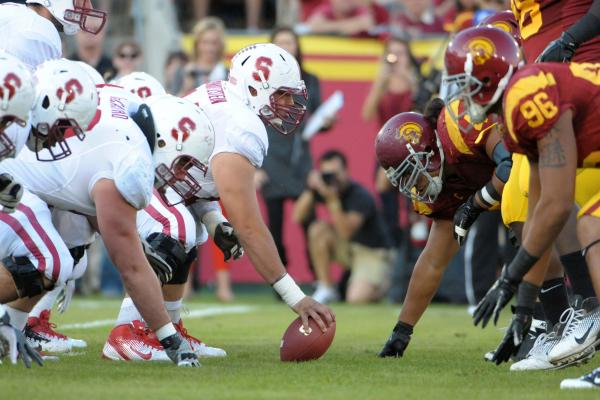
9/6 Stanford 10, USC 13

stanford-usc-usatsi_2 1. Perspective

Never before has there been such a discrepancy between what I was seeing on the field and what I was seeing on the scoreboard. Watching the game was literally like feeding an empty box of Cheerios to a crowd of hungry children. Well, not literally. Just kind of.

Stanford reached USC’s 32 yard line in every single one of its possessions. This has most likely never happened in the recent era of Stanford football. I looked back through 2010 at all of the games, and there were only two games in the 2010 – 2014 seasons when Stanford came close to achieving the same incursions into its opponent’s territory. Against Washington in 2011 and against Wake Forest in 2010, Stanford crossed its opponent’s 32 in all possessions but one. You might guess that Stanford scored more points than the 10 it put up against USC, and you would be correct. Stanford scored 65 against Washington and 68 against Wake Forest.

It is an extreme statistical improbability for Stanford to have only scored 10 points. Unfortunately, a conflagration of physical and mental mistakes combined with poor coaching decisions brought this improbability into reality. Furthermore, things didn’t break Stanford’s way. For example, all three of the game’s fumbles were recovered by USC.

On the other hand, as of today, it’s been exactly 1,031 days since Stanford did not have the football in the fourth quarter of a game with either the lead or a less than one touchdown deficit. Since the Oregon loss in 2011, Stanford has played 33 consecutive games with the smell of the taste of victory. Even if your binoculars are clouded with really high expectations, Stanford football is still looking pretty darn beautiful.  

2. Offense: Can I Have a Side of Smoked Penalties With My Eggs, Please?

I thought Kevin Hogan played a wonderful game. He made a lot of big throws, and picked up some clutch yards with his legs. He took a couple sacks, but generally when things got tight and his targets were covered he tucked the ball in and did what was necessary. I am very, very pleased with his play at quarterback, and this has rarely changed throughout his career. Coach Shaw said that there were probably four plays that Hogan would like back, “And that’s too many.” I assume he is talking about Hogan’s one inaccurate pass over the head of Hooper, his one failure to see a wide-open Greg Taboada, and the delay of game penalties. If that is the entire list of mistakes against a good defense, then that seems pretty darn good to me.

Ty Montgomery is a total star. He seems to have completely shed the inconsistent hands he had as a young player. All of the Stanford receivers and tight ends played great—there was not a single dropped pass. I would like to see Austin Hooper targeted more, especially in the red zone. There isn’t much footage of us using tight ends from last season, so I think we can surprise defenses this year by targeting our tight ends. Hooper was wide open on the “touchdown” catch that was called back because of the chop block call in the 4th quarter. As for Montgomery, Jon Wilner of the Mercury News writes, “I can’t help but wonder if Stanford ought to use Montgomery as a tailback in the I formation more often and less out of the Wildcat. My issue with the Wildcat – not only for Stanford but for all teams – is that the formation is often used when the quarterback and offense are in rhythm. Switching to the Wildcat for just one play seems to break that rhythm.” I completely agree, partly for the rhythm aspect, but more so because the Wildcat lacks deception. If Montgomery dots the “I,” then Hogan can still use play action to target a tight end. Montgomery played a lot of running back in high school, and he looked great on the one play when he lined up at tailback and ran for 6 yards in the second half.

Finally, I like the way Remound Wright is playing. He had 5.5 yards/carry and a beautiful 21-yard reception. Too bad that he didn’t get the ball on 4th and 1 from USC’s 3 in the 3rd quarter. Instead, Coach Shaw thought this would be a good time for Daniel Marx to get… […John Fishman 2001 drumroll, please… yep… keep it going… this next note is going to hurt like hell…]… his first career carry. Suck on that Gobstopper for while—it’s a tasty one.

Despite some solid physical play, the offense was obviously shattered by mental mistakes. Andrus Peat had a false start on the first play of the game. At the end of the 2nd quarter, Stanford sent 12 men onto the field—coming out of a timeout! On Stanford’s last play, a mental error on the left side of the line sealed Stanford’s fate. (Give USC credit there for a risky blitz; Shaw also deserves credit for trying to target Montgomery for the win.) The list of mental mistakes is long, and in the end, Stanford beat itself.

3. Defense: Still as Stout as Oatmeal Stout

USC surprised Stanford by coming out on the ground on its first possession. After yielding a touchdown on that drive, the Stanford defense locked it down. For the second straight year, the defense did not allow USC to score a touchdown after the first quarter. The defense held USC to 291 yards. It is safe to say that USC won’t be held under 300 yards again this year.

If there is one criticism of the defense it is that it was unable to force a turnover. One timely interception could have been enough to make the difference for Stanford. But all in all, the defense played another great game against a tough opponent.

4. Coaching: David Shaw Does Not Like Math or Having Fun

It would be stupid for me to play armchair quarterback with Coach Shaw’s play-calling. We ran a lot of great plays all game. The only problems with the x’s and o’s of play-calling that I have are:

  1. On important plays, we shouldn’t give the ball to someone who has never held it before.
  2. We should not make it so easy for the defense to know what is coming. For this reason, I hate the “Jumbo package” and I hate the Wildcat. We should run up the middle on a lot of key plays, but we don’t have to always wink at the defense and say, “We’re coming in for a big group hug, boys! Get ready!”

Excluding the Jumbo and the Wildcat, I enjoy the plays Shaw and the other coaches draw up every week. But my biggest issue with strategy is in regards to 4th down strategy. Field position is not nearly as important as Coach Shaw thinks. Take a look at the chart below.

STANFORD OPPENENTS’ AVERAGE PTS/POSSESSION FOR 2013 & 2014, BASED ON STARTING FIELD POSITION

Starting Yard Line # of Possessions Average Points Per Possession
1-9 12 1.33
10-19 28 0.75*
20-29 80 1.49
30-39 24 2.29
40-49 11 2.73
Past Midfield 7 2.72

*This is an outlier, due to small sample size, and, in part, Washington State having six scoreless drives that started from here.

The data reveals a few things. First, pinning your opponent deep might not be all that beneficial. Also, the data reveals is that it didn’t matter that much if opponents took over on their own 42 or Stanford’s 42. Midfield is such an important psychological line, but it means little. What you might do from your opponent’s 45 should be very similar to what you might do from your own 45. However, coaches are extremely conservative from their own territory. The book, Scorecasting, refers to this bias towards cautiousness as loss aversion. It is the same loss aversion that causes most people in society to not gamble, even when the odds aren’t necessarily stacked against them. Of the mathematical programs I’ve seen that calculate expected value (or expected points), all have shown that teams should basically go for it on 4th and 3 yards or less from anywhere on the field! (Here’s one example.) These facts alone show the gigantic discrepancy between current and optimal decision-making.

My chart above is not exhaustive evidence for being more aggressive on 4th down, since field position is something can continue to affect consecutive possessions. The computer programs must use some iterative formula to calculate the influence of field position on future drives beyond the immediate next drive. But it seems safe to say that the benefit of field position wears off pretty quickly. Many things can happen that “reset” or at least alter the benefit of good field position. Here are some examples: a long play, a scoring play, punting the ball into the end zone, or the end of the half or game. It seems pretty clear that maintaining possession is much more important than a little bit of field position.

Does 9 yards sound like a little bit of field position? That is what Stanford gained by punting the ball into the end zone from USC’ 29 yard line in the second quarter. According to the NFL-related link above, this takes about 0.51 points from your opponent, but in college it is a bit less—let’s say 0.45 points. For this decision to make sense, Jordan Williamson would have to have a 15% chance (.15 • 3 = 0.45) of making the 46-yard field goal. Well, despite being off to a tough start this year, Williamson is 9/19 (47%) in his career from 40-49 yards. Unfortunately, Shaw decided that a few yards of field position was more important than a decent chance at 3 points. (If it wasn’t 4th and 22, we would be talking about going for it rather than kicking.) Even more egregiously, Shaw opted against a 49-yard field goal try in the 4th quarter. Late in a tie game is exactly the time when field goals are worth trying.

Now, I admit that I have a slightly unhealthy obsession with connecting math and football. This blog is, in many ways, ridiculous. It fails to wield the human race’s most commendable swords: irony, satire, and wit. It quantifies what is infinite and joyous. There isn’t much joy in executing the will of a statistic. Knowing that perspective, I respect the fact that football doesn’t have to be about numbers at all. It is tons of fun to be whimsical and make decisions in the moment. So let’s throw all the math out of the window and get down to what is common to all of us: sports are supposed to be fun. Football is a diversion. It is entertainment. People are paying to be entertained. Here is Shaw’s problem: I don’t think there is a single Stanford fan in the entire stadium that could tell you that he or she had fun watching him decide to punt the ball on Saturday. Not a single Stanford fan in the entire stadium. It is, at its core, not fun to play not to lose. And it isn’t just about fun for the fans. I think the players deserve more fun as well. They work their asses off, and they should get to have some fun on Saturdays. They should get to live out the excitement of 4th downs. Even the defensive players would love to see our offense go for it more. They would relish the chance to stop an opponent who takes over at the Stanford 35 yard line after a failed 4th and 1 attempt. It is fun to engage some challenges. That is what is satisfying—even more satisfying than winning.

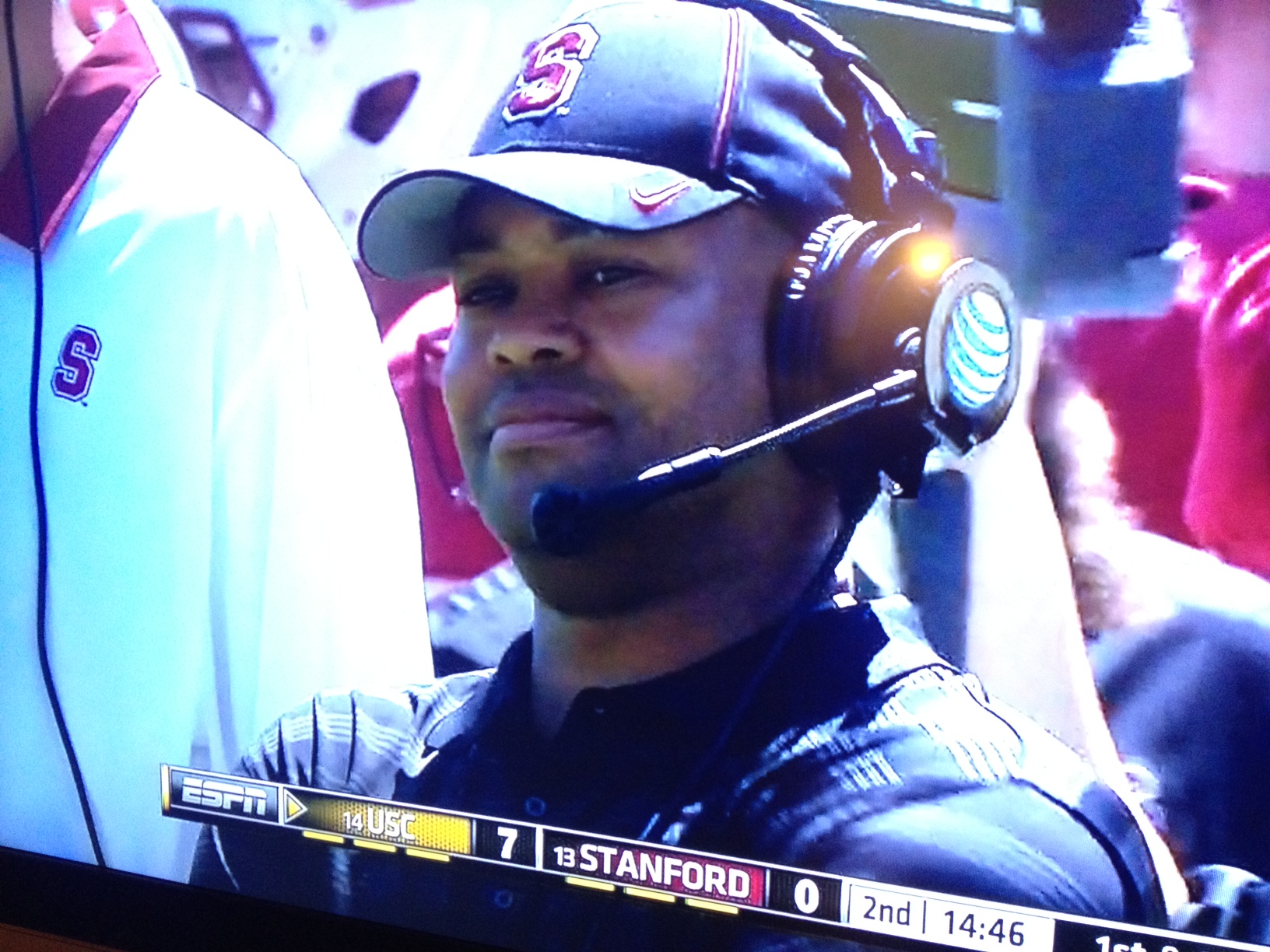
After Herbstreit and Fowler voiced their surprised reaction to Shaw punting from the 29, the ABC camera immediately found Shaw on the sidelines. photo You can be sure that, just below the bottom of the picture, those arms are tightly crossed.

5. Up Next: Army

Army lost its last 5 games of the 2013 season to Temple, Air Force, Western Kentucky, Hawaii, and Navy. On Saturday, Army (1-0) beat Buffalo 47-39, but Buffalo ran up 549 yards of total offense. Buffalo had 16 more first downs than Army and punted only once. Army is about to get demolished. Yes, Stanford only won by 14 last year, but since that game, Stanford has gotten better and Army has gotten worse. And what does Stanford need to improve on this week: scoring touchdowns. Expect the scoreboard to light up—Stanford will score at least 50.

The only uncertainty is if our defense can shut down the Army running game. It won’t affect the outcome of the game, but it would be nice to hold Army to less than the 284 running yards we gave up last year.

6. Up Next Year: UCF

Stanford recently announced a home and home against Central Florida. This is fantastic news. I relish the chance to play football against any team from the southeast, and UCF is a good one, having won the Fiesta Bowl last year. So next year’s home schedule is: UCF, Notre Dame, Cal, Oregon, UCLA, Washington, and Arizona. That has to be the best home schedule in the entire country. The nonconference schedule for the next 10 years includes: Northwestern, Central Florida, Notre Dame, Rice, Virginia, and BYU. And there are absolutely zero FCS games scheduled. As fans, we should be thrilled to enjoy these kinds of matchups. (Check out the schedules here.)

7. The Playoff Picture

Unlike Week 1, Week 2 had many results that clarify the view of the Playoff. Most importantly, the Big 10 has already eliminated itself from the discussion. Michigan St, Michigan, and Ohio State all crashed and burned, the latter two in embarrassing fashion. Nebraska could go undefeated, I suppose, but that seems highly unlikely after it needed a lucky play with multiple broken tackles to avoid overtime at home against McNeese State. Furthermore, Nebraska has not beaten a ranked opponent in almost two years. I suppose if Oregon and Michigan State both run the table, Michigan State would have a strong case, but that is highly unlikely. (Same with Wisconsin and LSU.) After 27 nonconference games in the first two weeks, Big 10 teams have exactly one combined win against teams from the other four power conferences. (Rutgers beat a winless Washington St team by 3 despite being outgained.) That is a nasty combination of bad scheduling and bad playing. It is clear that a 1-loss winner of the Pac-12 will get the nod over any Big 10 team, so despite a steeply uphill road ahead, Stanford still holds a full hand of cards.

To be honest, there are only a few teams outside of the SEC and Pac-12 that look solid enough to have a shot at the top-4 at the end of the season: Florida St, Baylor, and Oklahoma. (Notre Dame has also looked great, but its schedule is too tough.) Personally, I would love to see those three teams lose and have a Playoff made up of two Pac-12 teams and two SEC teams.

8. Around the Pac-12

Big win for Oregon. Lots of tight victories elsewhere. We are still finding out a lot about many teams. Watch out for Utah though, who beat up Fresno State just as thoroughly as USC did. We’ll amplify our Pac-12 discussion in the coming weeks.

9. Overrated Poll of the Week

USA Today Coaches Poll. They need to just get rid of this thing. It is a joke. #19 Virginia Tech beat Ohio State by two touchdowns at Ohio State and they are ranked one place behind Ohio State in the Coaches Poll. The coaches don’t have enough time to pay attention to other people’s games. Someone needs to step in and end this poll. I’m sure the coaches would prefer to use the three and a half minutes they spend on their polls as extra practice time anyways.

10. Transitive Property Application of the Week

9/6 Penn State 21, Akron 3

8/28 Akron 41, Howard 0

9/6 Rutgers 38, Howard 25 (Howard 437 total yards, Rutgers 397)

This coming Saturday, Penn State travels to Rutgers as a three-point favorite. Can you figure out where your money should be on this line? (For further info and contextual hints, in Week 1, Rutgers was outgained by Washington St., and Penn Sate beat a good UCF team. Also, Penn State just had its postseason ban lifted and its fan base is ecstatic. Meanwhile, Rutgers alum Ray Rice is not having the best week.)

8/30 Stanford 45, UC Davis 0

ty-montgomery-ncaa-football-uc-davis-stanford-268x1501. Perspective

In 2005, UC Davis came to Palo Alto to face a Stanford team that was showing major symptoms of the apocalypse. However, Davis was coming off season-opening losses to New Hampshire and Portland St, so surely the new Stanford coach, Walt Harris, expected to be 2-0 by the end of day. But Stanford fell flat after gaining a 17-0 lead, and UC Davis escaped the Farm with a 20-17 comeback victory. Walt Harris officially replaced Buddy Teevens as my least favorite person on the face of the earth.

David Shaw was not on staff at Stanford that year, and that is a good thing. Last Saturday, he led the Cardinal to a 45-0 victory, and Stanford is dancing once again under the adornments of victory.

In the offseason, it felt somewhat refreshing to reset our expectations a little bit lower. There is always personnel loss, and so we think of uncertainty. We may also think of balance, or the law of large numbers. Surely we can’t maintain such joy and triumph for another season! And then, at first touch, Ty Montgomery takes us on a curving waltz to the end zone. It was such a familiar picture that I could have sworn he was only running at half-speed. It is an image Stanford fans have seen now 17 home games in a row, the longest current home win streak in the country.

2. Offense: In Praise of Ed “Good Hands” McCaffrey’s Offspring

12 Stanford receivers caught passes in this game—the feather is going to be floating this year. Hogan wasn’t perfect, but he never is anyway. He was consistently good, which is what we are starting to expect from him. We won’t know anything about the offensive line and the running game until at least next week. With a weaker running game, red zone offense might be an issue this year. We failed to score any points on two drives inside UC Davis’ 5-yard line. However, we do know we have a slick tight end with great hands: Austin Hooper. Hooper caught four balls for 63 yards including a leaping touchdown grab. He should be a solid red zone target.

The offense blew the game open in the 2nd quarter, scoring touchdowns on the first play of one drive and the second play of the next drive. It didn’t take Christian McCaffrey very long for his reality to catch up to his hype. 122 all-purpose yards and three tackles on special teams means that this true freshman is going to be around the ball all year. But he is also going to be near the heart of the program, since he seems to have that Shayne Skov-like “I bleed football” sort of attitude. Shaw said during a halftime interview, “What I love about [McCaffrey] is that I tried to pull him off of the kickoff team after that long touchdown, but he wouldn’t come out because he loves kickoff.” The leadership and attitude of players like Luck, Skov, and McCaffrey transcend coaching and turbulence and keep the needle of the program pointed due north.

3. Defense: Midfield Is a Wall of Concrete

UC Davis needed its final drive of the game to accumulate over 100 yards of offense and cross midfield for the first time. Ouch. It doesn’t matter so much if our offense scores 45 or 65 in a game like this, but there is a big difference between winning 45-20 and winning 45-0. It was an impressive showing by the defense. A lot of schools dominated FCS opponents last weekend, but the Stanford defense put in the most thorough and consistent performance of any.

UC Davis never tried to throw the ball deep, so this game didn’t provide much of a blueprint for what is coming from USC. We’ll learn a lot about our defense this coming Saturday.

Also, I can’t help but note that former defense coordinator and current Vanderbilt coach, Derek Mason, lost to Temple 37-7 in his debut. It doesn’t mean much, but at least it is safe to assume that Mason didn’t abscond with our defensive mojo.

4. Coaching

The Pac-12 network game commentator noted that Shaw asked his veteran players at the end of summer camp who they are excited about seeing. Apparently, everyone responded, “Christian McCaffrey.” The answer is unsurprising, but it is a wonderful novelty to hear about a coach asking his players for their opinions. This is one of Shaw’s best qualities as a coach: he builds a familial culture of trust and respect.

I am still concerned about two things, however. On fourth down, we still punt and kick field goals too much. In a blowout, I have no issue with Shaw punting inside Davis’ territory. (Stanford punted from UC Davis’ 44, 39, and 35 yard-lines in the second half.) Shaw wants his punt team to get some practice for those late game situations when pinning a team deep might make sense. But in higher scoring games with time on the clock, we will sometimes need to be more aggressive. As football teams continue to absorb—albeit slowly—more math into the realm of strategy, they are realizing that the data is incontrovertibly in favor of going for it on many 4th downs in your opponent’s territory. I am concerned that Shaw remains unaware of these facts. (I’ll discuss these 4th down situations in more detail in a post soon.)

5. Up Next: USC

The Trojans are coming in hot—and fast. USC rolled up 701 yards in a 52-13 win over Fresno State. Steve Sarkisian has brought the up-tempo offense to USC, and Stanford is going to have a harder time getting to the quarterback than it has recently. Stanford’s defensive backs are going to have to win this game. USC is getting the ball to receivers and letting them make moves in space. Great tackling and perhaps and interception or two will go a long way to victory.

6. The Playoff Picture

There were very few results in Week One that will have playoff ramifications, so there is not much to write this week. Perhaps the only clear take-away from the first week is that the SEC is off to another hot start. The SEC won two big games: Georgia over Clemson and LSU over Wisconsin. A glance at the rest of the SEC non-conference schedule reveals that there are not many other stumbling blocks out there. And unfortunately for all college football fans, there is not a single game this season featuring a Pac-12 team against an SEC team. For the SEC to drop in stature, it will have to suffer a series of upsets. Perhaps San Jose State can rock the world and take down Auburn this weekend.

7. Around the Pac-12

The San Jose Mercury titled its article on the Cal-Northwestern game: “Bears barely hold on, but they’ll take it.” Cal will do a lot more than just “take it.” They are going to celebrate this victory like it hasn’t happened in years! Well… 686 days to be precise. Cal beat an FBS football team for the first time in 686 days. This is a good thing for Stanford, and it is good for the Pac-12. We will see if Cal’s defense can hold up, but its offense should put up enough points to win a few games this year.

It would have been nice if Washington State could have held on to beat Rutgers, which is now a member of the Big 10. The Pac-12 would benefit from a strong resume against the Big 10 when it comes time for the Playoff selections. Michigan St-Oregon, Michigan-Utah, and Washington-Illinois are still on the table. An Oregon win combined with a Washington win or Utah upset will secure a slight advantage for the Pac-12 in the head-to-head. The Oregon game is huge. As good as the Pac-12 has been in recent years, it has consistently come up short in the biggest games. Over the summer, the ESPN Pac-12 Blog posted the following question:

Screen Shot 2014-09-02 at 3.43.51 PM

What?! For all of Stanford’s and Oregon’s recent success, this is the list to choose from? Indeed. Stanford and Oregon have both failed in the biggest games against the best teams. For the Pac-12 to be in the discussion with the SEC, this has to change, and Oregon absolutely must beat Michigan State this coming Saturday.

8. Overrated Team of the Week

#11 UCLA Bruins (1-0). UCLA only scored one offensive touchdown against a Virginia team that went 2-10 last year and lost its last nine games. UCLA relied on three defensive touchdowns and was outgained by 28 yards. UCLA should not be anywhere near the top-10, and the reasons go deeper than the horrible performance against Virginia. In the three prior seasons, UCLA has zero victories against top-15 teams. UCLA has also lost six consecutive games to Stanford—no way they should be above Stanford in the polls. (They were above Stanford in both preseason polls, but in the Coaches Poll they are now just below Stanford.) Yes, UCLA some returning starters, but they need to earn it on the field, and not in the media spin rooms. And now that UCLA has played a (poor) game, they should be ranked about 15th or 20th—where they deserve to be until they prove otherwise.

On Watch: #7 Ohio State Buckeyes (1-0). Ohio State only outgained Navy by 30 yards in an opening win that was close until the fourth quarter. Furthermore, Ohio State has not beaten a top-10 team since 2006. (Stanford owns six top-10 wins in that time span.) Ohio State also has only one ranked team on its schedule this entire season. It is the softest of soft-serve, and they will be easily passed over by the Playoff committee with one loss. Jon Wilner of the San Jose Mercury has them at #17 in his ballot, and that seems to be about right to me.

10 Great Stanford Football Moments (of the Past 10 Years)

Before we look ahead to 2014, let’s double dip into the cosmic delight of recent Stanford football success. This Top-10 list is compiled from moments that had memorable amounts of any of three criteria: exhilaration, symbolic achievement, or auspicious potential. This is not a list of the ten best games and is not limited to games that Stanford won. Rather, it is a list of plays and moments that wafted the thrilling smell of success and made me proud to be a fan.

There are a few games noticeably absent from this list, including Stanford’s first BCS win in the Orange Bowl at the end of the 2010 season and Coach David Shaw’s first big win of the post-Luck era against USC in 2012. Also in consideration was the Colorado game in 2012, when Kevin Hogan’s first four drives as Stanford’s quarterback resulted in four touchdowns—the Hogan era was underway. Nonetheless, the list captures many of the great coaches and players who have guided Stanford’s recent success.

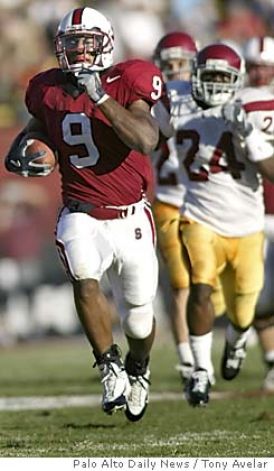
#10. Sept 25, 2004: JR Lemon Runs Out the Clock…With an 82-Yard Touchdown. There was still hope for Stanford football at this point in 2004. Stanford was 2-0 and about to take a 4-point lead into halftime against #1 USC. With only a few seconds remaining in the 1st half, JR Lemon took a handoff and went up the middle to run out the clock. Miraculously, he broke through for an 82-yard touchdown. This is the only moment on this list from the Teevens-Harris era, and it is fitting that this electric moment came in a game that Stanford lost. Still, it was one of the most exciting plays in Stanford history. USC 31, Stanford 28.

628x471

#9. Sept 25, 2010: Marecic Scores On Two Consecutive Plays. Stanford dominated Notre Dame in South Bend to establish itself as a force in its first year of BCS glory. The highlight of the game was Owen Marecic’s 20-yard pick six in the 4th quarter, which was exactly one play after he scored a touchdown on a 1-yard run. Stanford 37, Notre Dame 14.
https://www.youtube.com/watch?v=D5qCdMFHxms

#8. Oct 2, 2010: Can We Start the National Championship Talk? → The Lead That Vanished. After a Chase Thomas interception, Stepfan Taylor took a handoff on the first play of the drive and scampered 44 yards to put Stanford up 21-3 against #4 Oregon in the 1st quarter. For a few minutes, it seemed that undefeated Stanford might clear its biggest hurdle on its quest for the national championship. Unfortunately, the moment didn’t last—Oregon quickly scored and then recovered an onside kick to begin its onslaught. This is truly the one that got away, as Stanford never lost again the entire season. Oregon 52, Stanford 31.
https://www.youtube.com/watch?v=3x49Tw5dC5U

#7. Nov 20, 2010: Luck Levels Cal. In one of the most dominating Big Game performances in history, Stanford rolled out to a 45-0 lead. It was the fourth time in 2010 that the Stanford defense held a Pac-12 opponent scoreless for three or more quarters. But the highlight went to Andrew Luck, who knocked over Cal safety Sean Cattouse on a 58-yard run. The 2010 team not only won games—it flattened opponents. Stanford 48, Cal 14.
https://www.youtube.com/watch?v=S4_w-puInqY

#6. Oct 29, 2011: Fumble Recovery in the End Zone. Stanford had just won 10 consecutive games by 25 points or more, a new NCAA record. But this USC game was a dogfight that seemed destined to last forever. In the 3rd overtime, Terrence Stevens forced a fumble as Curtis McNeal looked to score, and A.J. Tarpley pounced on the ball to secure the victory. Stanford’s undefeated season was still alive. Stanford 56, USC 48.
https://www.youtube.com/watch?v=zr4KDMuwFNw

#5. Nov 30, 2012: Ed Reynolds’ “Pick Six” to the Rose Bowl. UCLA was driving to take a two score lead in the 2nd quarter, but Ed Reynolds picked off Brett Hundley and returned the ball 80 yards. Officials erroneously ruled him down at the one, but the play bookended one of the best seasons ever by a Stanford safety and helped send Stanford to the Rose Bowl. Stanford 27, UCLA 24.
https://www.youtube.com/watch?v=3_UoTQ3n_UU (play is at 2:30 mark)

#4. Nov 14, 2009: Going For Two in the “What’s Your Deal?” Game. The week before this USC game, Stanford had just beaten #8 Oregon. Confidence had arrived in full force on the Farm, and this game erased the idea that Stanford’s recent success might be ephemeral. The offensive line and Toby Gerhart were unstoppable. In the 4th quarter, after Gerhart scored on a 6-yard run to put Stanford up 48-21, Harbaugh decided to attempt a two-point conversion. Stanford did not convert the attempt, but USC was nonetheless embarrassed, and Stanford officially had swagger. USC’s streak of seven consecutive BCS bowls and west-coast dominance had come to an end. Stanford 55, USC 21.
https://www.youtube.com/watch?v=WeS3VeluAmg

#3. Nov 17, 2012: Redemption for Williamson. In overtime, Stanford kicker Jordan Williamson booted a 37-yard field goal to beat the top-ranked Ducks and give Stanford a clear path to the Rose Bowl. It was a special moment for Williamson, who atoned for the previous season’s Fiesta Bowl meltdown. Stanford 17, Oregon 14.
https://www.youtube.com/watch?v=YiiGUovlyJw

#2. Jan 1, 2013: Amanam Comes Up Roses. Stanford’s defense has prided itself for years on having to make one crucial stop to seal the game. Late in the 4th quarter, with Wisconsin potentially driving for a one-point victory, Usua Amanam intercepted Curt Phillips’ pass to secure Stanford’s first Rose Bowl victory in 41 years. Stanford 20, Wisconsin 14.
https://www.youtube.com/watch?v=jR86liAlcNE

#1. Oct 6, 2007: Bradford Makes “The Catch.” The Biggest Upset Ever. The Rising from the Dead. Stanford was 41-point underdog to a #2 ranked USC team that had won 35 consecutive home games. Stanford had lost 41-3 the week before, and was starting a reserve quarterback, Tavita Pritchard, who had only thrown three passes in his career. But Stanford’s defense forced 5 turnovers to keep the game close. Stanford was down six points with one last chance for a miracle. On 4th and Goal with 49 seconds remaining, Mark Bradford made a leaping catch in the corner of the end zone, and the story of west coast football in the 21st century was forever changed. (While Bradford’s catch provided the victory moment, Pritchard also completed an equally amazing pass to Richard Sherman on 4th and 20, just inches past the first down marker.) In Jim Harbaugh’s first season, Stanford had begun its resurrection. Stanford 24, USC 23.
https://www.youtube.com/watch?v=j48uQSAKC6k