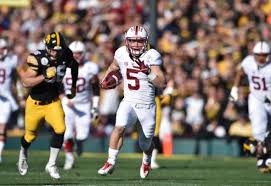
9/30 UW 44, Stanford 6

Since Stanford took time off from football during the UW game, I’m taking time off from the blog for this one game. Long story short, I didn’t even get a chance to watch most of it. I’m not going to go into why, but regardless I don’t think I’ll even bother watching the tape. The game is lost in history to me.

For some perspective, keep in mind that this hasn’t really happened–at least not against anyone not named Oregon. Excluding its struggles against Oregon in the past 7 seasons, Stanford was not in position to win a game late in the 4th quarter for just the third time in the past 92 games. (Northwestern 2015 and ASU 2014 are the other times…again, excepting a few Oregon games.) That is a pretty spectacular run.

But times have changed. Oregon’s dominance is over. And Stanford’s is at risk as well. UW is in prime position to win the conference. I expect Stanford to lose again, which means that UW would have to lose three games for Stanford to reach the conference title game. That isn’t happening. So, our best bet is to root for the Huskies to run the table and make the Playoff. Maybe Stanford can pick up the pieces and still salvage another Rose Bowl season.

We will know a lot more after the Washington State game. And there is another amazing statistic related to Stanford’s last 92 football games that is at play here. Stanford has lost consecutive football games only once in the past 92 games. Big game against Wazzu this Saturday night. I can’t wait.


9/24 Stanford 22, UCLA 13

1. Perspective – Here is Where We Are At With Stanford Footballimages
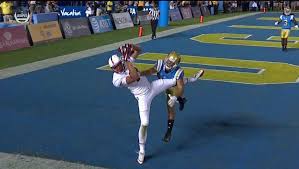
Wow. That was like going to a Grateful Dead concert and hearing only Brent Mydland tunes from Built to Last (“We Can Run,” “Victim or the Crime,” etc.) during the entire first and second set before a shreddingly-epic Scarlet-Fire for the encore. I watched the first half in a Vietnamese restaurant in Sebastopol, then the 2nd half on an iPad at home. We are rebuilding our house, and doing most of the work, so I have little free time and no cable television. So the viewing venues didn’t really add to my enjoyment either.

It was a grueling game to play and a grueling game to watch. The players put a lot out there for our entertainment and some Stanford dudes made some spectacular plays to seal the deal.

I don’t mind watching Stanford run and play conservatively. Here are the questions that interest me each time Stanford gets set to run an offensive play:

  1. Can McCaffrey get 4 yards when there is really no hole available and a normal running back would only get 1 or 2?
  2. Can we really gain enough yards despite the defense knowing what is coming?
  3. Is this going to be the play that contains an element of surprise?

I might be missing something, but I think much of my conscious and subconscious enjoyment watching Stanford games recently comes from the unraveling of reality as it relates to these three questions.

So I have absolutely no armchair quarterbacking to do with the specifics of the plays called. Shaw and Bloomgren are very smart and have a decent and improving feel for the tone of the game and when to drop into the downhill toboggan with some trick or treat. I’ll give just one example of many well-called plays. The first seven plays of Stanford final, desperate drive were Ryan Burns passes. On the 8th play, Stanford faced a 3rd and 3 from the UCLA 12 with a little under a minute remaining. ABC caught Shaw doing a run-in-place shimmy with his arms on the sideline—indicating to Burns to let McCaffrey run the ball. Burns handed off to McCaffrey, who picked up 4 yards for the first down. Great play call to go to McCaffrey there.

The running game was there all game for Stanford. Herbstreit and Fowler kept saying throughout the first three quarters that UCLA was beating Stanford at its own game—being more physical and consistent moving the ball. But it was a bunch of tofurky. UCLA was winning because of Stanford’s two turnovers—plain and simple. They weren’t playing better football. And Stanford was controlling the line of scrimmage. Stanford finished the game with 5.6 yards per rush. Mora and UCLA wanted to put up similar numbers on the ground. UCLA ran the ball 33 times, only four less than Stanford. But UCLA managed a measly 2.3 yards per rush. So the linemen on both sides of the ball played very well for Stanford and they deserve a ton of credit.

So why, besides the obvious turnovers, was this game in such utter peril for Stanford? Three other reasons: 1. Stanford committed a few untimely penalties that put itself out of run situations. 2. Stanford struggled to cover the tight end. (This was a problem in two big plays for USC last week as well.) 3. Shaw made a couple bad game-management decisions.

Early in the 3rd quarter, trailing 10-3, Stanford faced a 4th and 1 from the UCLA 42. Shaw showed he has learned little about these situations as the years go by. He sent in the punt team, and I sent in the following text messages to my tailgate crew:

“#&$*.”

“We were establishing the run perfectly.”

“4th and 1 couldn’t be more perfect.”

“You are going to run back-to-back wildcats—fine. Then get your one *@()$&#* yard when the time comes.”

“If you run up the middle every time you are basically asking to face a 4th and 1 eventually.”

“What are the odds McCaffrey picks up that 1 yard? First thought: 85%.”

Let’s break these odds down a bit more. Christian McCaffrey had 26 carries in the game. His runs went for the following yards, in order: 3, 13, 13, 3, 4, 1, 3, 12, 3, 4, 6, 8, 7, 4, 2, 3, 10, 1, -1, 8, 6, 9, 2, 3, 7, 4. There are no zeros in there, and only one negative number. He gained one yard or more on 25 of his 26 carries. That is an over 96% success rate folks.

Of course, with UCLA anticipating a McCaffrey run, it is not 96% likely that McCaffrey would pick up that first down. But I still say it is close to 90%.

Unfortunately, Jake Bailey kicked a beauty and Stanford pinned UCLA down on the 1, obscuring the poor decision from Shaw. Nonetheless, Shaw’s mathematically incorrect, overly conservative, and boringly passive decision killed a drive that had tons of momentum.

In the post game press conference, Kyle Bonegura of ESPN typed up the following report:

“Before Stanford coach David Shaw was even asked about why he punted on 4th-and-1 at the Stanford 39 with less than five minutes, trailing 13-9, he gave his reasoning.

‘We trust our defense. We had a fourth-and-1, and bad field position, and if we had been in good field position we would’ve gone for it,’ Shaw said. ‘But with bad field position we don’t go for it. We never go for it. Not with that much time left and with the defense that we have. Coincidentally, I had that conversation with my wife this morning about that exact scenario. Midfield, to our side of the field, 4th-and-1, and I told her that you punt. You punt every single time. If you have the defense that we have and the belief in what we do, that’s what you do. You punt. And you play great defense and you get the ball back, and you go out there and you execute the plays.’

It was a curious decision at the time, but the man stuck to what he believed in – and it worked. With three Pac-12 titles in four years, he should always deserve the benefit of the doubt.”

Here are the important take home points from all that jazz:

  1. Even Shaw’s wife senses that he is wrong on this issue.
  2. It didn’t work. Stanford won despite this incorrect decision. And it has worked against us. (Remember the USC game two years ago—in which Shaw punted from USC’s 29 and 32—that ended in a 10-13 loss?)
  3. Shaw deserves the benefit of the doubt in everything related to the team’s success—but not on this issue. Even the smartest guy in the room is not infallible from every thorny old bias.

With 4:40 remaining in the game, Stanford had a 4th and 1 from its own 39. Shaw wasted a time out and then punted. This is less egregious than the previous punt because of the field position and time outs Stanford still had, but you’re in perfect position to keep running the ball down the field and score with little time left. It is NOT a risky play to go for it. If you are Washington St, it might be risky to run on 4th and 1. If you are Stanford facing Michigan State in the Rose Bowl a few years ago it might be risky to run on 4th and 1. But in the past two years Stanford has had tremendous success picking up one yard.

Stanford football is close to getting to the top of the mountain. This issue is Shaw’s last hurdle to becoming one of the best college coaches of all-time. Unfortunately, the hurdle isn’t even in view yet in his opinion.

(One concession on this point though… if Jake Bailey and the Stanford punt team can continue to pin teams inside the 5, then we will be having a slightly different conversion. But only slightly.)

2. Perspective on the Players

It is frustrating and obnoxious to vent on this 4th down issue because it takes away from such a fantastic effort from so many players. Trent Irwin is catching metaphors like the pages of a Pablo Neruda book. Damn—that’s a bad simile. But Irwin has perhaps the best hands since the great Ed McCaffrey. Or at least since JJ Arcega-Whiteside. JJ Arcega-Whiteside burst on to the scene with the first three catches of his career and some Mark Bradford-style elevation sensation. He replaced the injured Francis Owusu and made the winning touchdown catch. Kevin Palma led the team with six tackles. Terrance Alexander and Alameen Murphy stepped into to replace injured cornerbacks Quenton Meeks and Elijah Holder seemingly without any drop-off. Safety Justin Reid made a huge defensive pass break-up in the closing seconds to preserve the victory. Sean Barton had a huge tackle for a loss. A.T Hall had a great game on the line and helped push McCaffrey over the first down line on his late-game run. Solomon Thomas had two tackles for a loss and a fumble return for a touchdown courtesy of Joey Alfieri. Conrad Ukropina send three more perfect pine nuts through the parallel bars. So many players made big contributions, many of them making their best plays of their college careers. It shows you how good of a job recruiting Stanford has done—how deep it is at so many positions.

And then there is Ryan Burns. Ryan Burns handled the postgame interview with class and charisma, and with a subtle smile. But really he had that same smile on his face the entire game. And maybe that has something to do with why he is the starter instead of Chryst. Chryst too looks excited and very competent when he’s out on field, but also slightly tense. Burns looks relaxed, like he is having the time of his life, just playing the game that he loves with people he loves. I like that in a quarterback.

3. A Lesson in Coaching from USC vs Utah

Utah ran the ball on all 12 plays, including a 4th and 1 from USC’s 14, and its opening drive resulted in a touchdown. If it is working, let the record keep playing. Great coaching by Whittingham. USC was also running the ball well. Justin Davis was averaging 13.7 yards per carry on his first 9 carries. On USC’s final 24 plays of the game, Helton had his Trojans hand the ball off to Davis exactly one time. Davis ended the day with 10 carries for 12.3 yards per carry.

And Helton suffers from Shaw’s 4th down punting syndrome, punting the ball on 4th and 3 from Utah’s 37 yard line late in the game, which gave Utah the opening for the come-from-behind victory.

Helton will not keep his job for very long.

4. Overranked Team of the Week: #22 Texas (2-1)

Rarely has a team been this overrated. Texas jumped into the rankings when it beat Notre Dame at home in overtime in its first game. Notre Dame, we now know, is not a good team. And then Texas lost to Cal. It was a close game, but Cal was the slightly better team—nothing fluky. So, at that point, if there was room for Texas in the poll, then there should have been room for both Cal and San Diego St (which beat Cal and is undefeated). But really Texas should have been completely removed from the top-25, as it owns no quality wins and lost to an average Cal team.

There are so many ways of justifying why Texas should not be ranked, but here is the most convincing. Ken Massey keeps a website that does a composite ranking by averaging out 80 different rankings and polls compiled for college football. Most of the rankings are computer algorithms—some well-known (Sagarin, Billingsley, and others used in the BCS era) and others mostly unknown—but all are presumably verified by Massey and post their rankings online every week. These algorithms for the polls are structured in vastly different ways, so among the 80 polls there exists an enormous range of rankings for any particular team. For example, Stanford is ranked #2 in a few of the polls, and as low as #29 in one of the polls. Strength of schedule, margin of victory, and other parameters can be weighted very differently, so a team like LSU that has lost but played a tough schedule shows an even wider range: #6 in one poll and #74 in another (averaging out for a composite ranking of #29). While some of the individual polls spit out absurd orders, the composite average usually does an excellent job of revealing a reasonable ranking. Here is the composite top-6, in order: Ohio State, Alabama, Michigan, Clemson, Louisville, and Stanford. Clearly very reasonable.

Because the AP poll is a composite average of a 65 voters, it also is also usually reasonable; a team might not be fairly ranked but it is rare that the AP poll has a team that is extremely misranked. One way we can know if a team is extremely misranked in a poll is to see how that ranking compares to its position in the other 79 rankings on Massey’s composite list. For example, whatever algorithm “CSL Ratings” uses to compile his rankings is clearly not working to appropriately rank Stanford at #29. All 79 other rankings have Stanford in the top-20. CSL’s rank for Stanford is an obvious outlier.

For each team in the AP poll, some of the other 79 polls have that team rated higher, and some have that team rated lower. The AP poll ranking usually falls near the median ranking in all 80 polls. For example, Stanford’s ranking of #7 in the AP Poll is very close to its median ranking of #6 from all 80 polls. But the Texas Longhorns have a unique situation. Texas’ #22 ranking in the AP Poll is the outlier. It is the highest ranking for Texas among all 80 polls! The other 79 polls besides the AP rank Texas anywhere from #29 to #86, with a median ranking of #53! Can 79 vastly different polls and algorithms all be wrong about the Longhorns while the human voters on the AP Poll be right? Nope. Impossible.

Give major props to Jon Wilner of the Mercury News. He initially ranked Texas #2 after the Notre Dame win (an over-reaction but he does that early in the year), but now Wilner has Texas completely unranked. He has done his job well. You have to make big changes at the start of the year as the information pours in. Not sure what the other voters are thinking on this one. Did they forget that Texas went 5-7 last year? Maybe… well, perhaps they may remember Texas’ 6-7 campaign the year before?

5. Underranked team of the Week: UCLA (2 – 2)

UCLA has done a lot more to earn a top-25 ranking than Texas. I’m not sure how good it is, but it is definitely better than Texas, and one could easily justify having them ranked right now. If Texas A&M and Stanford falter, then UCLA could be reevaluated. But for now, they’ve two top-10 teams and measured up pretty evenly.

6. Coming Up – @ Washington (4 – 0)

It feels like a game Stanford should lose. For one, Stanford is down a few injured starters. But I feel like there is still unresolved karma out there. Stanford was fortunate to beat Washington three years ago at home and ever since I’ve felt like we owed UW a win. In that 2013 game, UW outgained Stanford by about 200 yards, but somehow Stanford pulled out a 31-28 victory, helped in part by a 99-yard kickoff return for a touchdown from Ty Montgomery. Stanford has dominated the line of scrimmage in the past two games, so that bodes well for Stanford. But we’ll see.

If Washington has been watching tape, then it should be preparing to target its tight ends. Keep an eye on that.

This game is enormously important. Because of owning the head-to-head tiebreaker, whoever wins this game has a huge lead in the Pac-12 North and the Rose Bowl race. For example, if Stanford wins, it could likely lose up to three more games (one of them to Notre Dame) and still get to the Rose Bowl (assuming UW also loses one more game…perhaps @Utah). The winner is completely and utterly in a velvet-lined driver’s seat in a fast car headed south to Pasadena via Santa Clara. Go Cardinal.

9/17 Stanford 27, USC 10

1. Perspective

images

Despite winning 7 of the last 9 vs USC, this is the first game since 2009’s “What’s Your Deal” game that Stanford has dominated. It won the line of scrimmage, it had more discipline, and it definitely won the coaching battle.

The game had a different feel from the very beginning. Normally, the USC crowd is loud and proud at Stanford stadium. There were still a lot of USC fans around, but they were much quieter this time. A group of three USC fans next to our tailgate were napping about an hour before kickoff. Inside the stadium, there wasn’t much more energy. This is currently a lopsided rivalry and the idea that Helton can bring USC back to prominence is very much an uncertain proposition.

2. Offense

One of my favorite plays of the game was a 2nd quarter pass from Burns to Irwin. It was a quick out, and Burns put the ball on the outside shoulder to protect from interception. Irwin spun outside of the tackle and gained 15 yards. Just beautiful, veteran, textbook execution from a quarterback and receiver who do not have all that much experience. Burns played well again, and is exceeding expectations. The offensive line is also coming together nicely. The holes aren’t always there for the running game, but the pass protection so far seems very good.

Rector showed how fast he is with a take-your-pants-off explosion on a 3rd quarter reverse. While traveling about 12 years ago, I hopped off a train in Brasov, Romania and got in a woman’s car to be taken to her guesthouse. She had a thick accent and didn’t speak much English, but had clearly developed a proud and interesting diction. When discussing the weather forecast for tomorrow, she said, “It is…. instability.” As we started talking about places to eat, it somehow emerged that there was one Mexican restaurant in Brasov—probably one of the only ones in the country. I asked her if she liked the food there. She paused. “It is very… explosive.” I knew exactly what she meant, and went there for dinner later that night. It was the same kind of delicious explosiveness we’ve come to expect from Michael Rector.

McCaffrey is the first player to have 200+ all-purpose yards in 8 straight games in 10 years. That fact probably deserves its own paragraph. Or at least this concluding remark: the next closest player to have consecutive 200+ all-purpose yards has a streak of… 2 games.

On a side note, Adoree Jackson showed a lot of class all game. He constantly patted McCaffrey on the back or helmet after plays. It didn’t matter if McCaffrey had a good gain or not, he was just respecting one of the few guys on the field with as much talent as him. Jackson also had a nice interception in the 3rd quarter.

3. Defense & Special Teams

I don’t have time to break down these units but the secondary shut down Juju Smith-Schuster, holding him to 3 catches and 34 yards. And I think we might start seeing a surge in the “Ukropinus Pinea for Tree” campaign—the guy can flat out kick the pine nut.

4. Coaching – Helton or High Water

On the first four plays of USC’s first drive, Justin Davis ran for gains of 6, 11, 7, and 4 yards. The ABC announcer noted after the first two runs, “In the last 9 games these two have played, whoever has won the rushing battle has won the game.” Indeed, it is all about controlling the line of scrimmage in this game. On the 5th play, Helton called for a screen pass, which was blown up by Hoffpauir, and USC’s rhythm was disrupted. My first thought: not a great play call. The two good options after those first four plays are: hand off to Davis again, or play-action fake to Davis and pass downfield. After watching the tape a few times though, I noticed that Stanford loaded the box with defenders on that 5th play. After getting gouged on the first four runs, they made an adjustment. And it looked like that might have caused Browne to audible to the screen pass, which makes sense. So perhaps it wasn’t Helton’s fault in that situation, but Helton definitely struggled to make good decisions in the game.

In the 2nd series, USC’s two running plays went for 12 and 4 yards. But incomplete passes and false start penalties forced a field goal.

In its 3rd possession, USC’s running plays went for 8, 2, and 9 yards. Again, tons of success on the ground, but too many passing plays and penalties forced a punt.

In its 4th possession, USC ran 5 plays, and none of them were rushes! What a gift for the Stanford defense. They had yet to prove they could stop the run, but USC let them off the hook anyways.

On its 5th series and first of the 2nd half, USC finally let Davis loose again, gaining 5, 5, 6, 6, and 1 yards on its five running plays and the drive resulted in a touchdown.

On its next drive, USC did not run the ball.

Unfathomably bad coaching and play-calling. 12 of USC’s first 15 rushing plays went for 4 yards or more. You can move the ball all day with those kinds of numbers. Stanford was able to move the ball on the ground with far worse numbers.

First 15 Running Plays

Stanford USC
# of Plays Gaining 4+ Yards

7

12

% of Plays Gaining 4+ Yards 47%

80%

Of course, the false start penalties did force USC into passing situations, and eventually Stanford starting playing the run better. Early in the 4th quarter, on 4th and 1 from the Stanford 18, the Stanford defense made the stop to end USC’s drive. Of course, down 17 points, Helton should have taken the field goal anyways…

And later Helton just did the absurd. Still trailing 27-10 in the 4th, he punted on 4th and 6 from Stanford’s 44-yard line. It is the kind of bone-headed call that someone who is paid millions of dollars should never make.

5. Coaching – Shaw and the Art of Subtle Perfection

On the first play of the game, Burns dropped back to pass. Love it. Then we went with tempo and got the second play off quickly. Great. The plays yielded an incompletion and a fumble, but it didn’t matter. Stanford was already off to a great start the moment we saw some wrinkles from Shaw, and the play-calling and game management set the tone for one of David Shaw’s best games as a coach.

On Stanford’s 2nd drive, Shaw went to McCaffrey. On 3rd and 1, he picked up two yards. Later in the drive on a 3rd and 1, Shaw pulled McCaffrey out and had Burns take the shotgun snap and run for the first down. A great call—there is one more blocker with this play and the defense can’t just anticipate a McCaffrey handoff.

On the next play, Shaw called the double wheel, the trailing arcs of slick, the sushi boats on the sidelines. McCaffrey comes out of the backfield on a wheel route, but Love gets the fake handoff in the same direction and is also streaking out to the left. They are both headed in the same direction, and most of the attention is on the 2nd guy, as it looks like McCaffrey is just headed out to block. I remembered this play from three years ago, when Hogan connected with Tyler Gaffney for a touchdown pass against Army. (It is the first play on the video link.) The slight difference that time is it looks like the trailer, Kelsey Young, was a receiver in motion and not a second back. It is a fun play, and even if the lead guy is covered the quarterback can still target the trailer.

Shaw is an interesting guy when it comes to using some of his best-designed plays. Just this week, ESPN released video on the fake fumble touchdown pass to Rector in the Rose Bowl. Shaw diagrammed the play for the camera. What caught my attention is that he said he has had this trick play in his back pocket for 7 years! Jeez man… I get not wanting to show your best cards on every hand, but why would you hold on to the Ace of Spades for 7 years? I’ve grown to love the steady diet of simple brown rice served with the Stanford offense. If you don’t, then you can’t also appreciate the success the team has had. But let’s not wait so long to see these great plays, no? Alas… I fear that Shaw was only willing to openly share the play with a national ESPN audience since he doesn’t expect to use it for another seven years!

Nonetheless, Shaw had a brilliant game. (Obviously I give Bloomgren a ton of credit as well… I just don’t know who is calling the plays, so for now I am just saying “Shaw” when I really mean “whoever is managing the offensive game.”) A virtually flawless game. Here’s another perfect detail. In the 2nd quarter, Stanford had 2nd a 1 from the USC 48. Shaw was confident Stanford could pick up a yard on 3rd down, so he took advantage of having a down to play with. McCaffrey started down the left sideline, stopped, then took off. The cornerback was caught flat-footed, and McCaffrey was wide open for a touchdown. Burns missed the pass, but Shaw played his next card perfectly as McCaffrey gained two yards on the next play to pick up the first down. Hardcover textbook, rock solid football.

Later in the 2nd quarter, Stanford looked to take control of the game. Shaw called for eight straight rushing plays (the final 7 for McCaffrey) on the drive, all of them out of the jumbo elephant package. It was an early attempt to drop the hammer, and it worked. If you are going to tell USC that a run up the middle is coming, and still feel confident you can gain yards, then you have to be willing to go for it on 4th and 1. Shaw was completely ready and willing. And Stanford scored a decisive touchdown.

It was all running up the middle, which was why the Rector reverse was so perfectly set up later in the 3rd quarter. Well-crafted by Shaw. And the end result was a near perfect game. Even when things didn’t go well—like the interception in the 4th quarter—it wasn’t a bad call or a bad result. On 3rd and long, a deep pass that is intercepted is no worse than an incompletion and a punt on the next play.

6. Rankings & The Playoff Picture

I’m going to hold off on quibbling with any rankings for now… Save it for a future post. The Pac-12 has a nice “lead” over the Big-12, but it is also still too early to talk Playoff.

7. College Gameday & National Television

Unfortunately, I don’t think Stanford will be featured in a College Gameday onsite location game. Notre Dame is down, so is Oregon. The Washington game is on a Friday, so that isn’t an option. Even if Stanford and Cal came close to running the table until Nov 19th it would be hard to get a nod over Ohio State vs Michigan State. So there likely won’t be the exposure that comes with Gameday.

The only time when Stanford will really get the eyes of the entire nation is next Friday night, at Washington. For that reason, I like the Friday night game. It locks in a prime-time national audience with no overlapping games drawing viewers to other channels.

8. Coming Up – UCLA (2 – 1)

The only big overlapping game on Saturday is #17 Arkansas vs #10 Texas A&M at 6pm. So most college football fans will at least tune in for the first half of #7 Stanford vs UCLA on ABC. Stanford is going for its 9th consecutive win against UCLA. I can’t make that kind of stuff up… it has to have already happened for me to even consider it.

9/2 Stanford 26, Kansas St 13

1. Perspective – This Is Better Than Losing to Northwesternunknown

The field in the afternoon light. The ball in the air. Christian McCaffrey. Man it was fun to see him take the opening kickoff. He got a slither, a slide, and for a split second gave us the first adrenaline rush of the season when he found a gap before being dragged down on the 37. Exhale. Smile. High fives. Feel the gratitude. The entertainment has returned after the longest 9 months of the year.

Stanford hasn’t played a regular season game against a team that was actively in the Big12 since it played Texas 16 years ago. Great scheduling move by the athletic director. And the nonconference schedule looks fantastic for the foreseeable future. In 2021, for example, Stanford plays only Power 5 conference teams and Notre Dame.

If you would have offered me this 26-13 victory before the game started, I would have taken it—begrudgingly. It wasn’t an epic night for McCaffrey, but a lot worse things could have happened. Burns could have struggled; we could have committed a few turnovers; Stanford could have lost. All in all, we’ll take the win and move on with a nicely placed bar for Ryan Burns to work on maintaining.

2. Offense – Life of Ryan

Burns looked tall, athletic, and patient. And he just kept completing passes. He Nunesed a few balls into the turf in the second half, so we’ll have to keep an eye on that. But a good start nonetheless.

Chryst also looked great. He threw one good ball to McCaffrey, then handed the ball off to him as McCaffrey led Chryst’s only drive for a touchdown. McCaffrey was quick to thank Chryst for a key block downfield on his touchdown run. Got to love seeing the guys bond like that.

The last 38 minutes of offense were completely lackluster. But I’m not sure we were really running a full offense, and Kansas State usually has a good defense, so we’ll wait and see. I’m not going to read too much into the 2nd half just yet.

3. Defense – The Meaning of Life

It has been the defense that as kept us in so many games over the years, and the defense set the tone of the game again in this one. Of course, it is hard to tell if Kansas State really brought anything to the table. KSU quarterback Jesse Ertz was throwing feathers in a windstorm. It was clear that the best plays for the Wildcats were going to come from quarterback scrambles or broken plays that went on for a second too long.

The Stanford secondary established itself with four interceptions. Except one was lost in the sun, and one was a safety instead. So the unit had to settle for two picks. Still that places them 13th in the country in interceptions per game, far better than any time in the past five seasons. Statistically significant? Not yet, but I expect us to stay inside the top-20 in interceptions per game for the entire season.

It certainly helped the secondary that the defensive line was able to get to the quarterback. I knew we had a few sacks, but I was shocked to see the box score later. Stanford recorded 8 sacks, and currently leads the nation in sacks per game. While the interceptions are novel, the sacks are not. Stanford was 2nd, 5th, and 4th in the nation in sacks per game in 2012 through 2014. Peter Kalambayi recorded 2.5 sacks—also good enough to be the current national leader. When Kansas State was driving to make it a one-score game, Kalambayi recorded a huge sack that knocked the Wildcats out of field goal range.

4. Coaching

A few plays into the first series on offense, we saw what can happen when Stanford gets too predictable. Stanford lined up on 1st and 10 with only one wide out and McCaffrey took the pitch to the left. Fully 10 Kansas State defenders were within a few yards of the line of scrimmage with all eyes on McCaffrey. Pretty tough to find a gap when 10 guys are meeting you at the line. The play lost five yards.

Kansas State safety Dante Barnett was poaching the line of scrimmage all game. The play-action pass could have done some serious damage, but Shaw kept the playbook close the vest. Stanford only led 3-0 after the 1st quarter, and Shaw had some time during the quarter break to draw up the next play. Play-action fake to McCaffrey, Dante Barnett rushing in to make a tackle, and Rector was wide open downfield for a 40 yard touchdown pass.

Shaw is still punting from the opponent’s territory. But Jake Bailey, Stanford’s punter, pinned KSU inside the 5 a couple of times. It paid off… with four minutes left in the game, Stanford recorded a safety.

Kansas State lined up to kickoff after the safety and recovered an onside kick. I didn’t even know you could try an onside kick after a safety, or at least I’d never considered it since it is such a rare situation. Stanford wasn’t anticipating it either, and I don’t blame them. It was a weird game. There were only two Stanford guys up on the line on the side where the ball was kicked and they weren’t the hands team.

So give the staff a break on the onside kick. But when McCaffrey broke through for the late 4th quarter TD scamper, Stanford vaulted to a 12 point lead. The game was so weird at that point that I didn’t blink when we sent in Ukropina to kick the extra point. But man—this is an unacceptable mistake for the coaching staff. It still means that Stanford has no system for playing the numbers properly at the end of the game. Seems to me if the budget of the coaching staff is well into the millions of dollars, we could allocated one guy to specifically tell Shaw whether or not to go for one or two in the 4th quarter.

5. Coming Up – USC… and a decent blog post.

I got lost in time and this post was similar to Stanford’s 3rd quarter offense vs KSU. Next week, I’ll have much more on USC-Stanford, the Playoff Picture, the top-25 rankings, and the Pac-12. Go Card.

1/1/16 Rose Bowl: Stanford 45, Iowa 16

1. Perspective 

images-1David Shaw looked both pumped and relaxed before the game. He seems to have comfortably settled in. And on the very first play, he played the very best card in the Cardinal deck.
All season, there has been one play has been extremely successful while still underused. It has almost gone unnoticed because Stanford never, as far as I could tell, used it more than once in a game. Hogan is in the shotgun, three receivers are fanned out, one TE/receiver is in the slot, and McCaffrey is in the backfield next to Hogan. With four receivers, the there aren’t a lot of defenders left to cover McCaffrey. McCaffrey swings around the line and finds himself involved with a single linebacker or safety. In most iterations of this play during the season, he has had a linebacker on him. He jukes like he is going outside, then cuts inside on a dime store 45 degree hypotenuse of heaven. The slickest slant on this side of the Sierras. Hogan fires a bullet, and McCaffrey is off in space. Usually a safety or other cornerback has been able to track McCaffrey down after 30 or 40 yards. But this time, the Iowa linebacker was slid over on the other side of the field, and the safety came up to cover him. No chance. On the first play of the Rose Bowl, the Iowa defenders might have been a little nervous or flat-footed. What a beautiful time for the that play and that call by Shaw. Fortunately, McCaffrey’s speed and angle allowed him to break through for a 75-yard touchdown. Pass the guacamole… and a clean pair of shorts.

On Iowa’s first play, it was whistled for a false start. And so the game went. McCaffrey gained 65 yards on the next touchdown drive to have 140 yards with about 8% of the game elapsed. And on Iowa’s next possession, Quenton Meeks took and interception to the house to give Stanford a 21-0 lead.

The defense shut down Iowa’s running game, limiting them to 48 yards on 38 attempts. Almost everyone played well, including Shaw, who made the seemingly-obvious but historically-troublesome decision to go for it in the 2nd quarter on 4th and 1 from Iowa’s 33. Remound Wright picked it up no problem. And Shaw then used a fake fumble, trick play for a touchdown pass on the next play.

2. Hogan’s Legacy

Hogan’s record as a starting quarterback: 36-10. He’s led Stanford to three conference championships. He has three bowl victories including two Rose Bowls. He’s no Andrew Luck, or John Elway, or Jim Plunkett, and he doesn’t need to be—he has a better Stanford record than all of them. Well, OK… Luck had a slightly better winning percentage as a starter, going 31-7. But no Rose Bowl wins. Perhaps the simplest way of summing up Kevin Hogan is in one word—winner.

3. McCaffrey & The Heisman Trophy

“What’s the statistic du jour?”

“It’s the statistic of the day.”

“Mmmm… that sounds good. I’ll have that.”

2015 Season

#of Games with 350+ All-Purpose Yards

Christian McCaffrey

4

All other FBS players

0

What the hell is that? If it isn’t Ray Finkle, then it sure as hell is a Heisman-quality statistic. Well, he must have put up some of those numbers in meaningless games, right? The four opponents were: UCLA, California, USC (in the Pac-12 Championship game), and Iowa (in the Rose Bowl). Wow. All big-time games.

And he did this for the #3 team in the country. Of course, the Heisman winner, Derrick Henry, played for the #1 team in the country, Alabama. Should he get the edge for playing on the better team? In my opinion, the Heisman should go to the best player, not the best player on the best team. Henry already has a ring… that is his reward. Now if Stanford was the 40th best team in the country, you might give Henry a nudge, since he would be playing in bigger games with greater stakes. But you can’t differentiate between teams that are that close in quality.

Of course, Henry didn’t get the benefit of returning kicks and punts. So, let’s take return yardage out of the equation. McCaffrey averaged 7.0 yards/play from scrimmage. Henry averaged only 5.7 yards/play. That is a pretty significant difference for running backs. And statistics have played an important role in determining who wins the Heisman. Marcus Mariota (2014) and Jameis Winston (2013) both led the nation in passing yards per attempt. So what gives?

The racial discrimination explanation is probably insignificant and hard to quantify–though the number 43 is important. It has been 43 years since a white running back (John Cappelletti at Penn State) won the Heisman Trophy. So there might be a slight subconscious bias against white running backs.

I think the late kickoff time for east coast voters explanation doesn’t carry too much weight. In his Heisman season, Mariota played in 6 games that started at 9pm ET or later; McCaffrey played in 7.

I do think it is absurd that 15% of Heisman voters cast their ballots before the Pac12 Championship game, effectively ignoring one of the best college football single-game performances in history. That is part of the explanation why he didn’t win. As for the rest, I think that some people still just didn’t respect Stanford football enough. It is the only explanation for Stanford continuing to field the runner-up.

However, finally, as of this 2016 season, I think that there are now very few people left out there who don’t think Stanford players are as good as any players in the country. Stanford was picked by the media to win the Pac-12 conference for the first time ever, despite losing its four-year starting quarterback and a ton of talent on both sides of the ball. And it was slotted 8th in the preseason AP Poll. That is the kind of respect that teams like Alabama and USC are used to getting year after year. For the first time, the personnel losses didn’t matter; storylines didn’t matter; the name on the jersey is all that mattered, and that name is fully respected. That, for a long-time fan like myself, is nothing short of spectacular.

4. Up Next

What’s coming up?… A great matchup in the 2016 opener versus big purple: Kansas State. A quarterback situation that is to be determined. Lots of new faces (helmets) in the trenches.

Besides watching McCaffrey, I’m most looking forward to the defensive back play. In the past five seasons, Stanford has finished 102nd, 45th, 71st, 78th, and 106th in the FBS in interceptions per game. Look for this trend to change dramatically in the 2016 campaign.

12/5: Stanford 41, USC 22

1. Perspectiveimages

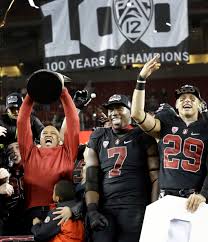
Since 1961, when the conference starting keeping track of a preseason media poll, Stanford has never been picked to win the title. On Saturday, Stanford earned its sixth Pac-12 championship in the past 50 years, and its third in the past four seasons.

Oregon or USC has led the preseason media poll the past 13 seasons. Despite the fact that Stanford has been a vastly better team than USC over the past six seasons, USC was again picked to win the conference this year. Furthermore, UCLA was also getting heaps of hype—ignoring the fact that it had lost to Stanford an astonishing seven (and now eight) consecutive times.

There was no faith in the dynasty. No respect. Of course, even most of the Stanford fans had left the bandwagon after the Northwestern game. I considered taking a year off from the blog! What an idiot.

Fortunately for us, Shaw rallied the troops and gave us a season that was supremely entertaining. And fortunately for me, my tailgate crew rallied as well and was 100% committed to going to Saturday’s championship game. Because of November home games and other obligations I have in December, I am spending basically every Saturday for two months driving hours away from Sebastopol. So I was prepared to watch the Pac12 championship on television in order to spend a rare weekend at home. But my comrades knew better, and they were right. It was a fun tailgate, an exciting game, and I was damn glad that I was there.

Stanford never went three and out, and only punted once. The offense was a pure joy to watch, and Stanford has now scored at least 30 points in 12 consecutive games. That is the longest active streak among Power 5 teams. Yep, you could make an argument that your Stanford Cardinal has the best offense in the country this season. Seriously. It isn’t a slam dunk case, but who else are you going to say is better?

Let’s lob in some facts that occurred in both the September game at USC and the Pac-12 championship game:

  • Stanford committed no turnovers.
  • Kevin Hogan completed at least 75% of his passes and averaged over 11 yards per attempt.
  • Kevin Hogan had at least 30 rushing yards.
  • Stanford had at least 35 minutes of possession.
  • McCaffrey put up huge all-purpose numbers.

Yet, in September against USC, McCaffrey didn’t have a single play from scrimmage go for more than 19 yards. Umm… well, he had a few big ones in this game. McCaffrey’s 461 all-purpose yards was the 5th best in FBS history, and boosted his season total to 3,496 yards, crushing Barry Sanders’record. (We should note that he technically hasn’t beat Sanders’ record yet—he should have 30 yards more to go if it wasn’t for a ridiculous stats-keeping decision by the NCAA.)

McCaffrey might not win the Heisman, but he should. That is a special record that he is setting. McCaffrey has 61% more all-purpose yards than any other Power 5 conference player this season. He leads Jakeem Grant of Texas Tech by 1,329 yards! What!?!?! It isn’t even close. No player is more dynamic in college football. If McCaffrey played for Alabama, he would win the Heisman by a mile. Pretty pathetic how biased the award is, but what can you do… the Pac-12 hasn’t won a national championship in over ten years. That is the first thing that needs to change if we are to expect the attention and respect.

After the game, McCaffrey was asked about the fact that he had a passing touchdown, rushing touchdown, and receiving touchdown—all in the same game. He said it was cool, but immediately pointed out that Kevin Hogan did the exact same thing in the game. First of all, that might be the first time in the history of major college football that two players on the same team have accomplished that feat in the same game. Second, you got to love that McCaffrey’s immediate response was to shine the spotlight back on Hogan. That moment right there defines the character of Stanford football.

For more on McCaffrey’s case for the Heisman, including the stunning fact that “McCaffrey is averaging 8.3 yards per touch… the best mark in college football history,” read this article from David Lombardi. (Lombardi doesn’t qualify this stat though… there must be a minimum number of touches he is using for this stat, though I couldn’t find or verify it with some internet searches. Let me know if you can.)

McCaffrey’s 461 all-purpose yards is the 5th best in FBS history. The record is held by Emmett White of Utah State, who gained 578 yards against a New Mexico State defense that was ranked 95th in total defense. McCaffrey’s game is likely “better,” given the opponent and significance of the conference championship. But I can’t find out who holds the 2nd through 4th most all-purpose yards. Let me know if you can find the info. What I’m getting at is that McCaffrey’s numbers might actually be the best ever in a championship-caliber game involving good teams.

2. Spreading the Field with Three Receivers

Stanford came out hot, spreading the field and taking some shots downfield. But then, during the middle of the game, and especially in the red zone, Shaw went with a bit of jumbo and wildcat and less spread formations. The results were not good. For example, on its fourth drive, Stanford started with two plays in spread formation and picked up the first down. Then, close to goal line, the Cardinal ran all four plays without three wideouts and turned the ball over on downs.

My dad, next to whom I had the pleasure of sitting, noticed the trend during the game. We discussed it throughout the 2nd and 3rd quarter and were hoping to see the Cardinal return to the spread formation. Shaw and coaching staff delivered in a big way. They absolutely realized what was happening: McCaffrey was having more success running the ball when USC was forced to use 5 defensive backs (three corners on the three receivers and two safeties). On its key 10-play, 4th quarter drive, Shaw called for three receivers on 9 plays. The only other play still had two receivers spread wide. No jumbo. No wildcat. The Cardinal coaching staff came through in a big, big way. They recognized a key game trend and capitalized on it.

In fact, on its last 16 offensive plays, Stanford did not use a single jumbo package, and never had less than two receivers spread out in formation. This is the exact opposite of what we did the last time we played USC, and shows the versatility of the team and the coaching staff.

The data was clear. The following drive chart tracks the percentage of plays in each drive the Cardinal lined up with at least three receivers. Notice the strong correlation between successful drives and a spread formation.

STANFORD Drive Start Time
# of Plays with 3+ Wideouts
Total Plays in Drive
% of Plays with 3+ Wideouts
Yards Gained in Drive
Drive Result
1Q 15:00 8 12 67% 55 FG
1Q 6:43 8 13 62% 78 TD
2Q 13:34 1 8 13% 59 FG
2Q 7:31 2 6 33% 13 Downs
3Q 11:51 2 6 33% 18 Punt
3Q 5:28 3 4 75% 78 TD
4Q 12:29 9 10 90% 75 TD
4Q 4:24 4 6 67% 37 TD

3. Shaw, Trick Plays, and 4th Down

On Stanford’s 2nd drive, up 3-0, it faced a 4th and inches from the USC 13. Shaw made the call to go for it, and I reached for a clean pair of shorts. The correct call—without question. I’m not sure if anyone on staff is aware of just how automatic this decision should be. (I’m not sure if any reporters know either—ESPN’s Kevin Gemmel wrote an excellent article about Wright’s success picking up TDs and short yardage but didn’t mention this statistic.) Coming into the USC game, Remound Wright was 27 for 27 converting 3rd or 4th downs with one or two yards to go. Insane. Shaw might not know the stat, be he knew exactly what to do: give the ball to Wright. He picked up the first down, and Stanford finished the drive with a touchdown.

And what a beautiful touchdown is was. Hogan pitches to Wright who pitches to McCaffrey who throws back to Hogan. What an awesome play and a great call by Shaw.

On Stanford’s next drive, on 3rd and goal from the 1, Wright was stopped for the first time in 29 tries. It was the exact same play to the same side Stanford ran on the prior drive, but this time USC knew exactly where Wright was going, and brought all of its linebackers to the left side so there was one available defender to meet Wright mid-flight. OK, so that is the first time all year that has happened. We have a 10-0 lead, so we already have a two-score advantage. Time to take another swig from the kombucha bottle and get back after it. But Shaw made the wrong decision and sent in Ukropina.

On the next drive, leading 13-0, we decided to go for it on 4th and 1 from the one. Well, fine, but why leading 13-0 and not 10-0? It makes more sense to go for it leading 10-0. Shaw needs some coherent strategy here. But, at least, we are seeing more aggression and confidence on 4th down than we have in the past. And the late 4th quarter, 4th down pass to Cajuste was as tasty as a Bloody Mary on the morning of Jazzfest.

Shaw is happier and more comfortable than ever. There is no doubt about his ability to lead the team—Stanford is headed to the Rose Bowl for the 3rd time in 4 years. He’s the only Stanford coach in the post WWII era to accomplish that. He’s established a solid and growing legacy, a consistent turnstile of top recruits, and a drama-free and team-oriented group of men. And, as I’ve noted over the past three years, he still has a tiny bit of upside with game management. But he is a very solid coach—there can be no question about that. Stanford is lucky to have him. Fortunately, he knows how lucky he is to have Stanford as well.

4. Defensive MVP: Blake Martinez

Two things worth mentioning here. First, Martinez had the play of the game when he caused the Kessler fumble that was returned for a Stanford touchdown. Second, for the season, Martinez had more tackles than anyone else in the Pac-12 conference—by twenty. He had 129 tackles on the season, good for 9th nationally, and 20 more than anyone else in the conference. He was our anchor as our defense worked through injuries and growing pains all season long.

5. How Close Was Stanford to Making the Playoff?

We can name that tune in one note. It isn’t a Stanford play, though. Erasing those fumbles against Oregon or converting the two-point conversion would not yet have guaranteed the win. But there is one single play that, if it alone had gone differently, would have allowed Stanford to make the playoff.

On September 12th in Knoxville, Oklahoma scored 14 unanswered to push Tennessee to overtime. Tennessee got the ball first in overtime and scored a touchdown. Oklahoma needed to score a TD to stay alive. It faced a 4th and goal from the Tennessee 1. Baker Mayfield faked the handoff and kept it and found the endzone. Oklahoma went on to win the game in the 2nd overtime. If Mayfield had been stopped on that play, then Stanford would have made the College Football Playoff.

6. Pac-12 Bowl Matchups

I hate to admit it, but the Pac-12 bowl lineup is lacking luster. The Pac-12 is sending 10 teams to bowl games, but very few provide national intrigue. The Pac-12 has no clear underdog—8 teams are favored and Oregon and ASU are about even. There is little chance to make a national statement, unless of course the conference goes 9-1, which is statistically unlikely. There is a chance to lose face though… which is the difficult thing when you are favored against no-name teams.

Honestly, other than the obvious Rose Bowl matchup and the Alamo Bowl between Oregon and TCU, only one other game interests me: Washington State vs Miami in the Sun Bowl. That is a great matchup for the conference, and in my opinion is the only game other than the Rose Bowl in which the conference can make a real statement by simply winning the game. In the other games, a statement is going to have to come with a lopsided victory.

Well, maybe I’m being too harsh here. I suppose Utah-BYU should be fun, and USC-Wisconsin isn’t bad either. But the Pac-12 really needs to get a regular bowl game against the SEC. Until that happens, we’re stuck with too many games like Arizona vs New Mexico.

7. The Rose Bowl: vs Iowa (12-1)

Of course, most of us were hoping for a shot at Ohio State. Despite 6 years of playing football as good as anyone else in the country, we have never once faced a team that has won a national championship in that span: Ohio State, Florida State, Alabama, or Auburn. It would have been special to have played the defending champions. But, as the reality sinks in, I’m just fine with Iowa. Ohio State presented a huge chance to make a statement, but it would have come with a risk. Ezekiel Elliot could have walked over our defense. I don’t think Iowa will rush for 300 yards against us. Ohio State might have. Plus, Ohio State has the dual threat quarterback, with which Stanford has struggled. Iowa does not.

So, I like the matchup. I’m sure Iowa’s defense will be tough to run against, but that’s OK. They aren’t used to facing offenses as good as ours. And I think our defense might be able to handle Iowa’s offense. Consider this stat: Iowa didn’t run a single play in Michigan State territory in the entire 2nd half. Vegas seems to feel the same way, as Stanford opens as a six point favorite… which of course brings up the fact that the committee ranked Iowa #5, one spot ahead of Stanford. I didn’t like it at first, but I suppose I understand it. If you look at what happened against our common opponent, Northwestern, it makes it hard to make a clear case that Stanford should be ranked higher. And it doesn’t matter anyways. It will be settled on the field.

The story of the game should revolve around the career of Kevin Hogan. Come, hear, Uncle Hogan’s Band, playing in the Rose. Come with me, or go alone, he’s come to take his teammates home. It’s the same story that Shaw told me, it’s the only one he knows. Like the first quarter he comes, and like the wins he goes. Ain’t no time to hate, barely time to wait. Wo, oh, what I want to know, how far Kevin Hogan goes.

Go Cardinal.

11/28: Stanford 38, Notre Dame 36

1. PerspectiveUnknown-1

Conrad Ukropina just put a feather in the cap of heaven. That was the most beautiful flying object I’ve seen in 25 years, since November 17, 1990. On that day, John Hopkins sent his 5th field goal of the day through the uprights in a dramatic last-second victory over Cal in what would come to be known as “The Revenge of the Play.”

Since the Harbaugh-led resurgence of Stanford football, we’ve seen some dramatic field goals at the end of games. Some fluttered in the skies and sailed adrift, like Jordan Williamson’s Fiesta Bowl meltdowns. But many led to victories, notably Williamson’s OT FG vs Oregon in 2012 and Nate Whitaker’s game winner at home against USC in 2010.

But this kick was different. It was just a perfect kick. Dead center, high and long. And smothered the playoff hopes of Notre Dame, which makes it extra special.

A hummingbird in a butterfly bush flower is a beautiful thing to watch, but it doesn’t send me into a group hug full of timeless ecstasy. Only Conrad Ukropina can do that.

2. Brief Game Notes

Stanford’s first drive was capped with a completion to Schultz that used McCaffrey as a decoy on play-action. Beautiful call by Shaw. And then Notre Dame ran the kickoff back for a touchdown. We’ve been spoiled by some great special teams coverage over the years. In fact, I can’t remember when the last time we’ve given up a kick return for a touchdown. If you can, let me know. So I guess we were overdue.

On the next drive, Rector and Cajuste made some amazing third down catches, and the offense was moving. On the following possession, Notre Dame had a false start on 4th and 1 from the 3 and had to settle for a field goal. The breaks were starting to go Stanford’s way. Stanford forced another Notre Dame field goal from inside the ten, and the red zone stops turned out to be the difference in the game. When forced to load the box with run defense and play man-to-man in the red zone, our defense isn’t actually that bad. Statistically, Stanford’s red-zone defense doesn’t rate that high, because teams have made a ton of field goals and Stanford has almost no 4th down stops or turnovers. However, Stanford, Northern Illinois, and Boston College are the only FBS teams to have allowed more red-zone field goals than touchdowns. Not bad, especially if your goal is to win games in offensive shootouts.

At the end of the half, Stanford forced the only turnover of the game as Kizer fumbled. It was another play that cost Notre Dame just enough points to ensure the Stanford win. And Notre Dame dopped a pass early in the 3rd quarter that would have led to another touchdown, only to settle for its third field goal of the game. As I watched the tape, I realized just how fortunate Stanford was. It played well and made some big-time plays, but Notre Dame definitely shot itself in the foot a few times. Notre Dame outgained Stanford by 111 yards, and average 8.9 yds/play compared to Stanford’s 6.6 yds/play. Add in the kickoff return for a touchdown, and delete the facemask penalty on Stanford’s game-winning final drive, and you most likely have a Notre Dame victory.

There were a few coaching decision to second-guess, and I’m happy that they belong to Brian Kelly and not David Shaw. First, Brian Kelly’s decision to try a drop back pass on Notre Dame’s 3rd quarter two-point conversion attempt was a mistake. The way they were running the ball, that call makes no sense. More importantly, after picking up a first down and getting down to the two, Notre Dame used its second timeout with 35 seconds remaining. It should have let a few more seconds run off the clock and just set up for a run play and preserved the timeouts. Then, it would have scored with 10 to 20 seconds left—not 30. But it might not have mattered—Hogan was just too determined to get the win. And the Fox announcing team just got so into Cajuste—Cajuste is loose!—that there was no way to lose. And I think we might be onto something with Cajuste. If you’re in a tight spot sometime in the future, don’t click your heals together, just yell at the top of your lungs, “Cajuste!!!!!!!!” I promise—good things will happen. If you need an extra boost, try this: “Cajuste!!!!! Ukelele!!!!!!” Thank you Gus Johnson. Thank you very much.

Joel Klatt incorrectly repeated how Hogan had just played his best game. Sorry Joel. Top five of his career, sure, but not his best. But he definitely went out on a high note. Thank you Kevin Hogan for four great years.

3. The Playoff Race & Stanford’s Chances

The playoff teams are already set assuming the favorites win. Oklahoma is in as the Big12 champion. Fair enough? Absolutely. They’ve looked good, are strong on both sides of the ball, and are ranked in the top 4 in virtually all rankings and metrics. On the Massey Composite Ranking site, Oklahoma is a top-4 team in 100 of the 110 different ranking systems. That is a really high percentage, as there is a lot of variability in those systems. (For example, one ranking has Stanford as high as #2 while another has Stanford at #19.)

The Big-10 champion is in as well. Make sense? No question about it. Iowa would be undefeated with a huge win over Michigan State, or MSU would own the best set of top-20 wins of anyone in the country: Michigan, Oregon, Ohio State, Iowa. The champion of this conference absolutely has to get in. It owns huge wins over the Pac-12 (MSU over Oregon, and NW over Stanford) and the fact that the conference has the defending national champion means something as well.

Alabama, when it beats Florida, is obviously in. It will have beaten more teams in the top quarter of the FBS than anyone else: Wisconsin, Georgia, Arkansas, Texas A&M, Tennessee, LSU, Mississippi St, and Florida. That is 8 wins against teams that a generally ranked in the top-30. Outstanding. In, and a heavy favorite.

Finally, if Clemson wins, they are in as well. Stanford dulled the shine of Clemson’s win over Notre Dame, but its win over Florida State now looks even better at FSU blew out Florida. Clemson also has had very few lucky or close wins. I would give the top seed to Alabama, but give Clemson the #2 seed. They are a lock.

But what if Alabama or Clemson lose? First of all, Ohio State is not getting in the Playoff. Ohio State owns a 1-1 record against top-40 teams. That isn’t good enough. And with the Big-10 already a lock to get a team in, there is no way the committee will choose two teams from the same conference unless they have to. Is there a scenario that would force their hand? Technically, yes. If Alabama, Clemson, and Stanford lose, then Ohio State is in the Playoff. But it won’t happen.

For that matter, Alabama isn’t going to lose either. If it does, the SEC is out of the Playoff, which is absolutely fine considering it owns no quality wins over top-25 teams other than the freakish week 1 South Carolina win over North Carolina. Florida is not a great team, and the committee knows it. If Alabama can’t beat them, then they have no spot in the playoff. So, if a miracle happens and Alabama loses to Florida, Stanford would be in the playoff with a victory over USC. But again, it ain’t going to happen.

So that leaves the issue of Clemson vs North Carolina. If North Carolina wins, and Stanford wins the Pac12 championship, then we have a very interesting situation. First of all, Clemson is out of the discussion. They don’t have a good enough record and strength of schedule to stay in the top-4 after losing. More importantly, the committee seems committed to selecting conference champions, which is a great thing. A lot of experts and analysts are writing and talking about how Clemson could stay in the mix after a loss. It isn’t going to happen. There would have to be a bad call at the end of the game that led to a UNC win for the committee to overturn things and put Clemson in. The game will be the deciding factor, and the winner will advance. It is as simple as that.

So if UNC and Stanford win: then it is UNC vs Stanford. First, let’s deal with the obvious: Stanford has two losses and UNC has one. We’ll need to account for the big difference in scheduling difficulty.

Let’s assume Stanford and UNC are average top-10 teams. Then we’ll use Sagarin’s rankings and data on how top-10 teams fare against other teams. Ideally, we would have a probability curve that represents the likelihood of victory versus the appropriate rank of the opponent. For example, an average top-10 team might own a 92% win probability against a team ranked 30th, and a 91.7% win probability against a team ranked 31st, etc. Unfortunately, I don’t have access to data like that, though it would probably be easy (but time-consuming) to gather. It’s much easier to group teams into intervals, so that we can analyze Stanford’s win likelihood against a team ranked 11-20, for example, or a team ranked 21-30. I’ve used the last five seasons worth of data to provide a clearer picture of the win probability at different intervals. Note that Sagarin’s rankings include FCS teams as well, for a total of 253 teams. Here’s the data:

Top-10 Team vs Opponent Ranked… 2015

Wins

2015

Losses

‘11-‘14 Wins ‘11-‘14 Losses Total Win Probability
1-10 7 7 46 46 50.0%
11-20 10 4 52 16 75.6%
21-30 11 1 52 8 87.5%
31-40 11 2 48 6 88.1%
41-50 7 0 38 2 95.7%
51-60 9 1 35 3 91.7%
61-70 10 1 19 0 96.7%
71-253 a lot 0 a lot 0 100.0%

First, let’s note why it seems like there are so few upsets. This is because early and mid-season upsets usually mean that the underdog is actually a better team than expected. By the end of the season, with all of the games played, it is extremely rare that a great team lost a game to a team that turned out to be horrible.

The primary issue with the data is the 51-60 interval. Obviously, the probabilities should continue to increase per interval. So I am going to adjust the win probabilities to the following to smooth them out a bit:

Top-10 Team vs Opponent Ranked… Total Win Probability
1-10 50%
11-20 75%
21-30 87%
31-40 90%
41-50 93%
51-60 95%
61-70 97%
71-253 100%

Now, let’s analyze Stanford and North Carolina’s seasons, including a theoretical Stanford win over USC in the Pac12 championship and a UNC win over Clemson in the ACC championship.

STANFORD vs Opponent Ranked… # of

Games

Win Probability Expected # of Wins
1-10 1 50% 0.50
11-20 3 75% 2.25
21-30 2 87% 1.74
31-40 2 90% 1.80
41-50 1 93% 0.93
51-60 1 95% 0.95
61-70 0 97% 0
71-253 3 100% 3.00
TOTAL 13 11.17

So, if Stanford is indeed an average top-10 team, it would be expected to win 11.17 games given its schedule. At 11-2, Stanford would have underachieved by 0.17 wins.

UNC vs Opponent Ranked… # of

Games

Win Probability Expected # of Wins
1-10 1 50% 0.50
11-20 0 75% 0
21-30 0 87% 0
31-40 1 90% 0.90
41-50 3 93% 2.79
51-60 2 95% 1.90
61-70 0 97% 0
71-253 6 100% 6.00
TOTAL 13 12.09

UNC would be expected to win 12.09 games given its schedule. At 12-1, UNC would have underachieved by 0.09 wins.

The difference is nominal, and Stanford’s 2nd loss is clearly expected based on how much more difficult its schedule is than UNC’s schedule. So, it would have to come down to other metrics. Margin of victory is high for both teams. Both teams are trending in the right direction with week one losses that look to be complete outliers. In my opinion, it would come down to this: who looks and plays better in its championship game. We saw this happen last year. Ohio State’s 59-0 dominance of Wisconsin demanded that it be put in the playoff. So if UNC and Stanford win, whoever gets the open spot will be the team that has a more convincing performance. If Stanford can win by two touchdowns while UNC barely beats Clemson, then Stanford will make the playoff.

If you’re curious about the possibility of Stanford vs Ohio State in the Rose Bowl, read up here.

These projections I think underestimate the importance of being conference champion, but some great stats, probabilities, and Ukropina pic can be found here.

4. Up Next: USC (8-4)

The big question is: can Stanford win convincingly? Can Stanford’s defense get a few turnovers and stops? Is Stanford even better than USC?

Last week, I wrote that Stanford was going to roll Notre Dame. I based that comment on this: I was sure that Hogan was going to have a great final home game, and I blindly hoped that Notre Dame just wasn’t that good on offense. Turns out, Notre Dame is pretty good team, and the Stanford defense struggles to turn in good performances against good offenses. Does the Stanford defense have a chance? Well, Oregon, Cal, Notre Dame, and WSU all have top-25 offenses. USC’s offense is not quite as good—32nd in total offense. But I’m still worried that USC will be able to run the ball. I hang my hopes on Helton calling too many pass plays and Stanford somehow intercepting a couple of passes. If the defense goes another game without getting any turnovers, the Stanford offense will need to be near perfect.

Should be fun evening at Levi Stadium. There’s good mojo there. Stanford played well against Maryland in the Factory-Farmed Chicken Bowl last year, and the Grateful Dead strung together some beautiful notes over the summer. We’re Truckin, down to Levi’s Stadium, woah oh baby back where I belong, back home, the game ain’t worth a dime, if we don’t lay them Trojans down.

11/21: Stanford 35, Cal 22

1. PerspectiveUnknown

Stanford won its 6th consecutive big game as Christian McCaffrey drove his tractor (re: offensive line) over a field of California golden poppies. It wasn’t the most satisfying Big Game we’ve seen recently, but the offensive line deserves a ton of credit. They’ve helped McCaffrey set a few school records:

  • Most all-purpose yards in a game (389 vs Cal)
  • Most all-purpose yards in a season (2807… and counting)
  • Most consecutive 100 yard rushing games (9… and counting)

We are fortunate fans to have such great players entertaining us. And we also have great coaches. Even though I am again going to point-out a major strategic issue with which Shaw struggles, I still appreciate the quality and consistency of his leadership. Clearly he knows how to get guys ready to play football.

2. Coaching & 4th Down Decisions

Sonny Dykes made a great call in the first quarter to go for it on 4th and 1 from its own 42. Goff hit Powell on a quick out and Cal’s offense got going in the right direction. Unfortunately for Cal, it kept getting stuck in the red zone and Dykes opted for field goals.

On AM 1050 after the game, Shaw said something like: That was our strategy on defense—limit big plays and then play clutch in the red zone and trade field goals for touchdowns. It’s just simply math. My first thought was, “Damn… our strategy is to just let them move down the field and score points?”

Shaw elaborated in his media conference the next day: “I hate the phrase ‘bend but don’t break.’ Because it sounds very passive. We’re not a passive football team. But, we want to keep the ball in front of us and not giving up the touchdown passes and trying until late in the game. But trying to keep the ball in front of us and get them to third and six in the red zone. Get them to third and five in the red zone. And not give up the touchdown to make them check the ball down and make them kick field goals. And that’s, once again, that’s — it’s math. If we can go down and score touchdowns and make them kick field goals, eventually, we’re going to win.”

Interesting… Shaw did indeed use the word “math!” Is this a good strategy? Thinking about it more and comparing the result to the big touchdowns in the Oregon game, I think it actually holds some water. However, you are basically admitting that your defense isn’t that good, and you are committing yourself to having to score touchdowns to win the game. Because Cal has a bad defense, it all seems plausible. But in order to win in this kind of offensive shootout, you may have to take some chances with your own offense, including going for it on 4th down.

In the 2nd quarter, Stanford faced a 4th and 1 from Cal’s 49. Shaw went jumbo with Wright and Stanford converted for a first down. Automatic. Easy decision from Shaw. In fact, the data on this will show just how easy these calls are in these situations. Stanford has the highest 4th down conversion percentage in the country for any team with at least 8 attempts. But then a few plays later, Stanford punted on 4th and 3 from Cal’s 41! What the hell is that? If you are going to let Cal convert short passes until it reaches the red zone, then what does it matter if they start their possession at their own 20 or 40?

In the stands, I screamed my usual pressure-release mantras: “Buddy Teevens! Walt Harris!” It helped a little. It annoyed some people around me, but others were clearly disturbed by Shaw’s decision and laughed at the single overlapping feature of Shaw’s regime and the Teevens-Harris era: an overly conservative offensive strategy on 3rd and long, on 4th and short, and within field goal range.

Shaw, you’re allright man. You aren’t Buddy Teevens. God bless. But let’s get coherent with our strategy here. If we are playing for red zone defense and giving up field goals, then we don’t care much about field position, right? We care about possessions and points.

And, we have the personnel to keep possession and ball into the end zone. Just how good has Remound Wright been in short yardage situations? Or, for that matter, both Wright and McCaffrey? I went back through every game and all the play-by-play data. Prepare yourself to be launched from a hookah into the magi-color swing set of crumbcakes and awe:

3rd and 4th Down Plays with 1 or 2 yards to go Conversions Attempts Conversion Rate
Fumbled Snaps 0 1 0%
Hogan Passes 4 5 80%
Hogan Runs 1 1 100%
McCaffrey Runs 10 10 100%
Wright Runs 25 25 100%

I knew something special was happening this year, but I didn’t know the data was going to be this amazing. In three years of blogging and digging through statistics, this find made my hair stand up straighter than any other piece of data. I couldn’t believe it as I went through the games. When running the ball on 3rd and 4th down with one or two yards to go, Stanford has converted on all 36 attempts!

In the 3rd quarter, Stanford faced a 4th and 1 from its own 43. No brainer, right? Surely someone on our staff must be aware of our percentages?! Shaw punted again. Cal, after scoring on its previous two possessions, took the ball and moved down the field and scored again. At that point, Cal held a huge yardage lead. Cal was moving the ball extremely well, and the game really could have swung in the Bears favor. Fortunately, there were no further possible situations for ignoring an obvious statistical advantage. McCaffrey took over and ran clock, and Cal also ran too much time off of the clock on its drives. At least the Bryce Love sweep for a touchdown in the 4th quarter was a great call by Shaw.

3. SEC & Rankings

I am shocked how little chatter there is about the abomination that is the SEC East. Last Saturday was absolutely embarrassing for the conference, but because two teams barely escaped with victories, it wasn’t major news. Florida was a 30-point favorite over 2-8 Florida Atlantic and survived by the thread of one play. FAU outgained Florida as well. If FAU would have converted one of their four shots at the end zone in overtime, then Alabama would be playing a team that lost to FAU in the SEC Championship.

South Carolina lost to the Citadel, and Goergia needed overtime to beat Georgia Southern. And this is November… teams should be playing their best football by now. Plus, all of the SEC teams were at home. Can you imagine if Florida had to travel to play at Florida Atlantic? They might have lost by two touchdowns!

Fortunately, the committee pays attention to stuff like this, and moved Florida down in the ranking. Stanford is the highest-ranking two-loss team, and it is above an SEC and a Big12 team that each have one loss. I’m fine with that.

Next week, if Stanford beats Notre Dame, we will look at ranking metrics and see if a Playoff case can be made for Stanford.

4. Up Next: Notre Dame (10-1)

The only thing that scares me about Notre Dame is that they beat USC when USC was playing well. But Notre Dame is banged up and trending in the wrong direction. And they have a ton of pressure on them with the Playoff nearing. Stanford gets a free-roll this week, and Hogan plays in his last home game. Read up on a great Hogan article and then get ready for a blowout. Stanford is going to roll.

11/14: Oregon 38, Stanford 36

images

1. Perspective & Defense

The following numbers tell a certain story:

Stanford Oregon
Time of Possession 42 min 18 min
Total Yards 506 436
Number of Offensive Plays 86 48
First Downs 32 19
Punts 1 4

On paper, it looks like a one-sided game, though Oregon’s 400+ yards are slightly alarming. But in the end, only two statistics mattered: Oregon had 9.1 yards/play, and Stanford turned the ball over three times. That was it—Oregon made big plays, and Stanford made mistakes. Other than about three plays of each side of the ball, Stanford played a great game.

On Sunday, my friend Peter texted a group of us, “If you were considering re-watching the fourth quarter—don’t! I just did and it was incredibly painful. We move the ball with complete ease on three drives only to fumble twice like we haven’t fumbled all season. And then also don’t watch the two-point conversion. I have no idea what #77 [right tackle Casey Tucker] was thinking… it is as if he never even saw Coleman even though he was two feet away from him.”

I had mostly gotten over the game by the time I read his text, but I agreed with Peter about one thing: I really didn’t want to watch the tape of the game. As it turns out, it took me six days to finally get enough emotional distance from it to sit and watch it.

It was a great battle. If you are an Oregon fan, then you think that the Ducks did enough to deserve to win the game. Your offense was unstoppable, and you made plays when it mattered. If you are a Stanford fan, then you gave the game away with three fluke turnovers. Which team is better? Which team deserved to win? I mean this in as unbiased of a way as possible, but I think Stanford is a slightly better team. Think of it this way: if you are a huge fan of both teams, and you get a free ticket to send Oregon or Stanford into the playoff, which team would you send? There is no way you would send Oregon’s defense against the best in the land.

The reality is, however, that you really wouldn’t want to watch Stanford’s defense face Alabama’s offense either. The Stanford defense isn’t good enough for Stanford to have really contended for a national title. And that is fine. It has been a wonderful season so far, but keep in mind that it was supposed to be and apparently is indeed a rebuilding year on defense. And next year may be another rebuilding year as well. Our defense is young. I’m reasonably happy with the way they have played this year. Oregon is a powerful offense. And they didn’t make any mistakes. The one big defensive play that we did make was earned, and Kevin Anderson almost took it back for a game-changing touchdown. But he was barely nudged by a fast piece of celery and tumbled to the turf. I immediately sensed the importance of that moment—and was deflated when we had to settle for a field goal. Ironically, it was a similar moment to the 2012 Stanford-Oregon game when Marcus Mariota broke free for what should have been about a 90 yard touchdown run but was tackled from behind by Devon Carrington around the 10 yard line. D’Anthony Thomas was running with Mariota the whole way, and instead of focusing on blocking, he ran ahead of Mariota as if celebrating the moment and his own speed.

But Thomas let Carrington catch Mariota, and Oregon ended up coming away with no points. Check out the play here. In a game like this, those little opportunities must not be squandered.

2. Offense & Coaching

The first drive started out well, easily reaching the red zone. On a 2nd down and 3, Shaw called for McCaffrey to throw a pass back to Hogan. It should have worked easily, but the pass was a bit low and Hogan dropped it. Then, on 3rd down, McCaffrey ran right for the first down, but it was called back on a holding penalty on Hooper. Hogan kept the rock on third and long and got back to 4th down and 3. Shaw sent in the field goal team. Ominous start. Stanford moved the ball easily, but its own mistakes stalled the drive. As it turned out, that would be the theme of the night.

The decision to kick isn’t surprising, but field goals are really, really bad if you are in an offensive shootout. We weren’t yet, but what did we expect? Oregon has a monster offense, and we knew it was going to be a high scoring game. So, is the correct play to actually go for it on 4th down? If we use the data just from the first 11 plays of that initial drive, Stanford gained three or more yards on 9 of those 11 plays. From that perspective (82% chance of 3+ yards), you could make a strong case that the correct strategy would have been to go for it.

In the 3rd quarter, on 4th and 2 from the 26, Shaw definitely made the wrong decision to attempt a field goal. Stanford was down 5 points, and the Oregon offense was rolling. Can’t settle for field goals. And why should we! Our offense was rolling too! The only way you can justify sending in the field goal team in that situation is if we are down exactly 3 or 10 points. This was Shaw’s only clearly bad decision of the game, and the mathematical football gods of karma punished him for it—Ukropina missed his first kick of the game.

Our only punt of the game came on our next possession, and it was primarily self inflicted by a holding penalty on 1st down.

Then, we really had to go to the passing game. And Rector and the other receivers had a fantastic game. They made some huge catches in traffic. The Stanford offense was virtually unstoppable. I find it interesting how easy it was for Hogan to move the offense with the passing game in the second half, considering that we hardly ever pass two plays in a row. Our entire offense is mostly premised on moving the ball slowly. We don’t go after many big plays. When we sense we are in a shootout, I think we need to throw the ball earlier in the game. More play action with some shots downfield. We don’t need to see the jumbo package on 2nd or 3rd and short when we are losing. Save it for fourth down.

You can’t second-guess the fact that the alternate, jumbo package center was in the game when the final fumble happened. Caspers has been snapping the ball to Hogan all year in the jumbo package and we haven’t seen a fumble yet. So we can’t fault anyone for that. Just a fluke play at a horrible moment.

But Tucker sure blew it on the two-point conversion attempt at the end of the game. It is hard to imagine what he was thinking or where he was looking. He completely missed the block, and Hogan had to force out the throw to Hooper a bit early. I love the play call by Shaw. Hooper was breaking open and if Hogan had another half second it would have been an easy conversion. But the missed block blew it up, and Oregon escaped. Yeah, they earned it with some slick waterslides of offensive fun. But just as clearly, they escaped.

3. The Playoff Rankings

I was pleasantly surprised to see Stanford sitting at #11, four spots higher than it is in other polls. It is pretty amazing to see our program get that kind of respect in a committee room. I think the football guys really respect the way Stanford plays football. And it is clearly willing to overlook the Northwestern loss. If you really consider that game to be a core part of Stanford’s resume, then there is no way that it can be ranked that high. Stanford owns only one win against a top-25 team (#24 USC), and has two losses. But it is really nice to see the committee consider what teams are powerful, on both sides of the ball, at this moment as the season comes to a close. It makes for a better playoff.

I also generally agree with almost all of the Playoff committee rankings. Never was I able to say this last year. But this year things have been good. The committee is really focusing on strength of schedule, and teams like #10 Baylor and #18 TCU are being punished for having zero wins against the top-25. In fact, Baylor and TCU’s best win is over either Texas Tech (6-5) or West Virginia (5-4). And TCU is certainly being downgraded for beating a horrible Kansas (0-10) team at home by only six points. They are possibly also being docked for their fluke last-second win against Texas Tech. I absolutely love how low TCU is ranked.

Speaking of Baylor and TCU, Jon Wilner of the San Jose Mercury News left Baylor off of his top-25 ballot. He justified it with the same logic of my previous paragraph—they haven’t beaten anybody good. But here is the problem—Wilner has TCU ranked #18, and TCU clearly has a similar or worse resume than Baylor. So, by his logic, TCU shouldn’t be ranked either. I’m not opposed to that idea… teams should have to prove themselves…. but at some point you have to select teams for the bottom portion of the poll. In his #22 spot he has Wisconsin, which owns zero wins over teams with winning records. And slotting in at #25, Wilner voted: Air Force! Oh God. Air Force (8-3) is going bowling, and eight wins is nice and all, but take a good clean look at the shape of your toilet bowl to know how many victories Air Force has over teams with winning records: 0. Wow. Wilner really fucked this up. I usually love how he votes and looks to justify some unusual rankings, and he often does a great job ranking some teams that he analyzes deeply. But then he completely fails to apply his same logic to other teams. People out there are pissed off at Wilner—Baylor fans especially. In this case, I think they have a point. He’s tied himself up in a pretzel of inconsistency.

The only other team that is a bit tricky to rank is #3 Ohio State. Ohio State has not played a ranked team all season. Even worse, OSU hasn’t played anyone in the top 35 of most rankings. Penn State (#42 realtimerpi, #39 Sagarin, #37 Massey Composite) is Ohio State’s strongest opponent to date. So why is Ohio State ranked so high? I can only presume that it is because they are the defending champions. And that makes sense to me. We aren’t suppose to use last year’s results when we are this deep in the season, but the fact that Ohio State hasn’t lost in over 20 games should mean something. I am very comfortable with Ohio State at #3 despite the fact that its toughest games are still ahead of them.

4. Up Next: California (6-4)

The Big Game has BIG CONSEQUENCES. A shot at the Rose Bowl is on the line, and the game is under the lights! Stanford has won five in a row. Will this one be different? For that matter, will it be any different than the Oregon game? It will all come down to Stanford’s ability to limit big plays and avoid turnovers and field goals.

11/7: Stanford 42, Colorado 10

1. Perspective Stanford running back Christian McCaffrey, back, fades back to throw a pass for a touchdown against Colorado in the second half of an NCAA college football game Saturday, Nov. 7, 2015, in Boulder, Colo. Stanford won 42-10. (AP Photo/David Zalubowski)

Leading up to the game, I had completely forgotten that Hogan was returning to the field where he made his first start three years ago. He led Stanford to a 48-0 win, including touchdowns on his first four drives as a college quarterback. There was good juju on this field for Hogan, and he was feeling it again this year, as he and McCaffrey led Stanford to a dominant win.

2. 1st Half Thoughts:

I missed most of the first drive as I got settled in at Papas y Pollo Mexican restaurant in Sebastopol. (My crappy satellite tv provider doesn’t have Pac12 network.) Early signs looked good for Stanford. McCaffrey was finding gaps and Hogan looked very comfortable. But so did Colordao. Lifau was throwing the ball well and Nelson Spruce looked as reliable as a receiver can possibly look.

Then, on a third and long situation that has recently had Shaw call a conservative run, Hogan sent a beauty over the top for a TD pass to Rector.

On another drive, Hooper made a great airborn, back-shoulder catch. People were stepping up and making plays just like the USC game. Awesome stuff.

And then Shaw threw down and officially introduced the new David Shaw. Stanford faced a 4th down and 2 from Colorado’s 6 yard line. It was a tough call. Stanford only led by 7, so a field goal makes it a two score game. But something is different about Shaw recently. He looks happier. And it is translating into making game decisions that make fans (and statisticians) very happy. Shaw went for it, and out of the jumbo package, Hogan tossed to a wide-open Dalton Schultz. Beautiful, beautiful play. I love this new attitude on 4th down, and it is essential if we expect to keep winning games. Our defense is not good enough to win in low-scoring, field position battles.

3. 2nd Half Thoughts:

Lifau came out running the option and had no trouble picking up easy gains on the ground. But Kevin Anderson and Peter Kalambayi came up big on 3rd and 3 to blow up a QB sneak for a two yard loss. And then, on 4th and 5 from the Stanford 11, the Colorado coach made the quintessential decision that exemplifies why these coaches should not be paid millions of dollars. Down 21 points, he sent in the field goal team. Colorado offense had looked decent. The game wasn’t over. But once the kicker stepped on the field—well, that was it. Bye, bye, Colorado.

And then he tried an onside kick! I actually love the onside kick attempt. Stanford had only one guy over there. If Stallworth doesn’t bring in the kick, Colorado had four guys right there to recover it. But that’s why you put great hands up there. On the next play, Hogan faked the handoff to McCaffrey and gave it to Bryce Love on the fly sweep. It was about to be busted up, but Love broke through for a 47-yard touchdown. Stanford was rolling.

And then the defense took over. On Colorado’s next 10 plays: 1 play went for positive yards, 4 plays went for no yards, and 5 plays went for negative yards.

Christian McCaffrey’s touchdown pass in the 4th quarter was amazing, though I was shocked to see used in a blowout. And then I realized what Shaw was thinking. He doesn’t care about this play working in a crucial time. He cares about the running game working in crucial times. He cares about teams not keying on one play or one run. After the game, he said, “We got to put a lot of things on film, so that was good.” Crazy. The logic seems flawed to me. It is a stretch to think that all the defenders are just going to stay home and not crowd McCaffrey now that they have seen a few trick plays. But, that is Stanford football. The trick play is not what we are after. The goal is sound, fundamental football—with only a few surprises. As long as your men don’t gang up on fewer of our men, we are going to win.

4. SEC Overrated Again… Though Not in the Eyes of the Playoff Committee

I haven’t started with my criticism of SEC bias yet this year, but in the comments section of Jon Wilner’s blog, an astute reader noted this fact: The SEC is 0-3 against teams that were in last week’s initial Playoff Rankings. The conference owns no major victories this year. I think Florida’s game against Florida State will tell us a lot more about the SEC.

Fortunately, the Playoff Committee dropped Florida and LSU well below Stanford, which is correct. I have no issue with the committee rankings, other than the fact that USC should be ranked ahead of teams like Wisconsin and Mississippi State.

Much more on the rankings next week.

5. Up Next: Oregon (6-3)

The game still feels dangerous. The Ducks offense is moving again, and I don’t think we have the speed to stop it. But, there is one major difference: Vernon Adams is not nearly the run threat that Marcus Mariota was. Last year, Mariota rushed for 92 yards against us on just 9 carries. Mariota averaged 51 rushing yards/game last season. This year, Adams averages 24. If we can keep Adams in the pocket and force a little pressure, I like our chances. Of course, it all hinges on the expectation that Oregon can’t stop us. They should score 30 points on us, but the expectation is that it won’t be enough. We’ll see if our line can indeed dominate, or if Oregon keys on McCaffrey, if Hogan can make them pay for it.