
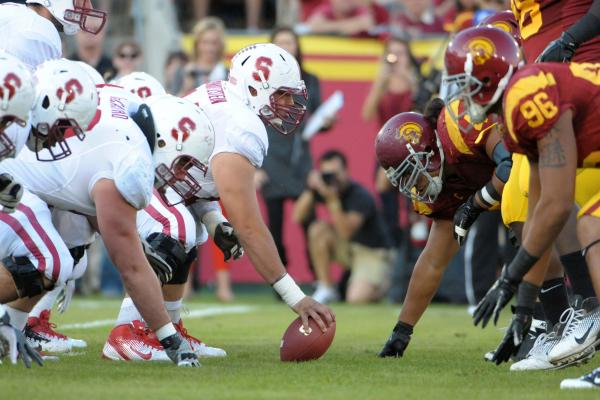
 1. Perspective
Never before has there been such a discrepancy between what I was seeing on the field and what I was seeing on the scoreboard. Watching the game was literally like feeding an empty box of Cheerios to a crowd of hungry children. Well, not literally. Just kind of.
Stanford reached USC’s 32 yard line in every single one of its possessions. This has most likely never happened in the recent era of Stanford football. I looked back through 2010 at all of the games, and there were only two games in the 2010 – 2014 seasons when Stanford came close to achieving the same incursions into its opponent’s territory. Against Washington in 2011 and against Wake Forest in 2010, Stanford crossed its opponent’s 32 in all possessions but one. You might guess that Stanford scored more points than the 10 it put up against USC, and you would be correct. Stanford scored 65 against Washington and 68 against Wake Forest.
It is an extreme statistical improbability for Stanford to have only scored 10 points. Unfortunately, a conflagration of physical and mental mistakes combined with poor coaching decisions brought this improbability into reality. Furthermore, things didn’t break Stanford’s way. For example, all three of the game’s fumbles were recovered by USC.
On the other hand, as of today, it’s been exactly 1,031 days since Stanford did not have the football in the fourth quarter of a game with either the lead or a less than one touchdown deficit. Since the Oregon loss in 2011, Stanford has played 33 consecutive games with the smell of the taste of victory. Even if your binoculars are clouded with really high expectations, Stanford football is still looking pretty darn beautiful.
2. Offense: Can I Have a Side of Smoked Penalties With My Eggs, Please?
I thought Kevin Hogan played a wonderful game. He made a lot of big throws, and picked up some clutch yards with his legs. He took a couple sacks, but generally when things got tight and his targets were covered he tucked the ball in and did what was necessary. I am very, very pleased with his play at quarterback, and this has rarely changed throughout his career. Coach Shaw said that there were probably four plays that Hogan would like back, “And that’s too many.” I assume he is talking about Hogan’s one inaccurate pass over the head of Hooper, his one failure to see a wide-open Greg Taboada, and the delay of game penalties. If that is the entire list of mistakes against a good defense, then that seems pretty darn good to me.
Ty Montgomery is a total star. He seems to have completely shed the inconsistent hands he had as a young player. All of the Stanford receivers and tight ends played great—there was not a single dropped pass. I would like to see Austin Hooper targeted more, especially in the red zone. There isn’t much footage of us using tight ends from last season, so I think we can surprise defenses this year by targeting our tight ends. Hooper was wide open on the “touchdown” catch that was called back because of the chop block call in the 4th quarter. As for Montgomery, Jon Wilner of the Mercury News writes, “I can’t help but wonder if Stanford ought to use Montgomery as a tailback in the I formation more often and less out of the Wildcat. My issue with the Wildcat – not only for Stanford but for all teams – is that the formation is often used when the quarterback and offense are in rhythm. Switching to the Wildcat for just one play seems to break that rhythm.” I completely agree, partly for the rhythm aspect, but more so because the Wildcat lacks deception. If Montgomery dots the “I,” then Hogan can still use play action to target a tight end. Montgomery played a lot of running back in high school, and he looked great on the one play when he lined up at tailback and ran for 6 yards in the second half.
Finally, I like the way Remound Wright is playing. He had 5.5 yards/carry and a beautiful 21-yard reception. Too bad that he didn’t get the ball on 4th and 1 from USC’s 3 in the 3rd quarter. Instead, Coach Shaw thought this would be a good time for Daniel Marx to get… […John Fishman 2001 drumroll, please… yep… keep it going… this next note is going to hurt like hell…]… his first career carry. Suck on that Gobstopper for while—it’s a tasty one.
Despite some solid physical play, the offense was obviously shattered by mental mistakes. Andrus Peat had a false start on the first play of the game. At the end of the 2nd quarter, Stanford sent 12 men onto the field—coming out of a timeout! On Stanford’s last play, a mental error on the left side of the line sealed Stanford’s fate. (Give USC credit there for a risky blitz; Shaw also deserves credit for trying to target Montgomery for the win.) The list of mental mistakes is long, and in the end, Stanford beat itself.
3. Defense: Still as Stout as Oatmeal Stout
USC surprised Stanford by coming out on the ground on its first possession. After yielding a touchdown on that drive, the Stanford defense locked it down. For the second straight year, the defense did not allow USC to score a touchdown after the first quarter. The defense held USC to 291 yards. It is safe to say that USC won’t be held under 300 yards again this year.
If there is one criticism of the defense it is that it was unable to force a turnover. One timely interception could have been enough to make the difference for Stanford. But all in all, the defense played another great game against a tough opponent.
4. Coaching: David Shaw Does Not Like Math or Having Fun
It would be stupid for me to play armchair quarterback with Coach Shaw’s play-calling. We ran a lot of great plays all game. The only problems with the x’s and o’s of play-calling that I have are:
- On important plays, we shouldn’t give the ball to someone who has never held it before.
- We should not make it so easy for the defense to know what is coming. For this reason, I hate the “Jumbo package” and I hate the Wildcat. We should run up the middle on a lot of key plays, but we don’t have to always wink at the defense and say, “We’re coming in for a big group hug, boys! Get ready!”
Excluding the Jumbo and the Wildcat, I enjoy the plays Shaw and the other coaches draw up every week. But my biggest issue with strategy is in regards to 4th down strategy. Field position is not nearly as important as Coach Shaw thinks. Take a look at the chart below.
STANFORD OPPENENTS’ AVERAGE PTS/POSSESSION FOR 2013 & 2014, BASED ON STARTING FIELD POSITION
| Starting Yard Line | # of Possessions | Average Points Per Possession |
| 1-9 | 12 | 1.33 |
| 10-19 | 28 | 0.75* |
| 20-29 | 80 | 1.49 |
| 30-39 | 24 | 2.29 |
| 40-49 | 11 | 2.73 |
| Past Midfield | 7 | 2.72 |
*This is an outlier, due to small sample size, and, in part, Washington State having six scoreless drives that started from here.
The data reveals a few things. First, pinning your opponent deep might not be all that beneficial. Also, the data reveals is that it didn’t matter that much if opponents took over on their own 42 or Stanford’s 42. Midfield is such an important psychological line, but it means little. What you might do from your opponent’s 45 should be very similar to what you might do from your own 45. However, coaches are extremely conservative from their own territory. The book, Scorecasting, refers to this bias towards cautiousness as loss aversion. It is the same loss aversion that causes most people in society to not gamble, even when the odds aren’t necessarily stacked against them. Of the mathematical programs I’ve seen that calculate expected value (or expected points), all have shown that teams should basically go for it on 4th and 3 yards or less from anywhere on the field! (Here’s one example.) These facts alone show the gigantic discrepancy between current and optimal decision-making.
My chart above is not exhaustive evidence for being more aggressive on 4th down, since field position is something can continue to affect consecutive possessions. The computer programs must use some iterative formula to calculate the influence of field position on future drives beyond the immediate next drive. But it seems safe to say that the benefit of field position wears off pretty quickly. Many things can happen that “reset” or at least alter the benefit of good field position. Here are some examples: a long play, a scoring play, punting the ball into the end zone, or the end of the half or game. It seems pretty clear that maintaining possession is much more important than a little bit of field position.
Does 9 yards sound like a little bit of field position? That is what Stanford gained by punting the ball into the end zone from USC’ 29 yard line in the second quarter. According to the NFL-related link above, this takes about 0.51 points from your opponent, but in college it is a bit less—let’s say 0.45 points. For this decision to make sense, Jordan Williamson would have to have a 15% chance (.15 • 3 = 0.45) of making the 46-yard field goal. Well, despite being off to a tough start this year, Williamson is 9/19 (47%) in his career from 40-49 yards. Unfortunately, Shaw decided that a few yards of field position was more important than a decent chance at 3 points. (If it wasn’t 4th and 22, we would be talking about going for it rather than kicking.) Even more egregiously, Shaw opted against a 49-yard field goal try in the 4th quarter. Late in a tie game is exactly the time when field goals are worth trying.
Now, I admit that I have a slightly unhealthy obsession with connecting math and football. This blog is, in many ways, ridiculous. It fails to wield the human race’s most commendable swords: irony, satire, and wit. It quantifies what is infinite and joyous. There isn’t much joy in executing the will of a statistic. Knowing that perspective, I respect the fact that football doesn’t have to be about numbers at all. It is tons of fun to be whimsical and make decisions in the moment. So let’s throw all the math out of the window and get down to what is common to all of us: sports are supposed to be fun. Football is a diversion. It is entertainment. People are paying to be entertained. Here is Shaw’s problem: I don’t think there is a single Stanford fan in the entire stadium that could tell you that he or she had fun watching him decide to punt the ball on Saturday. Not a single Stanford fan in the entire stadium. It is, at its core, not fun to play not to lose. And it isn’t just about fun for the fans. I think the players deserve more fun as well. They work their asses off, and they should get to have some fun on Saturdays. They should get to live out the excitement of 4th downs. Even the defensive players would love to see our offense go for it more. They would relish the chance to stop an opponent who takes over at the Stanford 35 yard line after a failed 4th and 1 attempt. It is fun to engage some challenges. That is what is satisfying—even more satisfying than winning.
After Herbstreit and Fowler voiced their surprised reaction to Shaw punting from the 29, the ABC camera immediately found Shaw on the sidelines. 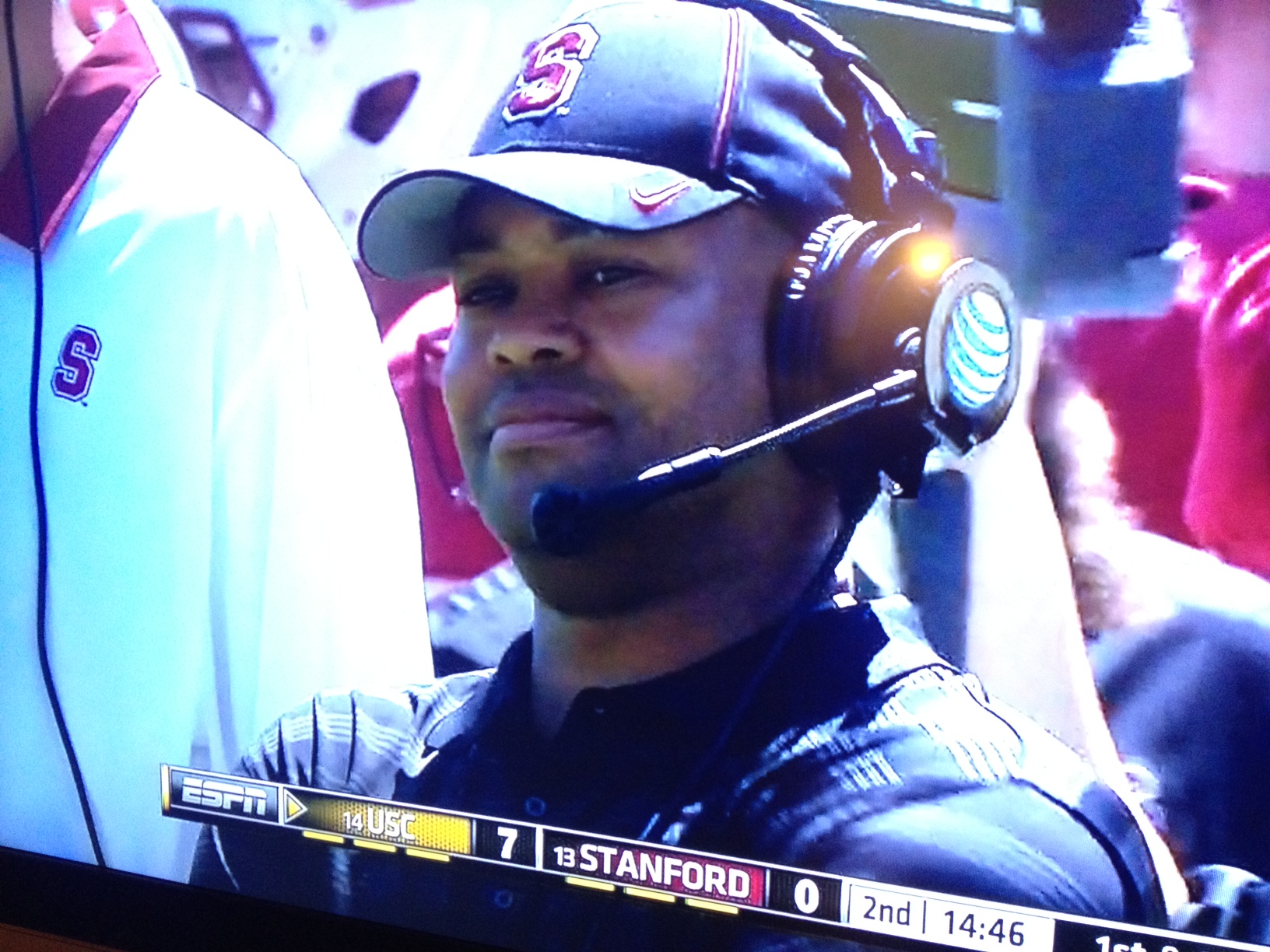 You can be sure that, just below the bottom of the picture, those arms are tightly crossed.
5. Up Next: Army
Army lost its last 5 games of the 2013 season to Temple, Air Force, Western Kentucky, Hawaii, and Navy. On Saturday, Army (1-0) beat Buffalo 47-39, but Buffalo ran up 549 yards of total offense. Buffalo had 16 more first downs than Army and punted only once. Army is about to get demolished. Yes, Stanford only won by 14 last year, but since that game, Stanford has gotten better and Army has gotten worse. And what does Stanford need to improve on this week: scoring touchdowns. Expect the scoreboard to light up—Stanford will score at least 50.
The only uncertainty is if our defense can shut down the Army running game. It won’t affect the outcome of the game, but it would be nice to hold Army to less than the 284 running yards we gave up last year.
6. Up Next Year: UCF
Stanford recently announced a home and home against Central Florida. This is fantastic news. I relish the chance to play football against any team from the southeast, and UCF is a good one, having won the Fiesta Bowl last year. So next year’s home schedule is: UCF, Notre Dame, Cal, Oregon, UCLA, Washington, and Arizona. That has to be the best home schedule in the entire country. The nonconference schedule for the next 10 years includes: Northwestern, Central Florida, Notre Dame, Rice, Virginia, and BYU. And there are absolutely zero FCS games scheduled. As fans, we should be thrilled to enjoy these kinds of matchups. (Check out the schedules here.)
7. The Playoff Picture
Unlike Week 1, Week 2 had many results that clarify the view of the Playoff. Most importantly, the Big 10 has already eliminated itself from the discussion. Michigan St, Michigan, and Ohio State all crashed and burned, the latter two in embarrassing fashion. Nebraska could go undefeated, I suppose, but that seems highly unlikely after it needed a lucky play with multiple broken tackles to avoid overtime at home against McNeese State. Furthermore, Nebraska has not beaten a ranked opponent in almost two years. I suppose if Oregon and Michigan State both run the table, Michigan State would have a strong case, but that is highly unlikely. (Same with Wisconsin and LSU.) After 27 nonconference games in the first two weeks, Big 10 teams have exactly one combined win against teams from the other four power conferences. (Rutgers beat a winless Washington St team by 3 despite being outgained.) That is a nasty combination of bad scheduling and bad playing. It is clear that a 1-loss winner of the Pac-12 will get the nod over any Big 10 team, so despite a steeply uphill road ahead, Stanford still holds a full hand of cards.
To be honest, there are only a few teams outside of the SEC and Pac-12 that look solid enough to have a shot at the top-4 at the end of the season: Florida St, Baylor, and Oklahoma. (Notre Dame has also looked great, but its schedule is too tough.) Personally, I would love to see those three teams lose and have a Playoff made up of two Pac-12 teams and two SEC teams.
8. Around the Pac-12
Big win for Oregon. Lots of tight victories elsewhere. We are still finding out a lot about many teams. Watch out for Utah though, who beat up Fresno State just as thoroughly as USC did. We’ll amplify our Pac-12 discussion in the coming weeks.
9. Overrated Poll of the Week
USA Today Coaches Poll. They need to just get rid of this thing. It is a joke. #19 Virginia Tech beat Ohio State by two touchdowns at Ohio State and they are ranked one place behind Ohio State in the Coaches Poll. The coaches don’t have enough time to pay attention to other people’s games. Someone needs to step in and end this poll. I’m sure the coaches would prefer to use the three and a half minutes they spend on their polls as extra practice time anyways.
10. Transitive Property Application of the Week
9/6 Penn State 21, Akron 3
8/28 Akron 41, Howard 0
9/6 Rutgers 38, Howard 25 (Howard 437 total yards, Rutgers 397)
This coming Saturday, Penn State travels to Rutgers as a three-point favorite. Can you figure out where your money should be on this line? (For further info and contextual hints, in Week 1, Rutgers was outgained by Washington St., and Penn Sate beat a good UCF team. Also, Penn State just had its postseason ban lifted and its fan base is ecstatic. Meanwhile, Rutgers alum Ray Rice is not having the best week.)


Well done on this post — didn’t want to read anything about this game but was glad I read your post. Simply brilliant.
What has Stanford’s net-yard-average gain been, per game, using the wildcat formation the past couple of years? Any way to research this?
Great question. I hope Stanford has its own data on this, though it wouldn’t surprise me if they didn’t. I don’t think the data exists other than what might have been extracted from watching film of all of the games. I don’t have all the tape, nor the time. I would guess the net gain isn’t that bad actually, but it feels like we are starting to see more negative plays from the Wildcat as defenses are more and more prepared for it.