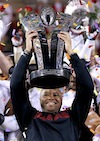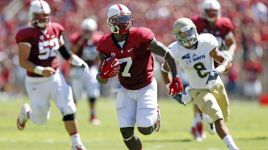
8/30 Stanford 45, UC Davis 0

ty-montgomery-ncaa-football-uc-davis-stanford-268x1501. Perspective

In 2005, UC Davis came to Palo Alto to face a Stanford team that was showing major symptoms of the apocalypse. However, Davis was coming off season-opening losses to New Hampshire and Portland St, so surely the new Stanford coach, Walt Harris, expected to be 2-0 by the end of day. But Stanford fell flat after gaining a 17-0 lead, and UC Davis escaped the Farm with a 20-17 comeback victory. Walt Harris officially replaced Buddy Teevens as my least favorite person on the face of the earth.

David Shaw was not on staff at Stanford that year, and that is a good thing. Last Saturday, he led the Cardinal to a 45-0 victory, and Stanford is dancing once again under the adornments of victory.

In the offseason, it felt somewhat refreshing to reset our expectations a little bit lower. There is always personnel loss, and so we think of uncertainty. We may also think of balance, or the law of large numbers. Surely we can’t maintain such joy and triumph for another season! And then, at first touch, Ty Montgomery takes us on a curving waltz to the end zone. It was such a familiar picture that I could have sworn he was only running at half-speed. It is an image Stanford fans have seen now 17 home games in a row, the longest current home win streak in the country.

2. Offense: In Praise of Ed “Good Hands” McCaffrey’s Offspring

12 Stanford receivers caught passes in this game—the feather is going to be floating this year. Hogan wasn’t perfect, but he never is anyway. He was consistently good, which is what we are starting to expect from him. We won’t know anything about the offensive line and the running game until at least next week. With a weaker running game, red zone offense might be an issue this year. We failed to score any points on two drives inside UC Davis’ 5-yard line. However, we do know we have a slick tight end with great hands: Austin Hooper. Hooper caught four balls for 63 yards including a leaping touchdown grab. He should be a solid red zone target.

The offense blew the game open in the 2nd quarter, scoring touchdowns on the first play of one drive and the second play of the next drive. It didn’t take Christian McCaffrey very long for his reality to catch up to his hype. 122 all-purpose yards and three tackles on special teams means that this true freshman is going to be around the ball all year. But he is also going to be near the heart of the program, since he seems to have that Shayne Skov-like “I bleed football” sort of attitude. Shaw said during a halftime interview, “What I love about [McCaffrey] is that I tried to pull him off of the kickoff team after that long touchdown, but he wouldn’t come out because he loves kickoff.” The leadership and attitude of players like Luck, Skov, and McCaffrey transcend coaching and turbulence and keep the needle of the program pointed due north.

3. Defense: Midfield Is a Wall of Concrete

UC Davis needed its final drive of the game to accumulate over 100 yards of offense and cross midfield for the first time. Ouch. It doesn’t matter so much if our offense scores 45 or 65 in a game like this, but there is a big difference between winning 45-20 and winning 45-0. It was an impressive showing by the defense. A lot of schools dominated FCS opponents last weekend, but the Stanford defense put in the most thorough and consistent performance of any.

UC Davis never tried to throw the ball deep, so this game didn’t provide much of a blueprint for what is coming from USC. We’ll learn a lot about our defense this coming Saturday.

Also, I can’t help but note that former defense coordinator and current Vanderbilt coach, Derek Mason, lost to Temple 37-7 in his debut. It doesn’t mean much, but at least it is safe to assume that Mason didn’t abscond with our defensive mojo.

4. Coaching

The Pac-12 network game commentator noted that Shaw asked his veteran players at the end of summer camp who they are excited about seeing. Apparently, everyone responded, “Christian McCaffrey.” The answer is unsurprising, but it is a wonderful novelty to hear about a coach asking his players for their opinions. This is one of Shaw’s best qualities as a coach: he builds a familial culture of trust and respect.

I am still concerned about two things, however. On fourth down, we still punt and kick field goals too much. In a blowout, I have no issue with Shaw punting inside Davis’ territory. (Stanford punted from UC Davis’ 44, 39, and 35 yard-lines in the second half.) Shaw wants his punt team to get some practice for those late game situations when pinning a team deep might make sense. But in higher scoring games with time on the clock, we will sometimes need to be more aggressive. As football teams continue to absorb—albeit slowly—more math into the realm of strategy, they are realizing that the data is incontrovertibly in favor of going for it on many 4th downs in your opponent’s territory. I am concerned that Shaw remains unaware of these facts. (I’ll discuss these 4th down situations in more detail in a post soon.)

5. Up Next: USC

The Trojans are coming in hot—and fast. USC rolled up 701 yards in a 52-13 win over Fresno State. Steve Sarkisian has brought the up-tempo offense to USC, and Stanford is going to have a harder time getting to the quarterback than it has recently. Stanford’s defensive backs are going to have to win this game. USC is getting the ball to receivers and letting them make moves in space. Great tackling and perhaps and interception or two will go a long way to victory.

6. The Playoff Picture

There were very few results in Week One that will have playoff ramifications, so there is not much to write this week. Perhaps the only clear take-away from the first week is that the SEC is off to another hot start. The SEC won two big games: Georgia over Clemson and LSU over Wisconsin. A glance at the rest of the SEC non-conference schedule reveals that there are not many other stumbling blocks out there. And unfortunately for all college football fans, there is not a single game this season featuring a Pac-12 team against an SEC team. For the SEC to drop in stature, it will have to suffer a series of upsets. Perhaps San Jose State can rock the world and take down Auburn this weekend.

7. Around the Pac-12

The San Jose Mercury titled its article on the Cal-Northwestern game: “Bears barely hold on, but they’ll take it.” Cal will do a lot more than just “take it.” They are going to celebrate this victory like it hasn’t happened in years! Well… 686 days to be precise. Cal beat an FBS football team for the first time in 686 days. This is a good thing for Stanford, and it is good for the Pac-12. We will see if Cal’s defense can hold up, but its offense should put up enough points to win a few games this year.

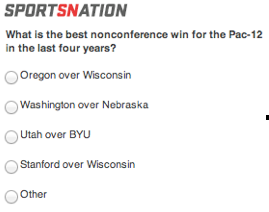
It would have been nice if Washington State could have held on to beat Rutgers, which is now a member of the Big 10. The Pac-12 would benefit from a strong resume against the Big 10 when it comes time for the Playoff selections. Michigan St-Oregon, Michigan-Utah, and Washington-Illinois are still on the table. An Oregon win combined with a Washington win or Utah upset will secure a slight advantage for the Pac-12 in the head-to-head. The Oregon game is huge. As good as the Pac-12 has been in recent years, it has consistently come up short in the biggest games. Over the summer, the ESPN Pac-12 Blog posted the following question:
Screen Shot 2014-09-02 at 3.43.51 PM

What?! For all of Stanford’s and Oregon’s recent success, this is the list to choose from? Indeed. Stanford and Oregon have both failed in the biggest games against the best teams. For the Pac-12 to be in the discussion with the SEC, this has to change, and Oregon absolutely must beat Michigan State this coming Saturday.

8. Overrated Team of the Week

#11 UCLA Bruins (1-0). UCLA only scored one offensive touchdown against a Virginia team that went 2-10 last year and lost its last nine games. UCLA relied on three defensive touchdowns and was outgained by 28 yards. UCLA should not be anywhere near the top-10, and the reasons go deeper than the horrible performance against Virginia. In the three prior seasons, UCLA has zero victories against top-15 teams. UCLA has also lost six consecutive games to Stanford—no way they should be above Stanford in the polls. (They were above Stanford in both preseason polls, but in the Coaches Poll they are now just below Stanford.) Yes, UCLA some returning starters, but they need to earn it on the field, and not in the media spin rooms. And now that UCLA has played a (poor) game, they should be ranked about 15th or 20th—where they deserve to be until they prove otherwise.

On Watch: #7 Ohio State Buckeyes (1-0). Ohio State only outgained Navy by 30 yards in an opening win that was close until the fourth quarter. Furthermore, Ohio State has not beaten a top-10 team since 2006. (Stanford owns six top-10 wins in that time span.) Ohio State also has only one ranked team on its schedule this entire season. It is the softest of soft-serve, and they will be easily passed over by the Playoff committee with one loss. Jon Wilner of the San Jose Mercury has them at #17 in his ballot, and that seems to be about right to me.

10 Great Stanford Football Moments (of the Past 10 Years)

Before we look ahead to 2014, let’s double dip into the cosmic delight of recent Stanford football success. This Top-10 list is compiled from moments that had memorable amounts of any of three criteria: exhilaration, symbolic achievement, or auspicious potential. This is not a list of the ten best games and is not limited to games that Stanford won. Rather, it is a list of plays and moments that wafted the thrilling smell of success and made me proud to be a fan.

There are a few games noticeably absent from this list, including Stanford’s first BCS win in the Orange Bowl at the end of the 2010 season and Coach David Shaw’s first big win of the post-Luck era against USC in 2012. Also in consideration was the Colorado game in 2012, when Kevin Hogan’s first four drives as Stanford’s quarterback resulted in four touchdowns—the Hogan era was underway. Nonetheless, the list captures many of the great coaches and players who have guided Stanford’s recent success.

#10. Sept 25, 2004: JR Lemon Runs Out the Clock…With an 82-Yard Touchdown. There was still hope for Stanford football at this point in 2004. Stanford was 2-0 and about to take a 4-point lead into halftime against #1 USC. With only a few seconds remaining in the 1st half, JR Lemon took a handoff and went up the middle to run out the clock. Miraculously, he broke through for an 82-yard touchdown. This is the only moment on this list from the Teevens-Harris era, and it is fitting that this electric moment came in a game that Stanford lost. Still, it was one of the most exciting plays in Stanford history. USC 31, Stanford 28.

628x471

#9. Sept 25, 2010: Marecic Scores On Two Consecutive Plays. Stanford dominated Notre Dame in South Bend to establish itself as a force in its first year of BCS glory. The highlight of the game was Owen Marecic’s 20-yard pick six in the 4th quarter, which was exactly one play after he scored a touchdown on a 1-yard run. Stanford 37, Notre Dame 14.
https://www.youtube.com/watch?v=D5qCdMFHxms

#8. Oct 2, 2010: Can We Start the National Championship Talk? → The Lead That Vanished. After a Chase Thomas interception, Stepfan Taylor took a handoff on the first play of the drive and scampered 44 yards to put Stanford up 21-3 against #4 Oregon in the 1st quarter. For a few minutes, it seemed that undefeated Stanford might clear its biggest hurdle on its quest for the national championship. Unfortunately, the moment didn’t last—Oregon quickly scored and then recovered an onside kick to begin its onslaught. This is truly the one that got away, as Stanford never lost again the entire season. Oregon 52, Stanford 31.
https://www.youtube.com/watch?v=3x49Tw5dC5U

#7. Nov 20, 2010: Luck Levels Cal. In one of the most dominating Big Game performances in history, Stanford rolled out to a 45-0 lead. It was the fourth time in 2010 that the Stanford defense held a Pac-12 opponent scoreless for three or more quarters. But the highlight went to Andrew Luck, who knocked over Cal safety Sean Cattouse on a 58-yard run. The 2010 team not only won games—it flattened opponents. Stanford 48, Cal 14.
https://www.youtube.com/watch?v=S4_w-puInqY

#6. Oct 29, 2011: Fumble Recovery in the End Zone. Stanford had just won 10 consecutive games by 25 points or more, a new NCAA record. But this USC game was a dogfight that seemed destined to last forever. In the 3rd overtime, Terrence Stevens forced a fumble as Curtis McNeal looked to score, and A.J. Tarpley pounced on the ball to secure the victory. Stanford’s undefeated season was still alive. Stanford 56, USC 48.
https://www.youtube.com/watch?v=zr4KDMuwFNw

#5. Nov 30, 2012: Ed Reynolds’ “Pick Six” to the Rose Bowl. UCLA was driving to take a two score lead in the 2nd quarter, but Ed Reynolds picked off Brett Hundley and returned the ball 80 yards. Officials erroneously ruled him down at the one, but the play bookended one of the best seasons ever by a Stanford safety and helped send Stanford to the Rose Bowl. Stanford 27, UCLA 24.
https://www.youtube.com/watch?v=3_UoTQ3n_UU (play is at 2:30 mark)

#4. Nov 14, 2009: Going For Two in the “What’s Your Deal?” Game. The week before this USC game, Stanford had just beaten #8 Oregon. Confidence had arrived in full force on the Farm, and this game erased the idea that Stanford’s recent success might be ephemeral. The offensive line and Toby Gerhart were unstoppable. In the 4th quarter, after Gerhart scored on a 6-yard run to put Stanford up 48-21, Harbaugh decided to attempt a two-point conversion. Stanford did not convert the attempt, but USC was nonetheless embarrassed, and Stanford officially had swagger. USC’s streak of seven consecutive BCS bowls and west-coast dominance had come to an end. Stanford 55, USC 21.
https://www.youtube.com/watch?v=WeS3VeluAmg

#3. Nov 17, 2012: Redemption for Williamson. In overtime, Stanford kicker Jordan Williamson booted a 37-yard field goal to beat the top-ranked Ducks and give Stanford a clear path to the Rose Bowl. It was a special moment for Williamson, who atoned for the previous season’s Fiesta Bowl meltdown. Stanford 17, Oregon 14.
https://www.youtube.com/watch?v=YiiGUovlyJw

#2. Jan 1, 2013: Amanam Comes Up Roses. Stanford’s defense has prided itself for years on having to make one crucial stop to seal the game. Late in the 4th quarter, with Wisconsin potentially driving for a one-point victory, Usua Amanam intercepted Curt Phillips’ pass to secure Stanford’s first Rose Bowl victory in 41 years. Stanford 20, Wisconsin 14.
https://www.youtube.com/watch?v=jR86liAlcNE

#1. Oct 6, 2007: Bradford Makes “The Catch.” The Biggest Upset Ever. The Rising from the Dead. Stanford was 41-point underdog to a #2 ranked USC team that had won 35 consecutive home games. Stanford had lost 41-3 the week before, and was starting a reserve quarterback, Tavita Pritchard, who had only thrown three passes in his career. But Stanford’s defense forced 5 turnovers to keep the game close. Stanford was down six points with one last chance for a miracle. On 4th and Goal with 49 seconds remaining, Mark Bradford made a leaping catch in the corner of the end zone, and the story of west coast football in the 21st century was forever changed. (While Bradford’s catch provided the victory moment, Pritchard also completed an equally amazing pass to Richard Sherman on 4th and 20, just inches past the first down marker.) In Jim Harbaugh’s first season, Stanford had begun its resurrection. Stanford 24, USC 23.
https://www.youtube.com/watch?v=j48uQSAKC6k

1/1/14 Rose Bowl: Stanford 20, MSU 24

Image

1. Perspective

Stanford scored an offensive touchdown on its first possession. It failed to score another offensive touchdown. It is almost impossible to beat a good football team when your offense goes 56 minutes without scoring a touchdown.

2. The Players

It was an evenly played game. Both defensive lines dominated, and both quarterbacks threw the ball fairly well downfield. (Cook had many more yards but threw twice as many passes as Hogan.) The main difference that stood out to me was a few key plays by defensive backs. Michigan State defender Trae Waynes made a great interception on a pass that was almost caught by Michael Rector. Stanford defensive backs did not make big plays at big times. Stanford defender Wayne Lyons dropped an easy interception and Stanford cornerbacks had two crucial holding penalties. Those were huge plays in this game. (Another turning point was the missed interception by Kevin Anderson. Instead of Stanford having a chance to go up 17-0, Michigan State continued the drive and narrowed the game to 10-7.)

3. The Coaches

MSU coach Mark Dantonio called a good game. After it became clear Stanford was going to shut down the Spartan running game, Michigan State shifted seamlessly into an air attack. During one drive in the middle of the first half, Connor Cook dropped back to pass on seven consecutive plays. In the 3rd quarter, when Stanford had later shifted its personnel to defend the pass, Langford picked up 34 yards on four consecutive carries.

The Stanford coaching staff failed miserably.

(Note: Because I don’t know exactly who called which play, I’m going to just refer to David Shaw when discussing game management and play-calling. Stanford has gone back and forth in stating who actually calls the plays. At one point in the season, it was reported that Mike Bloomgren calls the plays except when Shaw takes over in the Red Zone. But Shaw has also said that set nothing is set in stone and that he regularly takes over all play-calls at any point in the game. And when ESPN showed the Stanford sideline, it always looked like he was making the call.)

4th and 1 with the Rose Bowl on the line, and out comes the elephant package. My heart sank. Unless a trick play was about to happen, the game was over once that play was called. After the game, Tyler Gaffney said, “You have to give it to Michigan State for stuffing that because everybody in the building knew exactly what was coming—a run was coming up the middle—and it was a test of wills, and they got the better of us.” That is one perspective, and it is the mature and noble thing to do to give credit to Michigan State. Their defensive line was awesome. But reading between the lines reveals a sad truth—Michigan State knew what play Stanford was going to run. In most Stanford games, there isn’t a need for deception or timely coaching. Stanford can often completely stop thinking and just win the battle at the line of scrimmage. But the offensive line was not going to win this battle. In my opinion, the Michigan State defensive line had already won the battle by the end of the 2nd quarter. It is objective fact—as I’ll explain below—that the Spartans had won it decisively by the end of the 3rd quarter. Everyone in that stadium knew it. Everyone watching at home knew it. My girlfriend, Vicki, who is not a football fan, knew it—“It’s like they’re just wasting downs,” she said. David Shaw didn’t know it. Or he refused to believe it. The play-calling in the 2nd half reminded me of a stubborn father forcing a son to do something again and again, even though the child is obviously struggling. It reminded me of the kind of drills a team might do in practice, when the offensive line isn’t meeting an expectation. Repeat. Repeat. Let’s get it right. Try it again. Repeat… But this wasn’t practice. It was the Rose Bowl, and Shaw isn’t getting paid millions to act this way in the Rose Bowl. The goal is to win the game. And Shaw utterly failed at managing the game.

Let’s explore the facts that show why Stanford should have abandoned the running game in the 2nd half. Gaffney had a couple nice runs on the opening drive. After the first drive, there were only two successful Gaffney running plays: 47-yard gain and a surprise run up the middle on 3rd and 12 that went for 9 yards. (I actually don’t mind the call to run on 3rd and 12, since it is one of the few times that Shaw was unpredictable.) Ignoring the first drive of the game, and the 47-yard gain also in the 1st quarter, Gaffney gained 22 yards on 22 carries. Get out those calculators, this one comes out to: 1 yard/carry.

The low point came in a third quarter drive when the futility of running the ball was starting to be very apparent. During one stretch from the 1st to 3rd quarters, excluding the surprise 3rd down run for 9 yards, Gaffney gained minus 2 yards on 10 carries. The last of these 10 carries came on a crucial 4th and 3 play in Michigan State territory. At that point, it was objectively clear—minus two yards on the last ten carries—that predictable runs up the middle were not working. Here is some more perspective for just how dramatically unsuccessful the running game was at that point: coming into the Rose Bowl, Tyler Gaffney had been tackled behind the line of scrimmage 16 times in 13 games. That is an average of 1.23 times per game. With 4:10 remaining in the 3rd quarter, Gaffney had already been tackled for a loss six times.

At that point, with 19 minutes remaining in the game, Stanford’s primary identity was obliterated. Adapt, or die. Stanford would have to ride Hogan’s arm to victory.

Instead, on its next possession, Stanford handed the ball off to Gaffney on three consecutive plays, and promptly punted. Still in the 3rd quarter, Gaffney had now been tackled for a loss seven times. OK, so now we’re getting the idea. Let’s get Cajuste on the loose again. Inconceivably, on the following possession, Gaffney ran up the middle on 1st and 2nd down, bookending a streak of six consecutive (unsuccessful) Gaffney runs up the middle.

In the fourth quarter, Hogan only threw three passes, and Gaffney received six carries. Just unfathomable stuff. Stanford would have had a better chance to win if the Stanford coaches would have been removed from the sideline and replaced by a random fan who simply told Hogan, “You got this… just call whatever passing play feels right. If they ever drop into deep zone coverage, use your legs.”

Let’s look at three other coaching errors, two of them critical.

Timeouts. Shaw needs to be able to make a call on fourth down without taking a timeout. Stanford burned timeouts it could have used at the end of the game to get one last possession, even after the failure on 4th and 1. (I’d cut Shaw some slack if Stanford emerged from those timeouts in a creative formation for a novel play.) Those wasted timeouts really hurt Stanford, since its defense had the momentum to make another stop.

Deep in Your Own Territory. At some point coaches like Shaw should learn that being stuck inside your own ten yard line is a great opportunity to take a shot downfield. The one time Stanford did throw deep from inside its own ten, Hogan completed a 51-yard pass to Cajuste. Defensive coaches like to load the box, both expecting a run and trying for a safety. Receivers have a great chance to beat single coverage for a big gain. But offenses seem to worry too much about taking safeties and getting room for their punters. Stanford was excessively conservative in these situations.

Field Goals Instead of Touchdowns. Shaw, like most coaches, attempts too many field goals. But because Stanford has a good kicker and a great defense, Stanford should attempt more field goals than the average team. Still, there are certain situations when it kicking a field goal is undeniably the wrong decision. In the 4th quarter, down by 7 points, with only 4:15 remaining in the game, Stanford faced a 4th and 5 from the MSU 17 yard line. Let’s analyze some statistics related to the decision of kicking versus going for it. First of all, let’s completely ignore the game situation (down 7 points late) and just compare expected outcomes. Here’s the stats we’ll use: 

  • Stanford kicker Jordan Williamson is 22/27 (81%) on kicks of 30-39 yards for his career.
  • In 2013, Stanford was 25/54 on third down conversions from 4-6 yards. That is 46% conversion rate. (There isn’t enough data for 4th down, and 3rd down situations translate well to 4th down.)
  • In Stanford’s 51 trips (prior to the drive) into the red zone in 2013, Stanford has scored an average of 5.06 points per possession.

Let’s assume that if Stanford picks up the first down, then it translates into an average red zone scoring situation. (It might be slightly better than average because Stanford would have been inside the 12 yard-line, but slightly worse than average because of Michigan State’s defense—MSU’s defense allowed 4.27 points per red zone possession in 2013.) So, the expected points going for it = (chance of converting on 4th) * (points per red zone possession) = .46 * 5.06 = 2.33 points.  The expected points from field goal attempt =  (FG %) * 3 = .81 * 3 = 2.43 points.

The expected value from the field goal attempt is higher—primarily because Williamson is an above-average kicker—but it is only slightly higher. When you are losing by 7 points late in the fourth quarter, you need a touchdown! It is unquestionable that you increase your chances of winning by going for it. (I’m not going to do the math on this now.)

Shaw sent in the field goal team. But wait! It was a fake field goal! “Brilliant! Brilliant!” I yelled maniacally, as the holder rolled out and completed the pass. I haven’t seen us attempt a fake field goal in years! Oh, so brilliant! “Yes, Shaw! Yes, Shaw!” I screamed. Unfortunately, the play came back on a penalty. And then I saw the replay—it was a mishandled snap. Ahhh… of course.

Shaw is a brilliant coach and should prepare, nurture, and lead Stanford’s football team for many years. But in my mind, he needs to turn the over the in-game management duties to someone who is more capable.

4. The Pac-12 Bowl Season

ImageThe Pac-12 went 6-3 in bowl games. Was it a successful bowl season? Expectations were high for the conference, as Pac-12 teams were favored in all nine games. But it seemed like expectations were a bit too high. On Dec 16th, the ESPN Pac-12 blog (above graphic) showed that of 6,735 voters, 85% of them expected the Pac-12 to win at least 7 games. These numbers are biased because readers of the Pac-12 blog are likely to be hopeful and loyal fans of the conference, but the survey results still showed a very inflated sense of confidence. In my previous blog post, I also let my bias skew my thinking and wrote that I expected the conference to win 7 or more games. However, Pac-12 blogger Ted Miller correctly predicted the tipping point for a successful bowl season at 6-3. We can back up his intuitive expectation using the mathematics of expected outcomes. To determine what the expected results were, we need to translate the spread (line) to a percent chance of winning. People use different data to determine this, and I estimated my numbers using a few different sites. Here’s one. My numbers are actually slightly on the high side of these estimates. In other words, while I estimated Oregon’s chance of beating Texas at .85, most estimates would probably fall in the .80-.85 range. So, if anything, my numbers are slightly inflated towards Pac-12 success. The results, however, show a tempered reality. Despite being favored in all 9 games, the Pac-12 was more likely to win six or fewer games.
The first step towards determining the expected outcome involves getting an average winning percentage for the 9 games. Then, it is just a matter of calculating the various combinations. (The win percentages are in chronological order of the bowl games: WSU = .64 , etc…)

Chance of winning any one game =  (.64 + .67 + .58 + .58 + .85 + .85 +.70 +.70 +.61) / 9 = .68666… or (103/150)

9 Wins:  9C9 • (103/150)9                           = .0339

8 Wins:  9C8 • (103/150)8 • (47/150)1  = .1394

7 Wins:  9C7 • (103/150)7 • (47/150)2  = .2544

By adding up the chances for 7, 8, and 9 wins, we see that there is only a .4277, or 42.77%, chance that Pac-12 teams would win 7 or more bowl games. Clearly, my assertion that I would “take the over on 6.5 wins” was a bad bet. 6 wins turns out to be the most expected outcome, just slightly more likely than 7 wins. (The probabilities drop dramatically after 6 wins.)

6 Wins:  9C6 • (103/150)6 • (47/150)3  = .2709

So, it is fair to say that the Pac-12 met its expectations for the bowl season. In fact, one could still claim it exceeded them, considering that the margin of victory in all six wins was 15+ points. Plus, Washington State should have… I mean… well… it really punched itself in the groin. If Mike Leach could—or was willing—to do some simple math and have his team take a knee in the final two minutes, then the Pac-12 would have notched an impressive seven victories.

12/7 Pac-12 Champ: Stanford 38, ASU 14

Image

1. Pounding the Rock 

It goes without saying that dominating the line of scrimmage is the key to any Stanford victory. But opening up the passing game can certainly help Stanford stretch a slowly developing game into a sizable lead. Fortunately, Hogan hung strings of pearls over the ASU secondary and was 4 for 5 on passing attempts of 25 or more yards. Hogan completed two to Cajuste (Cajuste is loose!), one to Pratt, one touchdown pass to Montgomery, and had one incompletion to Owusu. In fact, after one of the completions, ESPN put up a graphic that noted that Kevin Hogan is third among AQ-conference quarterbacks in completion percentage on throws of 25 yards or more. And still, last night, as ESPN analysts were breaking down the Rose Bowl matchup, Jesse Palmer and David Pollack were discussing Hogan’s difficulty throwing the ball downfield. Hogan’s arm is not an issue—it is an asset. The variability in our downfield passing game comes primarily from our play calling, not from the play of Kevin Hogan.  In fact, with two years of eligibility remaining, Hogan has a chance to establish a legacy right up there with Plunkett, Elway, and Luck. Sounds crazy, but his cards are still on the table, so we’ll have to wait and see.

I also loved seeing Hogan run the read option and keep the ball on a run on 3rd and 7. Hogan has continued to be shifty with his legs. But the best set of legs for the 2013 season is obviously those of Tyler Gaffney. Gaffney had another great game, running for 133 yards and 3 touchdowns before being rested in the fourth quarter. He is having one of the best seasons in Stanford football history. And his success creates success in other plays. The sweep handoff to Montgomery has been so successful all year (22 yd TD run in this game) precisely because the defense has to respect the fake handoff to Gaffney.

Finally, I would be remiss to not mention the offensive line. Congrats to the big men for protecting the rock and opening up the pasture for Gaffney and others. They are the essence of Stanford football.

2. Zach Hoffpauir and The Party in the Backfield

After the game, Arizona State coach Todd Graham said, “[Stanford] destroyed the line of scrimmage.” It does not matter what your game plan is if you cannot keep things stable around the line of scrimmage.  Tackling was a bit of an issue early, as D.J. Foster broke through for two big plays. On the screen pass to Foster, Ed Reynolds took a bad line to the ball and cut off Skov’s pursuit. (Ed has lost the right to have this section of the blog named after him but remains a personal favorite.) But eventually the dominant defense took over.

Strangely enough, the blown call on the fumble recovery by Stanford in the third quarter ended Stanford’s streak of 37 consecutive games forcing a turnover. The announcers never really addressed the issue. It certainly looked like Mauro was on top of the football. It ended up not mattering thanks to a gritty goal-line stand by Skov (3rd down tackle) and #10 Zach Hoffpauir (4th down tackle), who apparently wasn’t supposed to be in on that play. Stanford is about to lose a lot of talent on defense, but it looks like there are guys like Hoffpauir waiting in the wings.

3. Math of David: Numbers and Coaching

Shaw mismanaged the clock at the end of the first half, and all year has made some questionable play-calls. But you can’t deny the fact that Shaw (and the team) has continued to come up big in big games. Shaw took chances downfield, and added some new wrinkles as well. On one play in the wildcat formation, Gaffney was supposed to throw to a wide-open Hewitt, but decided against it (or did not see him). Still, it was a new play that would have worked. The coaches also eventually adjusted to the blitz that ASU starting sending almost every play after it was down 28-7. They worked in some screen passes, including a 34-yard gain to Rector in the 3rd quarter. They should have gone to the screen faster, but at least they got it worked out eventually.

I’ve been critical of Shaw all year. I’ve been asking for three things:

  1. More running plays on third down.
  2. More play-action passing downfield.
  3. More aggression on fourth down (and less punting and FG attempts).

Shaw came up big in all three phases in this game: we ran the ball on 3rd and 7, we took 5 shots downfield, and we went for it on 4th and goal from the 1 yard line in the 2nd quarter. The fourth down play really made me proud to be a fan. The expected value definitely favors the run, but so does the entire image of our football team. One yard needed? Anytime. Any place.

Shaw has exceeded expectations. He has successfully navigated offensive transitions, from replacing a star quarterback to incorporating a new set of options at receiver. It took a couple of months of games after losing Andrew Luck, but nowadays I don’t find myself feeling too much nostalgia as I watch our offense. In 2012, Stanford completed 93 passes to tight ends and came into the 2013 season having lost its top 5 receivers (in terms of yardage). Shaw and the coaching staff have reworked our offensive play-calling and helped develop a very solid core of receivers, and every one of them is coming back next year.

Shaw deserves a high grade for another successful season. I think its time to finally stop (sarcastically) calling him Walt Harris when I disagree with one of his play-calls.

4. Playing for a National Championship

It is disappointing that Stanford hasn’t gotten a crack at the national title in these past four seasons.  Going into the bowls, Stanford is the only team in the country to win 11 games or more in each of the past four seasons. It is an unbelievable statistic, and cements Stanford’s place among the elite programs. But Stanford never managed to sprinkle enough luck into one perfect season. The BCS system doesn’t have any room for consistent greatness—its doors only open to teams without blemishes, or those that benefit from name and perception.

We needed that USC game, though even if we finished 12-1, I’m not sure that it would have mattered. The SEC bias would have carried Auburn into the title game, despite Auburn’s lucky finishes and Stanford’s dominance of their common opponent (Washington State). So, at least the four-team playoff will increases the chance that a Stanford team gets a chance at the title, assuming the committee factors in the difficulty of the Pac-12’s 9-game conference schedule. We’ll have to wait and hope that this amazing run of Stanford football seasons continues and that—just once—we actually get a chance to win it all.

5. The College Football Playoff

During ESPN’s Bowl Selection Show last night, Reece Davis, Lou Holtz, Jesse Palmer, David Pollack and Mark May all took turns sharing their mock brackets if the four team playoff were to start this year. None of the brackets included Stanford (and only Reece Davis included Stanford on his list of “First 2 Out.”) And there wasn’t really any discussion about whether or not there should be any discussion about Stanford. It bothered me. (At least the folks behind the screen at ESPN are working to establish objective metrics, and Stanford had the best season in the country according to one metric: http://espn.go.com/college-football/statistics/teamratings) A 3rd grader can watch some football games, look at win-loss records, and tell you which team is better. That is essentially what the analysts did. A college football analyst—and certainly the playoff selection committee—needs to go well beyond win-loss records and “eye tests.”

Below, we will look at the blind resumes of four conference champions for the 2013 season. None of these teams are in the top-3 of the BCS Standings—Alabama, Florida St, and Auburn would probably be “locks” for the playoff.

Team

Record

Number of Wins Against Current BCS top-30

Number of Wins Against Bowl Eligible Teams

Average BCS Rank of Opponent in Losses

Average Margin of Defeat in Losses

A

11-1

1

4

9

3.0

B

12-1

1

5

26

4.0

C

11-1

2

6

13

32.0

D

11-2

6

10

40

4.5

First, let’s note that the best team of these four would be obvious were it not for the second loss for Team D. It is clear that Team D played a much harder schedule: 6 wins against the top-30 teams is an extremely rare achievement. So, we must now judge how that second loss weighs against the strength of its victories and schedule. Before we do this, let’s just take note of the losses. Two facts jump out: Team C was blown out in its loss, and team D lost to mediocre opponents. Team B lost to a mediocre opponent as well, so the only reason Team A is still in this discussion is really because of the quality of its loss. But perhaps the most appalling fact about quality of losses is Team C’s 32-point defeat. In my opinion, that is too lopsided for its resume to hold up against other good teams, and I would eliminate Team C (Baylor). Since it remains to be seen how the committee will regard blowout losses, we’ll leave them in the discussion for now.

Now let’s try to quantify how an extra loss for Team D balances out with the five more top-30 wins that it has over Team A and B. One objective way a committee could do this is to compare the winning percentages of the teams when they do play top-30 opponents. Does having to play five more games against the top-30 justify an extra loss? In other words, if TEAM D went 4-1 (.800 win percentage) in those five more games against top-30 opponents, would that be much better than we might expect from those other teams? As we’ll see below, the clear answer is: yes.

Here are the records against BCS top-30 opponents: Team A (1-1), Team B (1-1), Baylor (3-1). Well, there isn’t much data to go on, but the winning percentages of Teams A and B are .500, compared to Team D’s .800 winning percentage in those games. It is reasonable to assume Team A and Team B would not go 4-1 in five games against the top-30, but we really need more data. If we use Jeff Sagarin’s rankings—this is merely to use more readily available data—to look at records versus the top-30, we see that there are only three FBS teams with a winning percentage above .667 (minimum of two games played): Auburn, Oklahoma, and Team D. That is three teams, out of 120+ FBS teams. It is clear that Team D’s extra loss is probably offset (and maybe considerably offset), by its extra quality wins. Exactly how a committee might quantitatively compare these numbers is beyond the amount of time I’m going to spend thinking about this right now, but it is safe to make one clear assumption: if Team A or B had interchanged five of its sub-30 opponents for five top-30 opponents, there is an extremely small (<10%) chance that either team would still have only one loss.  It seems that in this case, at the very least, Team D (Stanford) is deserving of equal footing in the discussion for the fourth playoff team.

Now that we’ve accounted for the fact that Stanford’s second loss is outweighed by its quality victories, we must consider its two losses to mediocre teams. This is an entirely different discussion, which the committee really needs to be transparent about. The only thing I will say for now is that if there is such a huge difference between losing to top-40 teams versus a top-10 team (and we are therefore going to eliminate Stanford), then we should probably also eliminate Team B (Michigan State), which doesn’t have the same quality loss as Team A.

So, if Stanford doesn’t deserve to be the fourth team in the playoff, then let’s wish Team A (Central Florida) good luck in the semifinal against Florida St. Yep, UCF.

Of course, we ignored the overall strength of schedule, which is why Central Florida really had no shot. I merely wanted to show that there are too many variables in play to ever have a fair system.  And it is confounded by the fact that there are no (and probably will never be) any transparent and quantitative evaluative methods that will be used to note, for example, how one extra loss compares to a more difficult schedule. If the committee tried to do some math, I’d feel much better about the system, but even some light math won’t solve this problem.

5. The 8 Team Playoff

The solution to the impossibility of selecting the four best teams is simple: each (AQ) conference champion should be guaranteed a playoff spot. All it requires is four more football games (total!—not for any one team). The top 5 conferences (Pac-12, SEC, ACC, Big 12, Big 10) send their conference champion to the playoff. The highest ranked non-AQ team gets an automatic bid. A committee gathers to select two at-large teams and seed the bracket.

The four quarterfinal games are still called the Rose Bowl, the Orange Bowl, the Fiesta Bowl, and the Sugar Bowl, and the committee will still try (without completely disrupting the integrity of seeding) to design the matchups in a way that preserves the historical connections the bowls have with conference champions.  (All of the other bowl games remain unchanged.) The national semifinal and the championship game are played at rotating sites.

Here is this year’s 8 Team Playoff Bracket:

*Note: The AAC will not receive automatic bids starting next year, so UCF would take the non-AQ spot.

Orange Bowl: 1. Florida St (12-0, ACC Champ)   vs  8. UCF (11-1, non-AQ Champ)

Sugar Bowl:    2. Auburn (12-1, SEC Champ)       vs   7. Ohio State (12-1, at-large)

Fiesta Bowl:    3. Alabama (11-1, at-large)            vs  6. Baylor (11-1, Big12 Champ)

Rose Bowl:     4. Stanford (11-2, Pac12 Champ)  vs  5. Michigan St (12-1,Big10 Champ)

1st Team Left Out: Missouri. The committee will overlook losses caused by having to play an extra game in a conference championship game. Unfortunately for Missouri, Ohio State gets the last spot for that very reason.

I wish that money was not part of the equation, but since it is, let’s consider the financial impact on the bowls. It is indisputable that making these bowl games national quarterfinals actually makes them more meaningful and will generate even more money for the bowl games. Each game is a part of something larger than itself, and much more immune to having the random insignificance of Baylor vs UCF. Imagine this: there will never be an insignificant Fiesta Bowl match-up ever again! Everyone wins—the networks, the bowls, the fans, the schools, the NCAA—and everyone has a chance to earn it on the field… (Except the smaller conferences, of course. The committee would have to be reasonably ammenable to selecting undefeated non-AQ teams.)

6. Stanford vs the SEC

Did you hear those beautiful and sweet whispers last week?… Could Stanford face Alabama in the Rose Bowl? If Ohio State dominated Michigan State such that the Spartans dropped out of the top-14 of the BCS Rankings, we would have seen Stanford versus Alabama in the Rose Bowl. I am incapable of seeing this objectively, but I think it is reasonable to say that this game would be one of the most anticipated college football games of my lifetime. The entire country would be tuning in to see the West Coast against the South, the best team from the Pac-12 for the past four years against the best team from the SEC for the past four years. Old-school, pro-style offenses and smash-mouth defenses. A rematch of the 1935 Rose Bowl. After Oregon’s failure to perform against the best of the SEC, this would be the Pac-12 next chance.

Unfortunately, we are left with what might have been. We have no way of knowing if any of the past four years of Stanford football teams could have beaten the best of the SEC. In fact, the disconnect goes back much further than four years. Stanford hasn’t played an SEC team since it beat Georgia, 25-22, in the 1978 Bluebonnet Bowl in the Astrodome. 35 years! But it gets worse… I looked through every Stanford season in its history and noticed something even more stunning (besides the fact that it used to play the Olympic Club)—Stanford has never played a regular season game against the SEC.

As far as I can tell, Stanford is still looking for its third nonconference opponent for 2014. Do you think there is any way that Stanford’s athletic director, Bernard Muir, can call up Ole Miss and talk them into scrapping their 2014 game against Presbyterian and replacing it with Stanford?

Seriously, it won’t happen next year, but please email Bernard Muir and request that he contact every athletic director in the SEC: athleticdirector@stanford.edu .

6. Around the Pac-12

The Pac-12 bowl matchups look pretty good in terms of ensuring a decent bowl record for the conference, but they also look fairly dull and include no games against the SEC. There are zero games in which the Pac-12 gets a chance to pull a big upset. Pac-12 teams are favored in eight of their nine games. I think the hardest games for conference teams to win are going to be the games against the Mountain West. If Pac-12 teams can get by Fresno State and Boise State and avoid suspensions from snowball fights (http://espn.go.com/college-football/story/_/id/10108429/oregon-ducks-football-players-face-discipline-organizing-participating-snowball-fight), we should come close to 9-0. I’d certainly take the over on 6.5 conference wins.

11/30 Stanford 27, Notre Dame 20

Image

1. Streaks

This week got busy for me. I didn’t get a chance to rewatch the game on television, so this week’s blog is destined to be lost in the ether between the huge Big Game victory and the huger Pac-12 Championship game. Next week we’ll have a long recap of the Pac-12 Championship game, solve the future playoff puzzle, discuss bowl matchups, and look at bias around the country.

Stanford continued some valued streaks with its win against Notre Dame. Most importantly, Stanford has now won 16 consecutive home games. What a luxury it is these days to show up for games on the Farm. The other significant streak continued thanks to Wayne Lyons, who had two game-saving interceptions in the fourth quarter.  Stanford has now forced a turnover in 37 consecutive games. And one more streak for good measure: Stanford is 9-0 in its last nine games against opponents ranked in the AP top-25.

2. Up Next: Arizona St.

Unfortunately, Arizona St. has a streak going right now as well: 8 consecutive home wins. Kevin Hogan and the offensive play-calling are the tickets to victory. We need to attempt (and complete) some balls downfield. After tossing champagne glasses over the Cal secondary two weeks ago, Hogan did not throw a single ball further than 25 yards downfield against Notre Dame. We will need to hit the play-action pass to Montgomery or Rector. I think we’ll see it tomorrow on our first possession.

Go Card.

11/23 Stanford 63, Cal 13

Image

1. Perspective

That was the longest first half I’ve ever experienced. Midway through the first quarter, the game was on pace to last 6+ hours and Stanford was on pace for 158 points.  (Or 157.5 points according to newly-exposed math genius Karl Lindgren-Streicher, who sits behind me with his calculabrain.) I could have watched that first quarter play out for the rest of my life and been mostly content. Of course, then I would have missed seeing our 12th string receivers make some amazing plays in the second half.

It is satisfying to win a rivalry game by 50 points. Also satisfying was our tailgate’s Fred’s steak on baguette sandwiches with horseradish sauce. The first bite hinted at the best sandwich I have ever had. During the boorish moments when Cal was inadequately trying to operate basic football functions such as tackling and punting, I ran back in time and remembered only one sandwich—at a tiny, old deli on the Amalfi Coast—that could rival the juicy perfection of a Stanford tailgate with Fred’s steak. Props to Kevin Stevens for the 17:13 (first side : second side) ratio and some Hogan-like execution behind the grill.

2. The Rock Floats Again

I spent some of the tailgate discussing a statistic that I had read earlier that morning on espn.com. Coming into the game, Kevin Hogan was completing more than 48% of his passes of 25 yards or more. This is an exceptional percentage for long throws, especially considering Montgomery has dropped at least two perfect passes. Hogan has gotten really accurate at throwing downfield, and for the second time this year, we saw him lead an explosive passing attack. Montgomery put up 5 first half touchdowns to make up for his miscues in the USC game. The last one was a sweet fade route into the corner of the end zone with time winding down. More importantly, we saw many different receivers catch big time 3rd and 4th down passes, including Jordan Pratt, Jeff Trojan (best hands on the team?), and Francis Owusu. Stanford is deep at receiver, and will be for many years to come. Now if Shaw can be more consistent and more aggressive calling for play-action downfield passing plays, we are going to look more like we did when Andrew Luck was still here.

3. Cal has a 44% Graduation Rate for Football Players

On the first play of the 2nd quarter, on 2nd and 8 from Stanford’s own 28, Hogan threw a quick screen to Ty Montgomery, who dropped a perfect pass. The Cal defender decided this would be a good time to get in Montgomery’s grill and talk smack. He let Montgomery have it…. despite the fact that Montgomery had scored two touchdowns in one quarter, and despite the fact that Stanford was winning 21-10. Not smart at all. The Cal defender’s moment didn’t last for long. On the very next play, Hogan threw another screen pass to Montgomery, who went right by the defender for a 72-yard touchdown.

4. Stanford’s BCS Chances

Well, last week I wasted a couple of hours researching Stanford’s non-Rose routes into the BCS bowl picture. I should have just had faith in the Arizona Wildcats, who dominated Oregon 42-16. Actually, I should have just had faith in karma after a couple Duck players said, in effect, that the Rose Bowl was already old hat for them. Home field has been huge this year in the Pac-12. ASU is undefeated at home this year. Stanford has won its last 15 home games. The Arizona vs ASU matchup is a big deal for the Rose Bowl since it determines the host team for next week’s Stanford vs ASU game. After the Stanford game finishes, remember to put on your Ka’Deem Carey fan caps.

5. Up Next: Notre Dame

I love that we play Notre Dame every year. And though this game does not matter for the Rose Bowl, it matters a lot. It matters because of what happened last year in South Bend. And it matters if Stanford is going to finish in the top-7 in the final AP rankings for a fourth consecutive year. If it does that, it will be the only team to do so. (Only Alabama can say it has had a better four season run, with its 2 or 3 national championships easily outweighing its meager 10th place finish in 2010.) Think about that… Stanford has a chance to claim its place as the second best team in college football for the past four seasons. That, my friends, is a lot to play for.

11/16 Stanford 17, USC 20

Image

1. The Achilles Heal of Stanford Football: Red Zone Play-Calling

Stanford lost a football game to a team from the state of California for the first time since 2009. Unfortunately, the streak didn’t come to an end last Saturday at the Coliseum because Stanford was outplayed. Stanford gave the game away. A couple mistakes certainly didn’t help, but the blame must once again go to poor play-calling.

First, let’s look at the mistakes by the players. The two biggest mistakes were Ty Montgomery’s dropped pass on the first possession and Kevin Hogan’s poor attempt at throwing the ball away which led to USC’s winning field goal. I don’t expect many people to agree, but I think the dropped pass was the bigger mistake. It should have gone for 7 points, and would have set the tone decidedly in Stanford’s favor. Instead, USC played with fire and intensity and the crowd was a major factor early.  With the Hogan interception, he should never have been put in that situation. He had just completed a pass to get to 2nd and 2, and Stanford should also have wanted to run clock. If you are in 4 down territory, then maybe you take a shot on 2nd and 2 knowing you have two running plays in your back pocket. But Stanford was not in 4 down territory, and should have run the ball.

While Hogan will take heat for that mistake, Hogan played a decent game. He also made the best call of the night early in the 3rd quarter. It was 3rd and 8 from USC’s 18 yard line. Hogan saw the safeties spread wide and checked down for Gaffney up the middle. Stanford picked up each block and Gaffney scored the touchdown to tie the score. 3rd and 8, and we went up the gut. At that moment, I thought we had the running game and the play-calling in place. We were going to grind our way to victory. When USC fumbled on the next possession, things were looking rosy for Stanford. But then Shaw’s play-calling took another fateful turn towards disaster.

It is important to know that David Shaw only calls the plays in the red zone. Mike Bloomgren calls the rest of the plays. So we have Shaw to blame for failing to run the ball on that next possession after the fumble. On 3rd and 3 at the USC 12 yard line, a Hogan pass was incomplete. On 4th down, Ukropina’s field goal was blocked and the score remained 17-17.

Two drives later, with the score tied 17-17, Stanford used a mix of short passes and Gaffney runs (Bloomgren’s play calls) to get to 1st and goal on the USC 6. On its first play of the drive from the red zone, Shaw, out of nowhere, called for the wildcat formation. The wildcat has worked sometimes with Kelsey Young in motion, but the wildcat always carries an inherent risk: negative yards. It is so obvious what is coming (especially since Young was not actually in motion on this play) that the defense can aggressively pound the line of scrimmage. Gaffney lost four yards, and now Stanford was out of position to run the ball into the end zone. (Note: Stanford is so bad at passing in the red zone, that I still think it should highly consider the run, even on 2nd or 3rd and goal from the 10 yard line.) To throw salt on the wound, on third down, Shaw called for a slant to Montgomery. On its own, this is not necessarily a horrible call. But Shaw had already tried this play in the exact same situation, at the end of the first half, and it failed miserably. So, it should come as no surprise to hear USC’s Dion Bailey explain after the game that he knew what play was coming. Because he recognized the play, he completely ignored his receiver and just waited in position to intercept the ball. Failure by Shaw, not Hogan. Hogan actually ran Bailey down and forced him to cut back and get tackled, which was a huge play.

I am fine with Shaw coaching Stanford for many years. But he needs a true offensive coordinator to call plays.  His brain is does not process information properly to play-call a football game. It is not adept at picking up patterns and subtleties and making quick decisions under pressure. He also has made mistakes with numbers and two-point conversion decisions, and has poorly managed the clock and time-outs.

It was a heartbreaking loss. Stanford outrushed USC 210 to 23 and the stout Stanford defense kept USC out of the red zone for the last 39 minutes of the game. Stanford should not have lost that game.

2. Stanford’s BCS Chances

Stanford needs help. It will not be chosen as an at-large team unless a BCS bowl is forced to do so. Basically, Stanford needs no big upsets among the top-4 teams, and it needs the top teams in the PAC-12 and SEC to continue to win and clog the top-14 of the BCS Standings. If the SEC can keep five or six teams in the top-14, then Stanford has a chance. Stanford is hoping for the fewest eligible qualifiers among the ACC, the Big 10, the Big 12, and the non-AQ conferences. (I am going to assume that Oregon wins out, since that is what Oregon does. I am also going to assume Ohio State wins out, since the Big 10 competition is horrible.) Here is the situation with other possible BCS at-large situations and teams:

  1. ACC. The ACC is virtually assured to get two teams. Clemson might lose to South Carolina, but they will still be ranked in the top-14. So the only way to limit the number of eligible ACC teams is if Citadel can knock off Clemson this weekend. Go Citadel.
  2. Big-10. Assuming Ohio State wins out, there is a chance that they will be the only Big-10 team that will be qualified. There are two games this weekend that would go a long way to that end. Stanford fans should be rooting hard for Wisconsin to lose at Minnesota and Michigan St to lose at Northwestern. Wisconsin losing is the most important game this weekend for Stanford, as it faces no challenge after this weekend and could easily sneak into the top-14.
  3. Big 12. Assuming Baylor wins out, there is a chance only one Big-12 school would be qualified. The simplest scenario is if Baylor dominates Oklahoma State this weekend and OSU falls dramatically in the polls. If OSU finishes 10-2, it might not be in the top-14.  But it would be close. It would be better if Kansas St also beat Oklahoma this weekend, and then Stanford fans could root for Oklahoma to knock off Oklahoma State to end the year. That would guarantee the Big-12 only has one eligible team.
  4. non-AQ. Stanford needs Fresno State and Northern Illinois to each lose a game. The best chance for Northern Illinois to lose is this Wednesday when they play at Toledo. Toledo is a solid team and certainly has a chance to win. Fresno State has played a ridiculously easy schedule that was made easier by not having to play at Colorado due to flooding in September. The best chance for Fresno State to lose is the Mountain West Championship Game, most likely against Boise State.

For now, we can probably assume that Stanford can afford for the ACC and one other at-large team from the above four groups to be in the top-14 of the Final BCS Standings.  We’ll look at things more closely next week. What your television remotes and cheering lungs need to know for this weekend is that you should root for (in order of importance):

  1. Citadel over Clemson!
  2. Minnesota over Wisconsin
  3. Toledo over Northern Illinois
  4. Northwestern over Michigan St
  5. Baylor big over Oklahoma St
  6. Kansas St over Oklahoma
  7. no big upsets in the Pac-12 or SEC (unless it involves Oregon)

3. Up Next: Cal

Well, this game could not have come at a better time. Is Barry Sanders Jr. getting 100 yards in garbage time too much to ask for?

11/7 Stanford 26, Oregon 20

images

1. Perspective

That was the first time I can remember the entire lower bowl of the stadium never sitting down at a Stanford football game. And it was loud. And it had the attention of the entire country. And everyone now knows Stanford can play football, against anyone.

And Stanford is 25-1 in its last 26 home games going back to 2009.

And Oregon has “a Stanford problem.”

2. Pounding the Rock

Two statistics tell most of the story in terms of consistency and physicality:

  1. On Stanford’s first series of the game, it went three and out. The next 31 Stanford 1st down series resulted in zero punts.
  2. Stanford had more rushing yards after contact (86) than Oregon had total rushing yards (62).

The physicality of Gaffney and the offense line dominated the game. Stanford finished the game with 274 rushing yards. I heard multiple people after the game remark, “I’ve never seen such dominant running before.” Well, we have seen Stanford dominate with the run game in the past few years. Andrew Luck claims his best game is a 2011 game in which he only threw for 169 yards. But he said it was his and the coaches’ recognition of the mismatches on the ground that was the most satisfying. Stanford rushed for 446 yards against Washington that game and won 65-21. (Luck had 92 of those rushing yards.) In 2009, we saw Stanford rush for 325 yards against USC en route to a 55-21 victory in the famous Harbaugh-Carroll “What’s Your Deal?” game. After that game, Carroll said, “I’m not sure I have the right words to describe being humbled like this. I don’t really know where to put it… We have fallen apart and given our opponents the opportunity to do whatever they want.” So we have seen Stanford dominate and dismantle ranked opponents on the ground in the past few years. But I think there are two distinctions that makes this Oregon game stand out:

  1. Hogan only attempted 13 passes. In Andrew Luck’s final 34 games from midseason 2009 through the end of the 2011 season, he never attempted less than 20 passes. On Thursday, Stanford didn’t need the passing game, even as a disguise.
  2. Stanford ran in the power formation dozens of times. Stanford never used to run like this in previous years. On 3rd and short they would set up in the power formation, but not 20-30 times per game. Again, Stanford didn’t even need to disguise its plan.

3. Ed Reynolds and The Party in the Backfield

I’m just going to let these statistics tell the story here:

  • Including last years game in Eugene, the Stanford defense held Oregon scoreless for 12 consecutive possessions.
  • Oregon hasn’t scored less than 35 points in two years worth of games against teams not named Stanford. In the past two games against Stanford, Oregon’s offense has scored 28 points. Oregon receiver Josh Huff was so frustrated he was crying on the sidelines early in the fourth quarter.
  • Oregon running back Thomas was quoted before the game saying that Oregon “Should at least put up 40.” Thomas was clearly humiliated and showed his immaturity by laughing and jawing with the crowd when Oregon was down 26-7 in the fourth quarter. ESPN announcers Pollack and Palmer quickly noted they wouldn’t ever want to see a teammate acting like that when losing so badly.
  • Coming into the game, Oregon had 31 receptions in which they gained at least 20 yards after the catch. That is an average of almost 4 per game. Against Stanford, the Ducks had zero plays that gained 20 yards after the catch.
  • Stanford has 62 sacks when sending four or fewer pass rushers since the start of 2012. The team with the next highest number of sacks has only 47 (USC).
  • The Stanford defense has forced a turnover in 34 consecutive games.

4. Math of David: Numbers and Coaching

We saw the gameplan on Stanford’s second possession of the game. On 3rd and 2: hand off to Gaffney. Same possession, 3rd and 1: hand off to Gaffney. Same possession, 3rd and 3 from the 5 yard line: hand off to Gaffney. One can only assume Shaw finally read my blog.

Well, he didn’t read my blog. But he definitely realized that Stanford was going to need to eat up clock with long possessions in order to keep the Oregon offense on the field. And so the gameplan was ground and pound, even if it wasn’t explicitly for the reason of it being the best way to put points on the board. The payoff, however, is that Shaw must now clearly see that running the ball, especially on 3rd and 4th down, is our best offense—in any situation against any opponent. I will be flabbergasted if we see Shaw call any more passing plays on 3rd and 2 this year.

5. Up Next: USC

USC has a solid run defense, so it will be interesting to see if the offensive line and Gaffney can have the same success it had against Oregon. Early third and short plays for Stanford will tell the story.

6. Around the Pac-12

UCLA beat Arizona, which is great for Stanford’s strength of schedule. Stanford fans should be rooting for Colorado and Arizona to lose all of its remaining games, even if it means Cal gets a conference win this weekend. We should also be rooting hard for Washington St to upset the Wildcats in Arizona this Saturday. And Stanford definitely would like to see UW, Oregon, ASU, and UCLA win its games against the conference bottom-dwellers, as some of the computer rankings (and the voters) reward “quality” victories over ranked teams.

7. Around the Country

Notre Dame, San Jose St, and Army all lost on Saturday, doing no favors for Stanford’s strength of schedule. All of them blew 2nd half leads. The Notre Dame loss hurts the most, as Notre Dame could have been ranked in a few weeks when they visit the farm. I don’t expect them to get by BYU either, so the season finale is going to lack some luster.

In terms of Stanford’s national title hopes, they are still so bleak that it doesn’t make sense to discuss them—at least until Stanford has played its USC game. Florida State is likely not going to lose, as their remaining schedule is weak. They will end the regular season having beaten only one team (Clemson) that will be currently ranked in the top-20, but they’ve dominated their opponents in such fashion that they will deservedly play in the national championship game. Alabama faces two games that might pose a challenge, though it is difficult to imagine them losing as well. (If Washington State can play Auburn evenly, then Alabama should roll.) Nonetheless, if Stanford can win out, there is the potential to play an undefeated Ohio State team. Wisconsin was 7-5 coming into last year’s Rose Bowl. Ohio State might come in riding a 25-game winning streak. It could be a classic Rose Bowl matchup. But first, USC…

8. Overrated Teams of the Year

#6 (Coaches Poll) Clemson is the only team I haven’t already called out this year in the top-25 that is definitely over-ranked. It has only one win (Georgia) against top 50 teams and a blowout loss to Florida St at home. But, they did beat LSU in a bowl game last year, so maybe they deserve a bit of a free pass for failing to show up against Florida St. So, I’ll let them off the hook, and instead look at how my over-rated teams have fared this year since being called out. (I’m going to use the Sagarin ratings for the current ranking.)

Week 2: #15 Miami Hurricanes (1-0). Currently: #32 (7-2)

Week 3: #13 UCLA Bruins (2-0). Currently: #14 (7-2)

Week 4: #17 Michigan Wolverines (4-0). Currently #54 (6-3)

Week 5: #24 Ole Miss Rebels (3-1). Currently #28 (6-3)

Week 5: #20 Oklahoma St (3-1). Currently #17 (8-1)

Week 8: #23 Texas Tech (7-2). Currently #44 (7-3)

I haven’t changed my opinion of any of these teams. I think each of these teams will lose another game this year as well.

10/26 Stanford 20, Oregon State 12

Image

1. Pounding the Rock

If you are someone who—with each change of momentum in a football game—finds himself getting up off of the couch to fist pump or flail arms in despair, then you probably got a decent amount of exercise watching the Stanford vs Oregon St game. The offense is such an old, clunky machine and when it briefly sparks to life it is so exciting! I can’t stay seated! When the tired and rusty tractor starts and actually plows a bit of the farm, it is so wonderful and miraculous that we feel all the hope and joy of the change in inertia. And then a few plays later, the farmer grabs a quick lemonade, Dallas Lloyd hops on the seat, drops the clutch, and the plowing stops just a few yards short of the end of the field. Is the machine really so finicky that variety is just too much for it to handle? Come on offense! Can’t we have a little slice with our dice? Or, if we are just an old tractor, then can’t Gaffney just run the darn thing for 60 minutes? And why would we ever pass on 1st down? Aren’t we better than this? Can’t we just plow one whole field at a steady and sweet pace until it is finished?

…and then I check the stats… Stanford is ranked 79th this year in total offense. I guess I need to reset my expectations and learn to love the rusty tractor. I guess it still works good enough. At least the harvests have still been coming in well for a few years now.

2. Ed Reynolds and The Party in the Backfield

It was clear from the first series that the defense was going to get to Sean Mannion. On the first possession for the defense, it gained 11 yards. (Oregon St lost 11 yards.) The defense outgained the offense on its first possession by 7 yards! With a penalty added on, Oregon St first drive resulted in a 4th and 26. Its second drive resulted in a 4th and 31! The Stanford defense ended the game with 8 sacks, and held Mannion and Brandin Cooks to season lows in passing and receiving yards.

But Alex Carter is still the worst ever at the game of “Three Flies Up.” He is the kid who looks and sees the ball in the air, and then looks at all of the other players to see what they are doing, and then kind of puts his hands on the other players as the ball comes down into the group. The ball could be coming right to him, but he won’t go for the catch. He’ll just hope his proximity to other players makes it harder for them to make the catch. This is worth seeing on film, so scroll to the 2:08:20 mark on Oregon State’s last drive of the game: (http://www.youtube.com/watch?v=a2FKmyriky4). Watch the play and then carefully watch the replay afterwards a couple of times. Watch Alex Carter’s head. He is in great position on defense. Perfect position. The ball is thrown desperately, and it is coming directly towards him. He looks up and sees it. He sees the ball coming right to him. At this point, he should turn into a receiver. His instinct should tell him he is in great position and his instinct should tell him when to jump up for the ball. But instead, after seeing the ball in the air, he stops looking at it entirely! He ignores the incoming ball, as he turns to face the defender and stay close to him. He lightly puts his hands on the defender and is called for pass interference. The announcer notes that this is hardly any contact at all and potentially a bad call, but these calls happen when the defender is not playing the ball.  This is the only ongoing flaw I’ve seen in the defense this year, but it has been a problem that has given up many yards in many games this year.

Considering that Oregon State Trevor Romaine made a 50-yard field goal on his first attempt, I was surprised that Mike Riley was so aggressive on 4th down. In the second quarter, OSU went for it on 4th and 3 from the Stanford 18, then 4th and 1 from the Stanford 34. OSU could have been leading 9-0. In the 3rd quarter, on 4th and 5 from the Stanford 35, OSU went for it again, when they were down 10 points. A field goal cuts the lead to a touchdown. Either way you look at it, Stanford’s defense made a huge plays when they were needed. Oregon State was 1-5 on 4th down. No play was bigger then Ed Reynolds emerging from the mist to blow up the potential game-tying pass and secure the victory.

3. Math of David: Numbers and Coaching 

Examine following series, early in 2nd quarter: 1st and 10 at STAN 25: Tyler Gaffney rush for 7 yards; 2nd and 3 at STAN 32:  Kevin Hogan pass incomplete; 3rd and 3 at STAN 32: Kevin Hogan pass incomplete. We got exactly what we wanted on 1st down, and then Shaw forgot to take his anti-schizophrenia medication and we turned into Washington St for two play calls. On the following series, Stanford was driving nicely down the field. On 3rd and 4 from the OSU 39, Shaw called a pass, and Hogan took a sack, which forced a punt. 3rd and 4 from opponent’s 39 could not be an easier situation to manage: it is four down territory, and if you are Stanford, you run two times.

Another problem with the play-calling is Shaw’s obsession with the jumbo run package, with everyone bunched up tight. There isn’t any room to run! Give Gaffney some space. He has shown he has the power to drag a tackler for a few yards if he is in space. The jumbo package is not the call for crucial 3rd and 4th down runs, and it almost cost Stanford the game after it didn’t pick up the 3rd and 1 late in the 4th.

Shaw deserves credit for a couple aspects of the game, however. At the end of first half, Stanford got the ball back with 46 seconds at its own 34 down 3-0. Classic Shaw conservatism says run out the clock, but Shaw let Hogan air it out. And as has been the case this year, when throwing downfield to Montgomery, good things usually happen. Montgomery made a great catch, and a Hogan scramble two plays later put us in position to score. We had 1st and goal at the 4, 13 seconds remaining, one timeout. Against Utah, Shaw worried about the clock and didn’t run the ball into the end zone. This time, with one timeout, Shaw recognized it made sense to try at least one run play, and Gaffney was able to pull off another beastly run. This drive was the turning point for Stanford. And on the 2nd half kickoff, Stanford got its first fumble recovery since the Army game, and two Gaffney runs later we were in control of the game.

4. Up Next: Oregon

This game is a free-roll. Nothing bad can happen. If we get beat, we can still win out for the Rose Bowl bid, play an Ohio State team riding a 24-game winning streak, and watch Oregon try to dethrone the SEC in January. If Oregon makes mistakes and Stanford controls the line of scrimmage, then Stanford gets to enjoy a heap of scenarios for sneaking into the national title game. But we aren’t even going to talk about that latter possibility. Stanford will lose this game unless its offense is balanced and sustains long touchdown—not field goal—drives. Stanford must own third and fourth down on both sides of the ball. I don’t think turnovers will be the key. It will be time of possession and finishing with touchdowns. Even in a close battle, I still worry about Oregon’s splendid cache of fake punts, onside kicks, and two-point conversions. Oregon has 20 consecutive wins (excluding the Stanford loss last year) by 17 points or more. Oregon has figured out how to be Oregon, and it doesn’t leave me feeling optimistic. Still, I can’t wait for the atmosphere at Stanford Stadium. I can’t wait for the roast duck at our tailgate barbecue. I can’t wait to see Mariota in person. And I can’t wait to see our guys get after him.

5. Around the Pac-12

It looks like Arizona State is stepping up as the team to beat in the South division. The Wisconsin win is looking more impressive, and its two losses were to Stanford and turnovers. (ASU had 5 turnovers in its loss to Notre Dame.) USC and UCLA also seemed primed to fight for that south title.

Teams not named Oregon and Stanford have dropped in the rankings, but I still think the league is strong and will fare well in the bowl season. Using Washington St. and Utah as measuring sticks helps show the depth of the league. The two teams are a combined 3-8 in Pac-12 conference play. Earlier in the year, Washington State played Auburn basically even on the road, and Auburn is 8-1 and ranked in the top-10. Utah beat a good Utah St team and won at BYU.  BYU is now 6-2 and owns solid wins over Texas, Georgia Tech, Houston, and Boise St.

6. Overrated Team of the Week

#23 Texas Tech (7-2). Texas Tech has only one victory against a team that has a winning record: Texas State (6-3). Meanwhile, BYU (6-2), which sits just below in the paragraph, owns six victories over teams with winning records. Yes, all six of BYU’s wins have come against teams with winning records, including 7-1 Houston and 6-2 Texas! Texas Tech should go quietly back to shadow that is Kliff Kingsbury’s beard, and BYU should join the SEC so with two losses and some good wins they would never be voted lower than 15th.

10/19 Stanford 24, UCLA 10

images

1. Pounding the Rock

After getting away from the ground game against Utah, the offense came out ready to pound it. Tyler Gaffney got the ball of the first three offensive plays, and that was all it took for a first down. Those first three plays set the tone for the entire game, and they also helped to set up Stanford’s first pass, a beautiful play-action toss to Montgomery. Montgomery dropped the sure touchdown, but Stanford continued to move the ball. Later in the drive, on 3rd and 3, Shaw called up a shovel pass, but Stanford made another uncharacteristic mistake as Gaffney dropped the ball and the drive stalled. On the second possession, Sanders dropped a screen pass that would have sparked the drive. On the third possession, Hogan scrambled for gains of 5, 10, and 9 yards, and had an amazing recovery of a pitch in the red zone that was fumbled by Wilkerson—another Stanford error that ended a drive. On the 5th drive, a dubious cut block penalty contributed to another stalled drive. And on the 6th drive, Cajuste lost the handle on what would have led to a sure touchdown. UCLA never really stopped Stanford, and the Cardinal would have had a huge lead at the half if it hadn’t hurt itself with sloppy play.

Fortunately, Kodi Whitfield provided the precision that would ignite Stanford and allow it to take control of the game. His third quarter touchdown catch might be the best in Stanford football history. (http://www.youtube.com/watch?v=82Be_-X_AIg) When the ball was in the air heading towards two converging UCLA defenders, not a soul in the stadium was thinking touchdown. Hopefully the floodgates open wide for Whitfield, especially with Cajuste out for the next game. Excluding the interception, Cajuste had a huge game, and we’ll need him back to have any chance against Oregon.

Meanwhile, is Tyler Gaffney morphing into a Toby Gerhart? 36 carries for 171 yards and 2 touchdowns… sounds like Gerhart to me.

2. Ed Reynolds and The Party in the Backfield

The defense played its most dominant game of the year. UCLA’s only whiff of success on offense came on broken plays with Hundley scrambling for spare yards. UCLA almost never tried to pass deep downfield, and when they finally did, Jordan Richards was there for the interception. Richards’ picks extended Stanford’s streak to 32 straight games with at least one takeaway.

3. Math of David: Numbers and Coaching

Shaw, ever the chameleon, followed up his Utah performance with some great play-calling. He kept the ball in the hands of Gaffney, and ran the ball on 3rd down. Some fans weren’t please to see running plays on 3rd down, but the statistics show that Stanford should be running often in that situation. (Shaw, however, needs to have Gaffney running the ball on all those third downs, not Ricky Seale on a 3rd and 5.) I also like seeing the pseudo-run of the shovel pass, even though it wasn’t executed properly. Shaw is obviously struggling and trying to improve his play-calling, but at least he is tinkering, knowing that it needs to improve.

Hogan threw the ball well on deep routes. The four deep passes of the game were the dropped “touchdown” to Montgomery, the dropped (and intercepted) pass to Cajuste, the touchdown to Whitfield, and the sideline catch by Cajuste on the 3 yard line. Stanford was in position to be successful on all four of those plays. I am still hoping that Shaw decides to throw downfield more. Hogan has earned the right to take 5-10 shots downfield every game. At the very least, it will keep the defense on its toes and open up the field near the line of scrimmage.

Shaw is still very conservative, punting past midfield and attempting field goals when many coaches would go for it. But Ben Rhyne continues to punt the ball inside the 10, and Ukropia was 1-1 on the day going into that 4th quarter attempt. What wasn’t conservative was Shaw letting Gaffney run the ball into the end zone at the end of the game. He clearly could have taken a knee. Shaw said postgame that they wouldn’t have been able to run the clock all of the way down and would have had to kick a field goal with ten seconds. That isn’t correct, however. After kneeling on third down, the clock would have run out. Shaw also justified not running against Utah at the end of the game because he was worried about the clock, but there was clearly plenty of time. Do we need to worry about the ability of David Shaw to do some quick mathematical estimation and calculation? Perhaps. The evidence thus far tells us that his mind just doesn’t estimate that well. I think Stanford might be better off with an offensive coordinator who manages late-game situations. Still, regardless of the flawed reasoning, I love that Gaffney got into the end zone for another score. We dominated UCLA, and we deserved to win by more than seven points, and the voters across the country needed to see that 24-10 final score.   Jim Mora shot Shaw a funny look across the field though, and after the game shook hands with Shaw with the frantic speed of someone trying to extract something out of a burning house. Mora handled the Nick Pasquale situation so well for his team that I started respecting him as a coach and a mentor. But, that’s out the window now. I hope Sarkisian invites Mora over for some tea, scones, and pouting.

5. Up Next: Oregon St. 

If Eastern Washington can put up huge numbers, can’t we? Unfortunately, Oregon St is a different team now, and the defense has much more confidence. I think the most interesting matchup is going to be Brandin Cooks, the nation’s leading receiver, against Jordan Richards and Ed Reynolds. Mannion is going to use Cooks on the wide receiver screen, but Oregon St also runs a pro-style package and will throw downfield. Can Richards and Reynolds keep pace with the best receiver in the country? We will see. Certainly an interception or two would go a long way towards a victory. And when is the last time Stanford caused and recovered a fumble? That would be the Army game. I think we are going to need a few turnovers to get the win. Or, of course, just unleash the Kevin Hogan air show (a la Washington St game).

6. Around the Pac-12

USC lost to Notre Dame, which doesn’t help the Pac-12 perception, but it does increase the chance that Notre Dame will be ranked when they visit the Farm in late November. Utah lost to Arizona, which doesn’t help Stanford’s perception, but Utah was without its starting quarterback, and Arizona still might prove itself to be decent. The middle of the Pac-12 is still very puzzling. Washington was crushed by Arizona St, who seems to be able to only play well at home. Only Oregon continues to play with the certainty of victory, dominating Washington State at home. Unfortunately, defensive coordinator Nick Aliotti didn’t like the taste of Connor Halladay slicing up his second string defenders in garbage time. Aliotti took to the airwaves and called Mike Leach “classless.” Aliotti was way out of line, for two reasons. First, Washington State is a passing team, and Halliday’s record 89 attempts was simply a result of Oregon’s fast offense and the Cougar’s inability to run (2 yards on 12 carries). Second, Mike Leach has executed a 31-point second half comeback before, with Texas Tech in the 2006 Insight Bowl vs Minnesota. Oregon isn’t going to crumble like Minnesota, but there is absolutely no reason for Aliotti to expect Leach to stop throwing the ball at any time in the game.

Aliotti, however, didn’t pluck nearly as many of the stupid strings as did Clemson coach Dabo Swinney. On Tuesday, Swinney said his team was much closer to Florida State than the 51-14 score indicated. If they were to play ten times, he said, “We’d probably win five, they’d probably win five.” That would be the exact opposite of deductive reasoning, I suppose. It reminds me of the kind of intelligent assessment we see from so many of our politicians, like Louisiana congressman John Fleming calling Obamacare, “The most dangerous piece of legislation ever passed.” Making these kind of statement basically renders the use of words totally useless. I’m going to play my karma card and say Clemson is on its way to a few more losses this year.

7. Underrated Team of the Week

#25 University of Central Florida Knights (5-1). I just listened to UCF quarterback Blake Bortles talk with Scott Van Pelt on ESPN radio. Bortles was insightful and offered some interesting perspective on his team’s big 38-35 win at Louisville. He was appreciative of the air-time and quite articulate. So he must have been scratching his head in disbelief when he looked at this week’s rankings. Bortle’s Central Florida team is ranked #25 in the USA Today Coaches Poll, nine spots behind #16 Louisville (6-1)! Louisville is a good team who deserves to be ranked. The dominant win against Florida in the Sugar Bowl last year still shows they can compete with SEC teams. But they absolutely—if there is any shred of respectability left in the polls—have to be ranked behind UCF. Unless, of course, UCF’s win was a fluke, full of blocked punts and turnovers. Let’s check the box score… UCF 446 yards and 2 turnovers, Louisvile 445 yards and 2 turnovers. Looks like UCF played well enough to deserve the win, and since UCF was on the road, it clearly deserves a higher ranking. Furthermore, UCF has a road win at Penn State, and its only loss was to South Carolina who came from behind to win by 3. Louisville’s best win was at home against Rutgers, so its resume includes zero top-50 wins. It is a travesty to see this carelessness in the polls, especially considering both teams will be fighting for a BCS berth with millions of dollars at stake.

Jon Wilner of the San Jose Mercury takes a lot of heat for the outliers in his AP ballot. While making his ballot, he spends time considering wild but justifiable week-to-week movements (this week he moved FSU from #17 to #2), emphasizing head-to-head results, and occasionally applying the transitive property when appropriate. Wilner is prone to selectively applying these methods and getting inconsistent results. But Wilner at least tries to bring some thought and analysis to his rankings. This week he has UCF and Louisville in the proper pecking order, with UCF at #14 (one spot below South Carolina) and Louisville at #25. The problem with most voters is that they just move a team up or down a handful of spots based on a win or a loss, and they don’t bother to check the other teams nearby in the rankings to really compare resumes. Wilner writes, “If the goal is to have an end-of-season ballot that wholly reflects the results [and not the bias of the preseason poll], then you cannot always move all teams incrementally.” (http://blogs.mercurynews.com/collegesports/2013/10/20/my-ap-top-25-football-ballot-florida-state-and-auburn-climb-oregon-falls-re-considering-alabama-at-no-1/) Hopefully, next year’s BCS committee will evaluate along these same lines. For now, we are left with a bunch of voters who are lazy at best, and ignorant at worst.