11/22 Stanford 38, Cal 17

1. Perspective/METRO

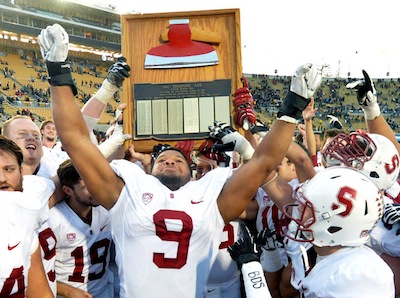
Stanford won the Big Game for the 5th consecutive time. As so many amazing Stanford statistical streaks have ended this season, the Big Game streak might just be the best one we still have going. That, and a 6th consecutive bowl game.

Currently sitting at 6-5, Stanford is closer to being 9-2 than 5-6. In other words, Stanford gave one to USC and lost some coin flips to Notre Dame and Utah. But in its six wins, Stanford has won fairly easily. The win over Cal wasn’t a dominant performance as some people have incorrectly noted, since the turnovers, replays, and penalties certainly catalyzed the Stanford victory. But it was smooth. Stanford smooth. 16 consecutive running plays kind of smooth.

The potential bowl matchup for Stanford isn’t looking so velvety, however. Various projections include an opponent like Arkansas State, Temple, or Boise State. Stanford is not going to face a top-25 team in its bowl game. So, this Friday’s game at UCLA is Stanford’s last chance to beat a great team. If Stanford loses, it will end the season 0-6 against ranked teams.

2. Offense 

There were multiple plays when Hogan checked down to find his second or third target. He had plenty of time to throw and looked very comfortable. Hogan also did a nice job lobbing the screen pass when Cal sent pressure. Stanford was much better in the red zone, though two pass interference penalties by Cal turned field goal attempts into touchdowns. So, Stanford and Hogan had some help, but Hogan probably could have thrown for 400 yards if Shaw didn’t let the run game take over. Hogan attempted zero passes in the last 24 minutes of the game. That’s 40% of the game—no Hogan passes. Amazing. In the second quarter, Stanford ran on 16 consecutive plays, then Crower tried a third down pass, then Stanford ran (or took a knee) 5 more times.

Remound Wright showed an ability to fight through tackles, something that we haven’t seen from Stanford running backs very much this year. (I’ve felt like Wright should have been the primary back for a few months now.) But Cal is not a good tackling team. 38 points and about 400 yards is exactly what one might expect from an average offense when playing Cal. Stanford still isn’t hitting the deep ball or breaking off long touchdown runs. It is still going to be a challenge to get the ball in the end zone in the next two games.

3. Ty Montgomery and Stanford Wide Receiver Depth

Francis Owusu and Christian McCaffrey made some great catches in tight spots. Owusu has been under the radar for two years now. He is fast and catches everything, and this year his biceps are starting to look more like Montgomery’s. It remains to be seen how serious Montgomery’s injury is, but Stanford has guys with great hands that are ready to play. Cajuste and Rector should both be back next year as well.

If I was coach, and Montgomery had another year of eligibility, I would move him to running back. If he didn’t want to, for purposes of being an NFL prospect, then I would have him split time at running back and at receiver. Should Shaw have considered this before the year? No way. There was no way to anticipate how much we could have used him at running back. And you can’t move his full-time position near the end of the year. Shaw has done a decent job gradually trying to get him more touches in the backfield as the year went on. Anyhow, my main point here is that there is little drop-off after Montgomery leaves. Stanford will be loaded at receiver again next year.

4. Defense 

Stanford had only two turnovers in conference play coming into the Big Game. The turnovers were long overdue and were the reason that Stanford won this game easily. (There could have even been more interceptions.) The pass rush and pass defense did a great job against Goff. Kalambayi, Vaughters, Richards, and Martinez made some huge plays. Martinez had a break-out game: 11 tackles, two interceptions, and one forced fumble. Stanford is losing so much talent on defense, but Martinez is someone who will be back next year.

The run defense, however, still leaves something to be desired. Cal gained 5 yds/rush. Stanford had trouble defending Lasco and Rubenzer on the ground. This leaves me a bit concerned about Hundley scrambling in the next game.

 5. Coaching

Shaw called a nice game. There were some misdirection, fakes, and Hogan keepers that worked nicely. He kept things conservative, which he likes to do when Stanford has a lead. Stanford’s fourth quarter TD drive was 78 yards on 9 consecutive running plays. They kept possession and kept the clock moving. The fact that we ran every play seems conservative, but it was anything but perpendicular bisectors of the Jumbo line (segment). Shaw’s plays were unpredictable and exciting. It was one of the best drives of the year.

Besides controlling clock, I also think he wants the running game and run blocking to get as much practice as possible. This seems like a good idea—the run unit needs to build some confidence.

Shaw also did the right thing by taking a knee at the end of the game.

I’m not sure why Sonny Dykes went away from Goff and Lasco. Lasco averaged 5.7 yds/carry, and Rubenzer looked awful throwing the ball. But I’ll let the Cal blogs ponder that one.

6. Up Next: UCLA (9-2)

This is going to be tough. Stanford has won the last six, but this is going to be a battle. The Stanford run defense needs to have a dominant game if Stanford is going to win. I haven’t seen UCLA play much this year, so I have no idea what to expect.

 7. Samaje Perine and Melvin Gordon

Two weeks ago, Melvin Gordon carved up Nebraska for 408 yards. Once Gordon had gotten the FBS single-game rushing record (by the 3rd quarter), he received no more carries. This past Saturday, Oklahoma’s Samaje Perine went for 427 yards against Kansas. Once Perine had the record, he also was pulled from the game. Both coaches should be complimented for chasing the record but not padding the stats in a blowout. And both Gordon and Perine flashed huge smiles and gave thanks to the people around them. When Gordon was interviewed about his record only standing for a week, he smiled and congratulated Perine. It’s nice to see success go to humble, kind people.

8. SEC Games This Week

The Pac-12 didn’t get to face the SEC this year, and likely won’t unless Oregon meets an SEC team in the Playoff. The ACC, however, has an exciting lineup of games against the SEC East this coming Saturday. For Georgia or Missouri—the potential SEC East champions—to have a chance to make the Playoff, the SEC East will need to perform well against the ACC this weekend. If Georgia beats Georgia Tech, Georgia will own two big wins over good ACC teams, while Ohio State still has a loss to a horrible ACC team. And Missouri plays Arkansas, the hottest team in the country. (More on Arkansas later.)

9. The Playoff Rankings: Line Up In Order of Number of Losses, Please 

In prior weeks, I’ve thought the committee has done a good job with the rankings. In the first rankings, it was clear the committee was using head-to-head and strength of schedule. And with the exception of Ohio State, I generally still accept the top of the rankings as reasonable. But as wins and losses have piled up, the committee has shuffled teams up and down just like the token coaches poll. As SEC West teams face a ridiculously hard schedule, they are being punished way too much for losses. At this point, the committee seems to be ranking by number of losses more than anything else.

Here is the list of the number of losses for the Playoff Committee’s ranking of teams 1-22: 1,1,0,1,1,1,1,2,2,2,2,2,2,2,3,2,2,3,3,3,3,3. Holy crap. It seems the committee has received the following task from its kindergarten teacher: please put the teams in order according to number of losses. Let’s look at some instances where the committee is ignoring its core criteria: head-to-head and schedule strength.

#12 Kansas State (8-2) and #15 Auburn (8-3). The committee says that it will only use the head-to-head criterion when the resumes are similar. Well, I guess the fact that Auburn won at Kansas State earlier in the year does not matter because the “bodies-of-work” are not the same. The committee is correct. The resumes are not the same. One team has four wins against FBS teams with winning records and the other team has six. One team has one victory over a currently-ranked team and the other team has two. One team has played three games against teams in Sagarin’s top-20 and the other has played six. So, you see, the resumes aren’t that similar—Auburn clearly has a better resume. Wait…. wasn’t that supposed to be Kansas State? Oops… Umm… but didn’t Auburn get blown out by Georgia? Yes, but Kansas State got also crushed by TCU. These two teams are misranked. Auburn owns much better victories (Arkansas, LSU, Ole Miss, Kansas State) than Kansas State (Oklahoma). The only conceivable reason that Auburn could be ranked behind Kansas State is because it has a higher number in the loss column. If that is the only criterion that the committee can handle, the committee members should just let their grandchildren do the ranking.

#18 Minnesota (8-3) and unranked Nebraska (8-3). Minnesota is grossly over-rated, and Nebraska has been over-rated the entire season. Neither one of these teams owns a win against a ranked team. Combine that stat with the fact that Minnesota lost to Illinois (and almost lost at home against Purdue), and we have absolutely no reason to rank Minnesota. Because Minnesota is totally over-rated, TCU and Ohio State are being over-rated as well. I have absolutely no idea how Minnesota is in the rankings when teams like Arkansas and LSU are unranked. Hopefully Minnesota will get exposed at Wisconsin this weekend.

#6 Ohio State (10-1) and #9 Georgia (9-2). Ohio State has played only one team in Sagarin’s top-30. Georgia has played six, and plays another this weekend. So what if we try to match up their schedules. Let’s take away Ohio State’s wins against Minnesota, Maryland, Cincinnati, Penn State, and Rutgers (the 2nd through 6th hardest opponents on Ohio State’s schedule) and replace them with games against Georgia’s 2nd through 6th hardest opponents: Arkansas, Missouri, Clemson, Florida, South Carolina. Would Ohio State win four out of five of those games? They would have to if they were as good as Georgia. OK, that math is fuzzy, and those SEC teams aren’t the most daunting, so let’s go a bit further and look at the Arkansas Razorbacks.

10. Making Sense of How Schedule Strength Affects Losses: the Case of Arkansas (6-5) 

Arkansas just shut out ranked SEC West opponents in back-to-back weeks: 17-0 over LSU and 30-0 over Ole Miss. Unbelievable. Outside of Alabama and Oregon, Arkansas is playing the best football of anyone in the country. And they are not ranked, because they have five losses. Obviously they are playing top-10 football right now, so is there a case to be made for ranking them?

Besides the SEC West division opponents, Arkansas drew the toughest two opponents from the SEC East: Georgia and Missouri. That means that they have played seven opponents who, at one point this year, have been ranked in the AP top-5. That is a stunning statistic.

For the following analysis, we are going to use Sagarin’s ratings, because it lists records against the top-30. Let’s assume Arkansas is an average top-30 team.

  • When it plays other top-30 teams, it has a 50% chance of winning.
  • Against teams ranked 31-60, top-30 teams are 59-15, winning 79.73% of the games.
  • Against teams ranked 61-100, top-30 teams are 59-2, winning 96.72% of the games.
  • Against teams ranked 101+, top-30 teams are 60-0, winning 100% of the games.

I was slightly surprised how few dramatic upsets there are, but it makes sense. Upsets are more common early in the year, because a big underdog might actually be a much-improved team. But by the end of the year, it is extremely rare that a team like Indiana has so many awful results yet owns a win against a team like Missouri.

Since Ohio State also seems like an average top-30 team, let’s look at what this means for Arkansas and Ohio State. Let’s also assume that Arkansas beats Missouri and Ohio State beats Michigan, so we see the full regular season’s results.

Arkansas             vs teams ranked:          1-30                   31-60              61-100        101+

# of Games                                                   8                        0                      2                     2

Probability of Winning                                 50%                  79.73%          96.72%          100%

Expected # of Wins                                      4                      0                    1.9                    2

Ohio State          vs teams ranked:          1-30                   31-60              61-100        101+

# of Games                                                  1                     5                      5                        1

Probability of Winning                                 50%                79.73%           96.72%          100%

Expected # of Wins                                    0.5                    4.0                    4.8                    1

After wins this weekend, Arkansas would be (7-5) and expected to have 7.9 wins, while Ohio State would be (11-1) and expected to have 10.3 wins. So, perhaps Ohio State has performed slightly better and deserves to be ranked just above 15th (average top-30 team), and Arkansas maybe just below 15th. But the analysis ignores the fact that Arkansas was not playing average top-30 teams. Arkansas was playing the best of the best: Alabama, Mississippi St, Georgia, Auburn, Ole Miss, LSU… Considering that, one could make a case that Arkansas should be ranked right around the same place as Ohio State, maybe just a few spots below. I would have Ohio State about 14th and Arkansas roughly 18th or 20th.

I’ll be the first to admit that the logic above isn’t clean analysis. It doesn’t prove a point beyond a shadow of a doubt. But it is indeed very revealing. I find it shocking that people in charge of ranking teams still don’t offer any quantitative analysis to reconcile a harder schedule with a worse record. There are better ways to do it than my method above, and I would like to see them.

11/15 Stanford 17, Utah 20

1. Perspectivehi-res-fdcbab9f8d2036e2a84acd521515a264_crop_north

Walking out of the stadium after Stanford had just lost a second consecutive game for the first time in five years, I was reminded that it wasn’t just me. I wasn’t going crazy. All season, my daydreams and sleep patterns have been haunted by the vision of David Shaw opting to punt from the opponent’s twenty-something yard line. Or thirty-something. Whatever. I can’t stand it. Leaving the stadium, I could tell I wasn’t alone. Multiple people nearby were complaining out-loud about Shaw’s decision to punt on 4th down from the Utah 34. I was pleased to know that I wasn’t the only one nitpicking David Shaw’s 4th down decision-making. It was a tie-game with little scoring. A 51-yard field goal could have won the game. Shaw made the wrong decision. At the time, the television announcer said, “He knows his kicker. He must know there’s no way he makes that FG.” Of course. The only way you don’t kick there is if you simply have no chance of making it. But Shaw knows Williamson has the leg. It was simply that Shaw, instead of playing to win, plays not to lose. After the game, Shaw said, “It’s not even close. If you miss, they have 20 yards before they try their own attempt. It’s an easy decision.” So Shaw is both wrong and stubborn. First of all, if they move the ball twenty yards, Phillips would have had to make a 63-yard kick. OK, so Shaw’s being a bit hyperbolic with his stubborn quote. But what is Shaw’s point? The fact that Williamson could have missed and Utah could have driven the ball thirty yards and Phillips could have made a long kick doesn’t even address the question of whether or not it was a good decision. Simply, Stanford should not have been playing for overtime. Stanford has a horrible red zone offense and a mediocre kicker—the two things you don’t want if you are headed to overtime. Plus, there isn’t any real difference between a 45-yard kick and a 51-yard kick as long as the kicker has the leg. Williamson has the leg—that is clearly the case. Williamson makes 46% of his kicks 40+ yards. Shaw gave up a 46% chance at the go-ahead score for a few yards of field position.

Thank God Williamson nailed the 51-yard kick in double OT. Shaw should have apologized to his team and to Williamson.

I watched the tape with my dad, and he made a great point about the decision-making on the Stanford’s long, 16-play, 4th quarter drive. After 14 plays, Stanford faced a 3rd and 11. Shaw called a time out. Utah’s defense was gassed! We gave them a breather. Mistake. Afterwards, of course, we didn’t even run a play that stood a good chance of gaining 11 yards.

2. Play-Calling and Execution

I watched the tape of the game and actually thought that the play-calling was pretty good. I think there were too many short-yardage plays on 2nd or 3rd and long. But other than that, there was great variety, lots of McCaffrey, lots of Montgomery. Shaw screws up some big decisions and wastes time-outs, but the day-to-day, general play-calls seemed very respectable.

The execution, however, was not good. Hogan missed throws. Hogan didn’t find the FB or TE outlet when he was pressured. Michael Rector dropped passes. Wright dropped a big pass. Everyone and their sister fumbled ball. Personal fouls, holding penalties, false starts. And Utah owned third down, and Stanford didn’t.

3. Up Next: Cal (5-5)

Stanford won last year’s Big Game by fifty points. This year, Cal is last in the nation in passing yards allowed at 375 yds/game. It isn’t even close—they are 50 yards behind the next-to-last team, Bowling Green. Despite some major offensive struggles, I expect Stanford to score some points. Even last year the Stanford offense was limping its way into the Big Game. Stanford failed to score more than 26 points in each of its 5 games before the Cal game. Then, it lit up the scoreboard for 63. Stanford can beat Cal in game with a decent amount of scoring. But, Shaw needs to be aggressive. We need to go for it on 4th down. And we need to get Montgomery at least 5, preferably 10 carries. But I don’t need Montgomery to embarrass the Bears again this year. I’d be happy with a 38-28 win.

4. Around the Pac-12

If Stanford’s results were typical of most teams, it would be pretty easy to rank teams. Stanford has lost to five ranked teams, and has beaten five unranked teams. It is fairly easy to slot Stanford as about the 35th best team in the country. They will be behind everyone they have lost to, and ahead of everyone they have beaten.

On Friday night, the NCAA basketball season got underway, and the 23 ranked teams that played that day went 23-0 against their unranked opponents. In basketball, a few mistakes or amazing shots don’t mean much—there are enough possessions in the game such that quality and performance are not easily muddled by a small sample size. In football, however a few keys plays can turn a game on its head. Last Saturday, Oregon State went 1-12 on 3rd down against Arizona State, but still pulled the upset. It scored touchdowns on a 78-yard run, a 66-yard run, a 20-yard pass, a 67-yard pass, and a 35-yard interception return. Also, decision-making combined with poor execution can really change a game. In two first half drives, ASU faced 3rd and 3 from OSU’s 11 and its 13. ASU tried and failed on passing plays each time, and then attempted two field goals. It came away with only 3 points.

Arizona State’s loss really hurt the Pac-12 chances at the Playoff. All eyes now turn to the Ducks. If the Ducks lose, the Pac-12 will likely be shut out. Anyone for a serving of 8-conference games and a November matchup with Presbyterian?

5. The Playoff Rankings

The Playoff picture is getting clearer. We have a feel for what the committee is prioritizing, and two things are standing out so far: wins against good (ranked) opponents, and head-to-head results. By the end of the season, conference championships and results against common opponents will also be used to give teams an added bump. For now, I think the hierarchy of admission to the four-team Playoff looks like this:

  1. Alabama, then Mississippi State (1-loss SEC Champion)
  2. Oregon (1-loss PAC-12 Champion)
  3. Florida State (undefeated ACC Champion)
  4. Mississippi State (1-loss SEC non-champion)
  5. Baylor, then TCU (1-loss Big-12 Champion)
  6. Ohio State (1-loss Big-10 Champion)
  7. Ole Miss or Georgia (2-loss SEC Champion)
  8. UCLA (2-loss Pac-12 champion)

It will still be interesting to see what the committee does when these criteria do not clarify which team is better. The big issue is the MSU vs Baylor/TCU quandary. It will all come down to this: how much will a conference championship matter? I believe the committee will only let it matter if they are considering teams with similar resumes. So, Baylor would obviously get the edge over TCU, but is Baylor’s resume similar to Mississippi State? Using current RPI rankings, both teams would have played six games against teams with an RPI over 70, and six games with an RPI under 70. They will have both played 3 teams in the current top-25. They would both have one loss. Clearly, the resumes would be very similar. I’m not going to list who has the edge on various criteria until we actually get to the last week of the regular season. For now, my hunch is that the best case could be made for MSU. Keep in mind that the SEC West went 3-0 against the Big-12. The committee doesn’t really look at things that way, but I think the SEC West has earned the right to have any one-loss teams in the playoff. Its nonconference wins just keep looking stronger and stronger. It is more than just the wins over the Big-12. While Oklahoma State and Notre Dame’s losses make Florida State’s wins less appealing, Ole Miss’ win against Boise State and LSU’s win against Wisconsin are looking better and better. Furthermore, the SEC-West still has zero non-conference losses.

That said, I don’t have much interest in watching Mississippi State in the Playoff. I’d rather the various conference champions get a shot at the title.

11/1 Stanford 16, Oregon 45

1. Perspectivephoto

In the first quarter of each of Stanford’s two previous victories against Oregon, the defense made a crucial 4th down stop. This year, the tipping point again came early—on Oregon’s first drive. On 3rd and 8 from Stanford’s 43, Helfrich called a conservative run for Freeman, knowing that they were in four down territory. There was no “difficult” decision to make on 4th down. No time out was needed to think it over. The Ducks were going for it. Stanford pressured Mariota as he dropped back to pass on 4th and 5, but he wormed out of the pocket and slipped downfield for the first down. That play told you all you needed to know about this game: Oregon was going to outcoach Stanford and Mariota was going to outplay everyone else on the field.

Obviously, Stanford is in a new era. That was clear to me after the Arizona State game. Before we consider our future and the cost of Royal Purple Las Vegas Bowl tickets, I want to take one last glance over the shoulder. In all of the plays from 2010-2013, I want one play back. It is from 2010, the year Stanford beat UCLA, Washington, and Oregon State by a combined 114-0 and took a 45-0 lead against Cal into the 4th quarter. 2010 is the year Stanford could have made history, and Oregon ruined it. In the 2010 Stanford @ Oregon game, Stanford went up 21-3, and Oregon scored in the second quarter to make it 21-10. Then, Oregon tried an onside kick. I wish Stanford would have recovered that kick. That’s it. That is the one play I want back—that onside kick. It was a huge momentum swing in Oregon’s favor and Oregon went on to win. Stanford didn’t lose another game that entire season, and I believe that Stanford could have beaten Auburn in the BCS championship game.

OK. It’s all out of my system. That’s all in the past now. Now I can properly refocus in the here and now, and also look to the future. Anyone up for a roadtrip to El Paso for the Sun Bowl?

2. Mariota

On the Friday night before the game, I saw Foreverland, a 14-piece Michael Jackson tribute band, at Eugene’s historic McDonald Theater. (Foreverland is also playing this Friday, the 14th, in Redwood City.) At the start of the third song of the second set, after hearing two notes of music, Steve S. turned to me and said, “Dirty Diana.” Wow. Talk about being in the moment. He was dissecting the music at a deeply subconscious level, and his reactions (and trans-dimensional dance moves) were lightening fast and highly accurate.

Similarly, Marcus Mariota was the smoothest of criminals against Stanford, and he responded flawlessly to Stanford’s pressures and coverages. On multiple 3rd and 4th downs, Mariota slipped from the pocket and picked up key yardage with his legs. He had every answer. In a 3rd quarter drive, Stanford sent pressure on two consecutive plays, and both times Mariota tossed screens to Freeman for 15 and 30 yard gains. Mariota was too fast and talented to handle, and he’ll likely be handling the Heisman a few weeks from now.

3. Controlling the Line of Scrimmage

If the Arizona State game was the bookend to a beautiful series of years of great Stanford offenses, then this game at Autzen Stadium was the bookend for the defense. Oregon and Marcus Mariota could not be stopped. The Stanford run defense put in its worst performance in years. The defense definitely doesn’t have the same kind of depth it has had in recent years, and a few injuries have really taken their toll.

It should not come as a surprise that Stanford couldn’t control the line on the other side of the ball. The Stanford run game was ineffective. Wright and Sanders combined for 2.1 yds/carry. For some reason, though, Stanford kept trying to establish the run. Stanford ran 39 times and threw 33 times. In the third quarter, already trailing, Stanford ran the ball 11 times and passed 7 times. Some of these runs were Hogan scampers, plays that I generally like. Still, Shaw called a few too many running plays. For example, Stanford ran the ball on the first play of all of its possessions in the first three quarters.

4. Coaching and 4th Down Calls

I like Oregon coach Mark Helfrich. He seems like a nice guy, and he smiles in a natural manner. He also goes for it on 4th down. Shaw has no coherent strategy for making in-game decisions, especially when it comes to 4th down. He wastes time-outs to talk himself into going for it, and then runs plays that are so obviously going to Montgomery that half of the opponent’s defense is waiting for Hogan to throw it to him.

Furthermore, we can’t afford field goal attempts against Oregon. Last year, we attempted five field goals against Oregon, and if the game would have been ten minutes longer we would have lost. You can’t beat good teams with field goals. Some nights, a good defense may bail you out and you may think your field goals were good enough. In the long run, too many field goals will lead to too many losses.

5. Autzen Stadiumphoto-1photo-2

The walk to the stadium is a serene saunter through fall foliage and across rivers and streams. It puts you in the right mood for something like a Bob Marley concert. But inside the stadium, the tone is focused and serious. It is loud, and almost everyone in the stadium cheers. The Stanford section is tiny—only a few hundred Stanford fans seemed to be there. You can’t even hear yourself as you whisper reminders that if we score here we are only one score down and then, well, you never know, of course… and… whoops… there goes Mariota.

6. Was This A Close Game?

Hogan and the Stanford offense moved the ball pretty well. Stanford didn’t punt until the 4th quarter. If a couple 4th down plays go differently and Hogan doesn’t turn the ball over, this game would have gone down to the wire. However, the team that runs the ball better is the team that has the advantage in the red zone. And the team that owns the red zone is the team that is going to win. In a dramatic shift from last year’s game, Oregon dominated the running game. The 29-point loss is definitely misleading, but Oregon was definitely the better team.

7. Up Next: Utah (6-3)

A lot on the line for both teams. If Stanford can win out, it still might get a decent bowl matchup. If Stanford can’t draw up enough screen plays to deal with Utah’s pass rush, it will be at risk for a losing season. It’s the last home game for the seniors. I expect the Cardinal to play well. Plus, the 3pm kickoff time is the best we’ve seen all year. Should be a glorious day.

8. The Playoff Rankings

I was completely surprised when the first rankings came out two weeks ago. The committee actually did what it said it was going to do! It valued strength-of-schedule and head-to-head results. While some ESPN pundits, such as Tom Luginbill, insist that Alabama is the best team because of the freaking “eye test,” the committee made rankings based on who had actually beaten who. I watched a College Football Daily on ESPN a couple weeks ago in which Luginbill argued that Alabama should be the top seed in the Playoff rankings. He just knew Alabama was better than Ole Miss even though Ole Miss had beaten them. Then, he posed the question, “Imagine you are the opposing coach in the playoff, who would you definitely not want to play?” Brett McMurphy and Kevin Carter answered, “Well, probably Alabama.” Luginbill sat back and smiled like he had just earned the last bite of a scrumptious, family-style platter of Rocky Mountain oysters. Not only did Luginbill and Matt Millen have no idea what criteria the committee was actually going to use, they hardly cared about actual results. Their argument for Alabama was no different than this: the Washington Nationals seemed better than the San Francisco Giants and did better in other games, so even though the Giants beat them in the NLDS, the Nats should actually move on to the NLCS because they are, um, “better.”

I am so happy that the committee has taken these idiotic, subjective arguments out of its ranking process. Instead, the committee is focusing on criteria that humans can actually evaluate with a decent amount of objectivity. From the Playoff website: “The selection committee will choose the four teams for the playoff based on strength of schedule, head-to-head results, comparison of results against common opponents, championships won and other factors.” It is clear so far that the committee is valuing the criteria that is set forth on its website.

Results from the past weekend hurt the SEC’s chances of getting two teams into the Playoff. Barring any major upsets, the playoff is going to consist of the following:

  • SEC Champion (two losses or less)
  • Florida State (undefeated only)
  • Oregon or Arizona State (one-loss only)
  • Baylor (one-loss only), or TCU (one-loss only) if Baylor loses

Nothing can change the above scenario unless one of the above five teams (excluding the SEC) wins its conference but has more than its current number of losses. The selection committee has shown that it is going to stick to its stated criteria, and conference championships won is explicitly listed as a major criterion. While TCU is getting a lot of love in the polls, Baylor will get the edge over TCU because of the head-to-head victory and its status as the conference champion.

For a second SEC team or Ohio State to make the Playoff, the ACC champion would need to have one loss, or the Pac-12 or Big-12 champion would need to have two losses. I don’t see this happening unless Florida State loses to Miami or Florida. Oregon and TCU will be solid favorites in their remaining games. ASU faces a tough test at Arizona. Baylor faces Kansas State at home. There are some speed bumps out there, but it looks very possible that the inaugural Playoff will consist of the champions of the four best conferences. If that scenario comes true, it is going to make for a fantastic Playoff.

9. Rooting For Oregon

Arizona State clobbered Notre Dame and Oregon beat Utah—both important results for the Pac-12. Once Stanford is eliminated from the conference title race, I root for the Pac-12’s best team to win it all. This year, that means rooting for Oregon. This is partly geographical: I like the northwestern states. (If Oregon, Northern California, and Southern California had to be made into two states, I would definitely have Southern California be on its own. This has little to do with people and more to do with landscapes and watersheds.) I also enjoy watching Oregon’s offense and respect Mariota and Helfrich. However, the primary reason I root for Oregon is because I love Stanford football. I want Stanford to get as much coverage as possible in the national media. If Oregon can win the national championship, that just makes next year’s Pac-12 North race and the Oregon-Stanford game that much more special.

Normally on Saturday morning, I love getting up early and watching ESPN’s College Gameday. This year, however, the coverage of the Pac-12 has been sparse. Part of that is probably due to television contracts, but either way, I’m getting tired of hearing about Florida State and the SEC. Gameday hasn’t even been to a Pac-12 conference game the entire season. If Oregon can win the national title, Stanford football is more relevant and more fun. I just hope Oregon doesn’t blow it and lose to the SEC again.

10/25 Stanford 38, OSU 14

1. Perspective LVCKNCDBRGHYGZJ.20141026004532

Stanford is 13-0 in its last 13 games following a loss. The road has been windy recently, but at least we’ve steered clear of disaster. There’s no need to borrow a towel—our car hasn’t hit a water buffalo.

2. Defense

The defense continues to impress, so much so that I didn’t even spend the time watching the tape of the defensive series. With our offense struggling so much, I only watched offensive tape of this past game. The statistics tell you all you need to know about how good our defense is playing. The first team defense held Oregon State to 133 total yards through the first three and a half quarters. Amazing stuff.

The defense’s steak of 31 games of holding opponents to 30 points or fewer will be tested at Eugene this week.

3. Offense and Play-Calling

After the Arizona State game, Shaw finally accepted some blame for not calling plays to fit his current personnel strengths. He said flatly, “I’ve done a poor job of structuring our offense so that our guys can be successful. We have to use our personnel better.” Was Shaw able to back up these words with a distinctly new direction in play-calling? The short answer is: yes.

The first half play-calls were chock-full of plays such as: quick curls to tight ends, wide receiver screens to Montgomery, slants to Montgomery, curl routes to other receivers, pitches or screens to McCaffrey in the flat, and Sanders running diagonally off the tight-ends. Shaw followed through on his promise. There was a far greater percentage of plays that have been working so far this year.

Stanford didn’t run up the middle until its 10th play of the game when Remound Wright rushed for no gain. But it was 2nd down and 1, so it was the proper time to try this play. On the next play on 3rd and 1, Shaw didn’t get stubborn by running straight ahead again or stupid by trying a pass. Hogan used Montgomery on a sweep as a decoy and pitched outside to McCaffrey, who easily ran for the first down. Beautiful call.

The next run up the middle was not until the 18th play of the game. In my opinion, it was the first play-call of the game that was not perfectly dialed up by Shaw. (Shaw should be highly praised for 17 consecutive play-calls to start the game that were all, at the very least, reasonable and justifiable.) On Stanford’s 18th play, Wright took the ball from Stanford’s own 17 on 1st down and lost a yard by running straight up the middle. This is exactly the play Stanford needs to avoid whenever it isn’t working. And in this game, like many others this season, it wasn’t working. Still, it was only the 2nd time in 18 plays that Shaw had called for it. We can live with that ratio.

Unfortunately, on the next play, Hogan decided to stare down Montgomery, who was triple covered on a slant. Interception. Only two plays earlier, Hogan had stared down Montgomery on a slant and thrown into double coverage for an interception. Besides the run up the middle, this is really the only other play that isn’t working well for Stanford this year: throwing to Montgomery in double and triple coverage. This one is not Shaw’s fault… it all falls on Hogan. Just because that play is called doesn’t mean Hogan shouldn’t be reading the defense for better options.

I suppose there is a third play that we’ve seen a lot this year that I don’t like: the lob pass in the corner of the end zone. It has worked a couple times, but it hasn’t worked many, many more times. At the end of the first half, the lob was unsuccessful on two consecutive plays. I think we should abandon it unless Cajuste or Taboada have single coverage and at least a 10-inch height advantage. It shouldn’t be thrown to Montgomery ever.

Shaw shut down the playbook in the 2nd half. I don’t really have a problem with Shaw running up the gut when the game is in hand. He is trying to keep the play-book closed to game film and also challenge his offensive line to try to improve its blocking. Seems reasonable to me. I also love that Shaw was on top of calling those defensive time-outs at the end of the 1st half. It got Stanford a scoring opportunity, but then Shaw made his first, and possibly only, strategic blunder of the game. Stanford had the ball on the OSU 9 with 16 seconds and no time-outs. Stanford tried the two lob passes mentioned earlier. Each used exactly 5 seconds of clock. With 6 seconds remaining on 3rd down, Shaw tried a field goal. Wrong call.

First of all, the lob pass takes a lot longer to run than a slant across the middle. It is pretty simple to try to quickly target a tight end or wide receiver in the back of the end zone and have only 4 or 5 seconds of clock run off. Even if Shaw lacks the instinct to do some casual expected value estimation, the fact that each of the last two plays took five seconds should have told him something! Anyhow, let’s look at the math. If we run a quick pass play, let’s assume there is a 25% chance of a TD, 50% of an incompletion that takes five seconds or less, and 25% chance of a turnover or expired clock. (These are reasonable numbers—teams historically convert 30% on 3rd and 9, and the Stanford rate would have been higher since its offense was dominating OSU—though lower because of the short field.) Also, Williamson is making 57% of his kicks this year.

Expected Value of Trying for TD: (chance of TD) • (TD points) + (chance of FG) • (FG points) = .25 • 7 + .50 • .57 • 3 = 2.6 points

Expected Value of 3rd Down FG: (chance of FG) • (FG points) = .57 • 3 = 1.7 points

Obviously I don’t expect Shaw to do any of these calculations in the moment, but a familiarity with these types of calculations allows one’s instinct to recognize in a matter of seconds when one strategy is very likely more favorable than another. Just because Shaw is paid millions of dollars per year doesn’t mean that he needs to be thinking this way. It does mean, however, that he needs to delegate these decisions to another staff member who has immediate access to his ear in crunch time.

4. Up Next: Oregon (7-1)

The funny thing about Stanford’s recent decision to limit its interior running game is that the run game just might work against Oregon. Oregon is 76th in the nation in run defense. I think Shaw will give the running game a chance to establish itself. If Sanders can somehow find some seams on the edges, and Wright can pick up four yards through the middle, then Stanford will try to make the game look similar to last year’s trench war. If Oregon stops the run, at least Shaw now has the other blueprint fully drawn-up. Because of what ASU did, I expect Oregon will stop the run. How good of a game Hogan will need to have will depend entirely on our defense.

For the first time, I’m headed up to Autzen for the game. Keep an eye out for the cape in the Stanford section. 

5. Essential Inequalities for the Inaugural Playoff Committee Rankings

There is a lot to be determined in the remaining games this season, and it is currently a really tough task to distinguish among so many teams with one and two losses. For example, I really don’t know what to make of the Big-12. TCU and Baylor look pretty good (at least offensively), but they both played such horrific nonconference schedules that it is tough to rank the Big-12 against other conferences. West Virginia, Kansas St, and Oklahoma St hung tough against Alabama, Auburn, and Florida St, but all three Big-12 teams lost. Even though those teams look competitive, the Big-12 has zero victories against top-25 teams. The bowl results from last year are mixed as well; the Big-12 had a decent but not spectacular bowl season.

The Pac-12 is also very difficult to place. UCLA beat Texas, but so has every other team with reasonably ambulatory capabilities. USC’s loss to Boston College is utterly confusing. Arizona looked mediocre in its nonconference games. Utah’s win at Michigan is looking like it is no different than going through a turnstile.

However, there are a few things that the committee must clearly get right in order for it to take its first step forward with any credibility. And there is a central theme, of course. The SEC has earned its seat at the head of the table, and the Big-10 should be taking scraps of leftover fat. Here are the essential inequalities:

  • Oregon > Michigan State. Oregon 46, Michigan State 27. End of discussion. Prediction: The committee will get this one correct.
  • Arizona St, Arizona, and Utah > Ohio State. Ohio State has a bad home loss, a bad OT win, and no win that is as good as the best win that each of these Pac-12 teams has. Ohh… but wait, isn’t this Ohio State? What about the history? The pageantry? The recent dominance? Phony baloney. The Buckeyes haven’t beaten a top-20 team in three years. Prediction: The committee to fail on this one because of name bias against Utah.
  • Auburn, Mississippi, and Alabama > all Big-10 teams. Michigan State has only one win against the top-75, and that is against a very overrated Nebraska. Michigan State should be nowhere near the playoff discussion right now. Prediction: The committee will get this one correct.
  • Auburn, Mississippi, and Alabama > all Big-12 teams. As mentioned above, the Big-12 lost its games against the better SEC teams. The Big-12 did not win a single nonconference game against a ranked opponent. Or even a nearly-ranked opponent for that matter. It went 4-6 against the other Power 5 conferences. The four wins are against three bad Big-10 teams and Tennessee. Ouch. The Big-12 will likely be left out of the Playoff. Prediction: The committee will get this one correct.
  • Auburn > Mississippi > Alabama. Auburn has only lost to two teams in its past 17 games: the best team from 2013 (FSU) and the best team from 2014 (MSU). Neither Ole Miss nor Alabama played FSU last year or MSU this year. So to compare these three teams you really have to take FSU and MSU off the table. Clearly, Auburn owns the superior resume. Is Auburn better than Alabama? Personally, I don’t think so. But that doesn’t matter. They have the better resume. They beat the top team from the Big-12 (Kansas St) on the road and crushed LSU (41-7), who just beat Mississippi. And, while Alabama might be better than Ole Miss, Ole Miss beat them head-to-head. For every argument that Alabama should be ranked higher (59-0 win over Texas A&M), there is an argument that speaks otherwise (one point win against Arkansas). Prediction: The committee will fail on this one because of the name bias towards Alabama.

So who is in the current top-4? FSU, MSU, and Auburn should be locks. After that, you could make a strong case for Ole Miss, Notre Dame, or Oregon. If anyone else takes that fourth spot, the committee has failed.

10/18 Stanford 10, Arizona St 26

1. A New Era of Stanford FootballStanford Arizona St Football

This last game will stand as a bookmark as the end of a golden era in Stanford football. The losses to Michigan State last year and USC and Notre Dame this year can be considered from different views, some of which point to Stanford still being an elite football team. What happened on Saturday against Arizona State cannot be spun. ASU does not have a dominant defense. UCLA scored 62 points on them. Both Weber State and New Mexico gained over 300 yards. The Stanford offense was inept. And its best player, Ty Montgomery, is dropping passes and fumbling punts that he should not be trying to catch. Things are not working for Stanford, and the difficulties can no longer be seen as outliers.

The eye-test tells us we aren’t watching the same kind of Stanford team we’ve seen in recent years, but the statistics tell the clear, sky-blue story:

  • Stanford hadn’t lost a game by more than one touchdown since 2011 against Oregon—39 games ago.
  • Stanford hadn’t lost three games in a regular season since 2009 against Arizona—67 games ago.
  • Stanford hadn’t been down 14-0 since 2009 against Oregon State—68 games ago.
  • Stanford hadn’t been shut out at halftime since 2007 against Washington State—88 games ago.
  • Stanford hadn’t scored 10 points or less and gained under 300 yards since 2007 against Washington—89 games ago.

If the Stanford offense puts up 30+ points from here on out, we will reconsider the narrative. But the chance of that happening is the limit of f(x) = 1 / x   as x approaches infinity. The era that saw Andrew Luck lead rampaging offenses and Hogan stretch out to 10-0 as a starter vs top-25 teams is over. Done. Over. Sayonara.

2. Remembering The Golden Era

Stanford might have set one of the most amazing football records of all-time. From the end of the 2010 season to midway through the 2011 season, Stanford won ten consecutive football games by 25 points or more. I can’t figure out if this is a record for FBS major conference football, but it might be. The 1995 Nebraska Cornhuskers are commonly thought of as one of the most dominant teams ever, going 12-0 with a 38.7 pt margin of victory. From 1994-1996 Nebraska never had a streak of 10 consecutive 25 pt wins. The 1972 USC team cruised to 12-0 but only beat Stanford by 9 that year. It is possible that Stanford owns this amazing record.

It was a golden era of Stanford football. Unfortunately, because of the Oregon Ducks, it won’t be nationally remembered. Stanford was good enough to compete for a national title in 2010 and 2011, but Oregon erased the chance. Stanford returned the “favor” in 2012, taking away a great chance at the national title from Oregon in a shocking upset. In the end, Stanford never got a shot. The Playoff came a few years too late for Stanford. We never got to see it match up against the best of the SEC.

Still, it was an amazing resurrection and a once-in-a-lifetime run of glory that we can always cherish. How far gone are those times? In the 38 games since the 2011 Oregon game, which ended the streak of 10 consecutive 25+ point wins, Stanford has never even had two consecutive 25 pt wins.

3. The Reason For Stanford’s Struggles: Blocking

This blog has criticized Shaw and the offensive coaching staff for many strategic mistakes with in-game management, but it is now clear that Stanford has some personnel and execution problems. We can’t run the ball. More specifically, we aren’t blocking like we used to. This year, the holes aren’t there. It doesn’t take a special running back to run through a hole. Stanford has been blessed with some amazing running backs, but they aren’t irreplaceable guys. Toby Gerhart was inches away from the Heisman Trophy in 2009, but through 70 NFL games, he has had only one 100-yard game. Through 22 games with the Arizona Cardinals, Stepfan Taylor has never rushed for more than 40 yards in a game. Tyler Gaffney has yet to take a handoff in the NFL. These guys were beasts, and definitely broke tackles for extra yardage more than Wright and Sanders have done. But they weren’t being swarmed at the line of scrimmage nearly as much.

What is more important to a run: one running back or the seven or eight players in charge of creating a gap? The answer is obvious. Stanford is inexperienced at all of the blocking positions: the line, the tight-ends, and fullback. Everyone except Andrus Peat is new, and they are clearly struggling to overpower quality foe. Even beyond the departures of the great offensive linemen like Martin, DeCastro, Fleming, and Yankey, we are missing the blocking of tight ends like Zach Ertz and fullbacks like Owen Marecic and Ryan Hewitt. Unfortunately, blocking power doesn’t appear overnight. It might be a year or two—or more—before Stanford becomes a dominant running team again

4. A Smaller Reason For Stanford’s Struggles: Hogan

Hogan has not improved his accuracy. He has also not increased his ability to find 2nd or 3rd targets. He too often locks in on Montgomery and throws it his way whether or not he is covered. Arizona State decided that Stanford would have to ride Hogan’s arm to victory. Arizona State either loaded the box to stop the run or blitzed when Hogan dropped back. Hogan had an opportunity to exploit some one-on-one matchups. He often missed his target—especially on some downfield throws on Stanford’s last drive.

5. Jim Harbaugh and David Shaw Are Both 4-3 This Season

Is there any reason to lament the departure of former Stanford coach Jim Harbaugh? Well, Harbaugh’s 49ers are showing some similar problems. I don’t watch NFL football, but my dad drew some parallel lines after the games this weekend. The 49ers offensive line has been dealing with injuries and only two of the five linemen from the 2012 Super Bowl team have consistently played this year. The Harbaugh-Shaw style of football is only as good as its blocking, especially when neither Stanford nor the 49ers has a pure pocket passer.

6. The Silver Lining: Stanford Is Still A Good Team

ASU did not dominate Stanford. They were better, but not in any sort of distinct way. They had a better quarterback, and probably the best player on the field, wide receiver Jaelen Strong. But not much more than that. Ty Montgomery and Christian McCaffrey gave ASU 10 points off of fumbles. It should have been a close game, especially considering we were driving for another score late. Furthermore, ASU had an extra week to prepare. It didn’t affect its offense, but its defense had clearly watched film on Stanford and come up with a game plan. Although Stanford is not what we want them to be, they are still very competitive against good teams and usually beat bad teams.

The loss to USC was a fluke. Stanford was the better team that day. And Stanford battled Notre Dame, which looks like a legitimately good team. Now, if we lose to Oregon State, I’ll stop cherry picking stats and revising history and there will be no excuses for Stanford. But for now, we are still an above-average team. Not completely fun to watch, especially given the soaring expectations spun from the spirals of Andrew Luck—but still a team you wouldn’t trade for a randomly-selected team from any of the major conferences. To put it more specifically, I wouldn’t trade our current team for Florida, or Tennessee, or Texas A&M, or South Carolina, or Texas, or Michigan, or Nebraska, or Oklahoma, or Wisconsin, or Miami, or Penn State… Not so bad, right?

7. Up Next: Oregon State (4-2)

Despite its recent struggles, Stanford has still managed to avoid back-to-back losses for the past 67 games—thus making this Oregon State game that much more important. If Stanford loses, it might not finish with a winning record. If Stanford wins, the Oregon game still has a lot riding on it.

Big game. Huge game. Damn… I’m actually getting excited for it now… didn’t think that was going to happen so quickly after the trauma of this last one. At least the morning tailgate is guaranteed to be an unstoppable, offensive force.

8. The Pac-12 and the Playoff Picture

There was one football game I thoroughly enjoyed watching last Saturday evening: Florida St vs Notre Dame. Even though Notre Dame lost, it held its own. ASU and USC have a shot later this season in two games that will be important for the perception of the conference.

For the first time this season, there is a full slate of six Pac-12 games coming up this weekend. We’ll discuss the Pac-12 Playoff and bowl implications further next week. We’ll also have an updated look at ranking the top-25, just in time for the Playoff Committee’s first rankings release.

10/10 Stanford 34, WSU 17

1. Perspective628x471

Coming off the heartbreaker to Notre Dame, and considering the upheaval in the Pac-12, Stanford was facing a lot of uncertainty. Heck, Connor Halliday had just set the all-time NCAA record! But Stanford played solid football against an inferior opponent, and the ship is back on course.

Stanford has played 66 consecutive games without suffering back-to-back losses. While Stanford is off to a tough start in 2014, the bounce-back wins remind us how lucky we are as fans—our suffering is quickly supplanted by the joys of victory. Stanford has won the next game following each of its 12 losses in that time span. Is this fact a testament to the heart and character of the team, or is it just an expected statistical outcome of a winning team?

Stanford is 54-12 in its past 66 games. 54/66 reduces to 9 wins per 11 games, or a 82% win percentage. How likely is it that Stanford won all 12 games following a loss?

(9/11)12 = .09 or 9%. (The sample might seem skewed if Stanford losses to good teams and then has easier teams scheduled for the subsequent games, but those 12 wins include wins over Arizona, UCLA, USC, and Notre Dame.)

Thus, it is fairly safe to conclude that Stanford relies on focus and motivation rather than statistics to win its next game after a loss. For a program to have sustained success, that kind of heart and character goes a long way.

2. Offense and Play-Calling

After the game, Shaw said, “We looked like us and we felt like us.” Presumably he was referring mostly to execution, but I think the statement applies more to play-calling. Let’s look at a few important adjustments that were made that I think will lead to a much more productive offense.

  • Simplify the Running Back Situation. Barry Sanders took most of the carries on the first drive and looked great. Remound Wright took most of the drives after that. Sanders had 9.7 yds/carry and Wright had 7.0 yds/carry. Great numbers. Kelsey Young, on the other hand, took one handoff for three yards and one sweep on a successful play that was called back by a penalty. I think that Shaw has narrowed our running back situation to Sanders and Wright, which has seemed like the correct thing to do for a while now. Kelsey Young is better on sweeps and reverses in the open field, but he doesn’t have the same running back instincts as Sanders or Wright. From now on, I expect to see a two-man show, and that simplification should help the offense stay in a better flow.
  • Use More Deception. Twice in the first half, Stanford used Ty Montgomery in the backfield as a decoy. Dave Fleming, who called a good game with Danny Kanell, noted from the booth, “That was another play when Ty Montgomery, the wide receiver, was in the backfield as a running back. That’s two plays—neither time he has gotten the ball. I think some were thinking maybe Stanford has gotten predictable. They have not been predictable on offense tonight.” Montgomery as a decoy has a lot of potential for the rest of this year. Also, Shaw had Hogan use play-action out of the Jumbo package multiple times, including a roll-out TD throw to tight end Taboada. As sick and tired as Stanford fans have gotten watching us run up the middle for one yard out of the Jumbo package, it sure does set up nicely for some play-action.
  • More Christian McCaffrey. McCaffrey was deliberately targeted many more times this game. He has shown an ability to make plays, and he runs downfield with a purpose. Shaw should continue to call his number more often.
  • Target the Tight-Ends. Tight-ends had three TD catches. In the 1st quarter, Hogan hit Cotton on a beautiful play that included multiple tight ends downfield, confusing the safety. It was the type of play we saw Luck and Ertz connect on so many times a few years ago. And it was deceptive. It was on play-action out of the Jumbo formation. To me, this is the quintessential Stanford offensive play. Where has it been all season? With four great receiving tight ends, we should be using this play more. It works.
  • Go For It on 4th Down. In the 2nd half, on 4th and 6 from WSU’s 30, Stanford went for it. I like the call. It should have worked, since Rector was tackled before the ball reached him, but there was no pass interference call. The silver lining of more missed Williamson field goals is that Shaw will be more willing to go for it on 4th down. Still, technically, the play didn’t work. Stanford is one of three teams that has not converted a 4th down attempt yet this year. (Strangely, Florida St is one of the other two teams—0/1 on the year.) But I’m hoping Shaw comes around to going for it more on 4th down. Against ASU last year, Shaw ran the ball on 4th and Goal from the 1 in the 2nd quarter. Expect Stanford to pound the ground on 4th and short against ASU.

If we can continue to do more of the above, and keep Hogan rolling out and throwing from play-action situations, our offense will be more successful.

3. Defense

Stanford still maintains the #1 scoring defense in the country. It has yet to give up more than 17 points. In the past 29 games, no opponent has scored 30 or more points—the longest such streak in the country.

The defense pressured Halliday and made tackles when necessary. Zach Hoffpauir finished with a game-high 15 tackles. Beautiful stuff from one of the best defenses in the country.

4. Around the Pac-12

The match-ups theory of tailgate monarch Danny B. and brewflip classmaster Karl L.S. is holding true. Oregon beat UCLA for the 6th consecutive time. UW beat Cal for the 6th straight time. USC beat Arizona for the 2nd straight time. Stanford beat WSU for the 7th consecutive time.

Washington vs Oregon will get a bit of hype and intrigue this weekend, but it shouldn’t. Oregon has won 10 in a row against UW—all by at least 17 points.

Watch out for Cal against UCLA. Cal has won its last seven home games against UCLA.  

5. Up Next: Arizona State (4-1)

Staying with the matchups theory, let’s look at recent battles. Stanford beat Arizona State twice last year. Both games were blowouts. Stanford ran the ball for well over 200 yards in both games. How has ASU’s defense changed since then? It has gotten worse! It lost 9 starters on defense. This year, it is 103rd in rushing defense, allowing 203 yards/game. Last year it was 26th in the country in rushing defense. Of course, Stanford isn’t bringing the same rushing attack from last year either, but the fall-off hasn’t been as dramatic. If Stanford can run the ball and control the line of scrimmage, it should be able to win. Keeping Jaelen Strong to less than 150 yards receiving might be a good idea as well.

 6. The Playoff Picture

After LSU’s win against Florida, the SEC West is now 26 – 0 when not playing itself. The SEC West’s remaining nonconference games are Samford, Western Carolina, Presbyterian, Louisiana-Monroe, Tennessee-Martin, and UAB. (A load of crap, but that’s a dump for another time.) So there’s six more wins. Surely though the SEC West will lose to an SEC East team later this year. If the only loss is Arkansas losing to Georgia, for example, then the SEC West will be sending two teams to the playoff. The only argument against the SEC West’s supreme dominance is that they eat more cupcakes than other conferences. This is clearly true, but the SEC West also owns better wins than other conferences. It owns wins versus: #17 KSU and #26 Wisconsin (Sagarin rankings). It doesn’t sound like much, but it is better than other conferences. The entire Pac-12 only has one nonconference win over the top-40: Oregon over Michigan State.

The SEC West plays 75% of its conference games against its division, compared to only 55% for the Pac-12 North. In a year when the SEC West is deeper than the thoughts of Jack Handy, the set-up of the conference schedule means that these seven teams have some of the hardest schedules in the country. Normally, Mississippi State should be punished for scheduling Southern Miss, UAB, South Alabama, and Tennesee-Martin. It also plays the lump of sand that is Vanderbilt. So it has five guaranteed wins. No Pac-12 team has a schedule with 5 guaranteed wins. But, the seven other games on MSU’s schedule are brutal! So, this year, the soft serve of SEC scheduling is much less egregious. The SEC West will eat its own, just like the Pac-12 is doing. When the feast ends, though, there will likely be two SEC West teams still sitting at the Playoff table.

7. Holy Molasses: Mississippi State Is For Real!

A few weeks ago, I wrote that Mississippi State would lose its next three games and once again disappear from the paragraph of the AP Poll. Instead, the Bulldogs did something that has been done only one other time in the past 55 years: win three consecutive games against top-10 teams. Stunning. This is an unfathomable turnaround. In my lifetime, probably no fan base has experienced the kind of long-awaited euphoria that has recently engulfed the state of Mississippi. How are they possibly getting any work done down there this week? They should just declare a continuous statewide holiday until Ole Miss or MSU lose.

8. Overrated Teams of the Week

#8 Michigan State Spartans (5-1).

#13 Ohio State Buckeyes (4-1).

#19 Nebraska Cornhuskers (5-1).

Everyone knows the Big Ten has already blown its chance to send a team to the Playoff. But then why are its teams still over-ranked in the polls? The Big Ten has zero nonconference wins against the top-40 this year. The Big Ten’s best win is Penn State (4-2) over UCF (3-2). Holy broccoli stalks of girthless depravity! Deplorable! Ohio State has lost to every top-20 team it has played for the past three years. Nebraska… uh… I’m getting tired of listing reasons why Nebraska is mediocre. Michigan State looks pretty good, but not better than Oregon! If Oregon and Arizona lost and needed to move down, then Michigan State needs to move down with them! (Though Michigan State should still be ahead of Stanford because of the Rose Bowl.)

How will justice prevail such that these teams move down in the rankings? Unfortunately, the Big Ten is done with nonconference games. We’ll have to hope that Michigan State, Ohio State, and Nebraska lose to the little sisters of the poor.

10/4 Stanford 14, Notre Dame 17

1. Perspective

IMG_5673It is tempting to think that Stanford should have won. After all, we were only a mistake on 4th and 11 away from victory. But if you are a Notre Dame fan, you were probably really frustrated all game and felt like you almost lost one that you deserved. Considering this, I don’t think it is fair to feel like Stanford should have won this game. Yes, it almost won, but not because it earned it. Notre Dame made just as many mistakes, if not more, than Stanford. In the end, Notre Dame outgained Stanford by 165 yards. Notre Dame was the better team on Saturday.

I just don’t have the heart this week to dissect the game that much. For a great recap, click here. Normally, after a loss, I feel even more compelled to write, explain, and question. Instead, I was more motivated to break down rankings and polls.

2. Offense & Defense

It was ugly. Our running game got worse. Hogan played worse. And, the inconceivable—our trusty receivers dropped passes. Yeah, it was raining. But man, it was an ugly one to watch.

The defense didn’t play that well, especially Wayne Lyons. But this loss is all on the offense. 2.47 yards/play is atrocious.

3. Coaching

Shaw did a few interesting things with some play calls. There was a very surprising (and successful) run call on 3rd and Goal from the 11. There was a sprinkling of the usual variety of runs, screens, and formations. This was especially evident in Stanford’s 3rd drive, halfway through the first quarter. On the first two drives, Hogan looked awful when dropping back to pass from the pocket. So, on first down to start its third drive, Stanford rolled Hogan out and he hit Cajuste for 17 yards. On the next play, Montgomery dotted the “I” for 5 yards. Then, Montgomery ran for 6 more out of the Wildcat. Next, Hogan tossed a screen pass to Skov for 16 yards. The offense was moving. What was the secret? None of those plays involved Hogan passing downfield from the pocket. For the first time all year, I thought to myself, “Alright, we’ve got our identity this year.” Keep Hogan on the move, or get the ball out of his hands quickly. I even texted some friends, “I think Shaw might figure things out here. No more dropping back to pass from the pocket.” What a load of bologna that turned out to be. Immediately following those four beautiful plays, Hogan dropped back to pass from the pocket on each of the next three plays. Two incompletions, then an interception.

I don’t understand why Shaw doesn’t do more of what works. If something is working, do it again and again. Don’t just assume you have to show a variety of looks to keep the defense honest. Make the defense adjust and stop what you are doing. There were exceptions, of course, but the play-calling generally kept Hogan passing from the pocket the rest of the game. Considering the rain and Hogan’s struggles, this was a mistake.

4. Officiating

9 penalties against Stanford. 1 penalty against Notre Dame. There were clear pass interference infractions by Notre Dame that were not called. Furthermore, the replay booth was ridiculously quick in reviewing (or deciding not to review) a few plays that went in Notre Dame’s favor. On Notre Dame’s first 4th quarter scoring drive, a crucial 3rd down pass was erroneously ruled complete, and Notre Dame later kicked a go-ahead field goal. Mistakes from the field referees happen, but mistakes from the replay booth are unacceptable.

5. Around the Pac-12

The supposed top-4 teams in the Pac-12 (Oregon, Stanford, USC, and UCLA) all lost this past week, and every game was close. All five Pac-12 games were decided by one score or less. All five road teams won. And, another Hail Mary to win a game! (ASU over USC.) Lots of great drama.

Sweat-pant enthusiast Danny B. and leather football helmet model Karl L.S. posed the following question amid sagacious verses of texts: “Who is the best team in the Pac-12?” They arrived at the following answer: “It all comes down to match-ups.” They might have the only reasonable answer to that question. Stanford has beaten Oregon twice in a row. Oregon has beaten UCLA five times in a row. UCLA has beaten USC twice. USC has beaten Stanford twice. That chain right there, among the four better teams in the conference, shows the problem with determining the best team. More recent ownership of match-ups: UCLA has beaten Arizona twice in a row. Arizona has beaten Oregon twice. Stanford has beaten Arizona St twice. Arizona St has beaten USC twice. Stanford has beaten UCLA six times in a row. Stranger still, in the past season and a half, Washington State is 4-0 against Utah, Arizona, and USC.

So, it depends on the matchup. But when it comes down to it, the winner of the Stanford-Oregon game has won the conference championship every year since the Pac-12 started. Until that changes or one team falls way off, you can still make an objective case that Stanford and Oregon are a notch above the rest of the league.

I will also say this: Stanford and Oregon are a combined 11-0 against UCLA in the past eleven games. It was ridiculous for pundits to ever rank UCLA above them earlier in the year. And it all adds a bit of drama to the Oregon-UCLA game this coming Saturday.

6. Up Next: Washington St

Well, if it depends on the match up, then Stanford should be in good shape. It hasn’t lost to Washington State in seven years. However, Connor Halliday just set the all-time NCAA passing record, throwing for 734 yards against Cal—in a 60-59 loss! So who really knows what is going to happen… last weekend’s results showed that this entire Pac-12 season is going to be wild and unpredictable.

7. The Playoff Picture

Results. And data. For the first time all year, there is now plenty of data to make objective attempts at ranking teams. When considering a multitude of data from an entire season, it should be obvious that computer programs do a better job of applying and synthesizing the criteria that people normally use to analyze teams: record, strength of schedule, margin of victory, home/away/neutral location, yards gained differential, etc. Humans can’t deal well with so much information. The most obvious way to rank teams objectively would be to create a committee—who would create a computer program that combines the important and most accepted aspects of existing computer polls, and then publicly release the formula. So why did we leave the computer rankings behind? Why would people think that humans do a better job?

First off, humans can account for things like bad officiating and lucky plays. This makes sense, but there is still a major problem: what qualifies as bad officiating? There are too many bad and lucky calls throughout the year for humans to consistently make adjustments.

Perhaps humans don’t trust the way a computer program would handle an undefeated team with a soft schedule. Certainly one camp would want this team to have a chance to play for a national championship, while the power conference leaders would scoff at this idea. At least with a human committee making the decision, we can vocalize our opinionated, self-serving despair at other human beings rather than computers. People can influence other people. Once a computer program is written, it can’t be influenced. Many people get really frustrated when their opinions aren’t heard. They want to hold on to the belief that they can—to whatever tiny extent—influence the system. I think this is the primary reason why computer rankings are no longer used.

However, there is actually one ranking criterion that humans can handle better than computer programs. Human polls can account for head-to-head results, and to a lesser degree results against a common opponent. I don’t think a computer program could do this very well. Let’s look at a simple example. Sagarin’s current ratings yield: #6 Texas A&M (5-1), #7 TCU (4-0), #8 Mississippi St (5-0). Well, obviously this is problematic, because Mississippi St is undefeated and just crushed Texas A&M on Saturday. If there were just a few isolated head-to-head results, one might be able to write a computer program that would do the following: after spitting out the rankings, if a team was, for example, within two or three spots of a team that it beat, then it gets bumped up one spot ahead of the loser. But, it simply can’t work. The program would lose functionality when there were too many of these head-to-head results clustered together. Furthermore, what about the team(s) in the middle of teams that have head-to-head results? In the example above, what would happen with TCU? Would the rankings get changed to TCU > MSU > TA&M, or MSU > TA&M, TCU? There is no way for a computer program to handle this properly.

So, despite the wrath of human bias, which is probably philosophically impossible for human minds to avoid, the human polls can do one thing better than computer polls: account for head-to-head results. As we discussed earlier, this is really the only thing it can do better (besides the related aspect of common opponents). So, when a human, or a playoff committee, looks to rank teams, he might basically glance at a statistically-driven set of computer rankings to get a feel for things, and then adjust based on head-to-head results.

Unfortunately, the polls usually just reflect an incremental shifting of teams in somewhat prescribed amounts from their position in the preseason poll. Preseason bias ruins the entire poll. People don’t make radical adjustments based on results. Jon Wilner on the Mercury News is one voter who does carefully consider head-to-head results, as well as quality wins. (Of course, he takes a lot of heat from a lot of idiots who aren’t smart enough to realize how he tries to rationalize his poll.)  If we are going to bother to look at human polls instead of computer polls, then head-to-head results must be weighed heavily.

People who say that last year’s results shouldn’t matter are completely naive. The entire shape of the poll is based on the preseason poll, which is based on last year’s results! You can’t escape last year’s results, so instead of letting them subconsciously muddle the rankings, they should be used. Early in the year, a poll should use last year’s results by analyzing head-to-head results, especially if a team is difficult to slot because it has not yet played other teams in its vicinity in the rankings.

However, if a team is undefeated and already has a quality win this year, there is no reason to look at last year’s results. Barring an officiating error or series of fluke plays, an undefeated team must—absolutely must—be ranked ahead of a team it has beaten. Especially if it won on the road. In the Coaches Poll, Oklahoma is still above undefeated TCU, and Oregon is still above undefeated Arizona. If USA Today had any shred of respectability, it would stop publishing this poll immediately.

8. A Reasonable, Human-Created, Results-Driven, College Football Poll

First, a short overview of what I think should be important criteria:

  • The poll is meant to reflect results. It is not meant to be predictive.
  • Head-to-head results matter a lot.
  • Quality wins matter a lot. Scoring margin matters, but not as much as quality wins. Beating a good team by a few points is much more important than beating a mediocre team by a few dozen points.
  • Computer polls should be considered, as they take in enormous amounts of info.
  • Undefeated teams must be ranked ahead of teams that they have beaten.
  • There should be clumps of teams from single conferences. Non-conference results are more often used to slot groups of teams from a same conference.
  • If considering any results from last year, Bowl games are given more weight than games earlier in the season.

For the first time in my life, I threw a bunch of hours down the wormhole and tried to make an objective top-25. Here it is. (References to top-40 or top-20 are from Realtime-RPI current or season-ending rankings.)

1. Florida St. (5-0). Beat #19 OSU. Beat #24 Clemson. Beat #2 Auburn in national championship. 21 consecutive wins. 21 consecutive wins.

2. Auburn (5-0). Won 14 of last 15 games, losing only to #1 FSU in national championship last year.

3. Mississippi St (5-0). Beat #17 Texas A&M. Won at LSU, which gets them the nod over #4 MSU, which has no quality road wins.

4. Mississippi (5-0). Beat #7 Alabama.

5. TCU (4-0). Beat #6 Oklahoma.

6. Oklahoma (4-1). Lost to #5 TCU. Beat #7 Alabama in Sugar Bowl.

7. Alabama (4-1). Lost to #4 Ole Miss. Lost to #6 Oklahoma in Sugar Bowl. Lost to #2 Auburn last year. Won 15 consecutive games before that, including national championship.

8. Arizona (5-0). Beat #9 Oregon.

9. Oregon (4-1). Lost to #8 Arizona. Beat #11 MSU.

10. Notre Dame (5-0). Beat #16 Stanford. Lost to #6 Oklahoma last year. Beat #11 MSU last year.

11. Michigan St (4-1). Lost to #9 Oregon. Beat #16 Stanford in the Rose Bowl.

I’m confident that this top-11 is solid and about as objective as a human poll can be. You could argue against FSU at the top—I will agree they aren’t the best team in the country this year—but 21 straight wins! The point of a poll is rendered useless if reigning champion with the nation’s longest winning streak isn’t ranked first. Perhaps you could say Arizona or TCU are too high, but then you would be letting your bias affect what has actually happened on the field. And anyways, if Arizona and TCU prove to be one-hit wonders, they will fall in subsequent polls. It is an absolute joke that Michigan St is ranked above Oregon and Arizona in the AP Poll. (Wilner has his order correct: Arizona (8th) > Oregon (9th) > MSU (14th).)

After the top-11, there are some clumps of teams that are harder to slot.

12. Utah (4-1). Beat #13 UCLA. Because it lost to WSU, it seems strange to put Utah at the top of this list of Pac-12 teams. But none of the teams below have played WSU. Furthermore, Utah beat UCLA on the road. And it dominated Fresno State just like USC.

13. UCLA (4-1). Lost to #12 Utah. Beat #14 ASU.

14. Arizona St (4-1). Lost to #13 UCLA. Beat #15 USC.

15. USC (4-2). Lost to #14 ASU. Beat #16 Stanford.

16. Stanford (3-2). Lost to #10 Notre Dame. Lost to #15 USC. Stanford owns 7 top-40 wins since 2013, as many as any other team except Auburn. Stanford also outgained USC by 122 yards.

I’m not sure the above Pac-12 teams should be above the four teams below. None of the four teams below have played a Pac-12 team this year or last year. Baylor’s win against Texas looks more impressive on the scoreboard than UCLA’s win, but it really isn’t. Still, you could probably justify these next four teams at #s 12-15.

17. Texas A&M (5-1). Lost to #3 MSU. Tough team to rank. Was totally over-ranked after beating a now-average South Carolina in Week 1. Texas A&M’s best win in the past two seasons was a fortunate 52-48 comeback win over Duke in the Belk Bowl. They get the edge over Missouri because they beat South Carolina by 24. Missouri won by 1. We’ll say that trumps Missouri’s 7 pt win over Texas A&M last year.

18. Missouri (4-1). No big wins this year, and lost to Indiana. But, had a great season last year, including a win over #19 OSU in the Cotton Bowl.

19. Oklahoma St (4-1). Lost close game to #1 FSU. Lost to #18 Missouri in Cotton Bowl. No big wins this year, but been consistently good for years. Beat #20 Baylor by 32 pts last year.

20. Baylor (4-0). Hardest team to rank since it hasn’t played a team with a winning record. Computer polls say top-10. I say give it more time. Lost to #19 OSU last year. Clobbered Oklahoma last year, but also lost to UCF in the Fiesta Bowl, so I’m downgrading the Oklahoma win from earlier last year. Also, Oklahoma had a different quarterback then. One might also compare Baylor with UCLA using the common opponent of Texas. Baylor won by more points, but it benefitted from lucky special teams plays. UCLA outgained Texas by 121 yards with a backup QB. Baylor outgained Texas by 55 yards. Ultimately, Baylor has zero wins against top-40 teams.

Then it feels like there is a drop-off from here. While you could flip Texas A&M, Missouri, Oklahoma St, and Baylor above the clump of Pac-12 schools, I don’t see how the group of teams below could possibly be ranked any higher.

21. Georgia (4-1). Beat #24 Clemson. Lost 5 games last year.

22. Marshall (4-0). No wins over top-40, but beat #23 ECU by 31 near the end of last year. Ranked because of its consistent margins of victory this year.

23. East Carolina (4-1). Easily beat Virginia Tech, who easily won at #25 OSU. Lost to South Carolina, but gained more yards. Beat UNC by 29, whereas #24 Clemson beat UNC by 15.

24. Clemson. (3-2). Lost to #21 Georgia. Lost close game to #1 FSU. Beat #25 OSU in Orange Bowl.

25. Ohio State (4-1). Lost to #24 Clemson in Orange Bowl. Lost to #11 MSU last year. Lost to every top-20 team it has played for the past three seasons.

Why these lurking teams haven’t earned a ranking:

  • Georgia Tech (5-0). No wins against top-40 teams this year. Small margins of victory. 6 losses last year.
  • LSU (4-2). Committed zero turnovers but still lost to Auburn by 34. Losing that badly trumps the reasons why LSU should be ranked. The 34-pt loss explains why it is ranked differently than a similar two-loss Stanford. Out of conference, LSU barely beat Wisconsin and beat a measly Iowa by 7 in the Outback Bowl. Not enough to offset the 34 pt loss.
  • Kansas State (4-1). It has a good loss against Auburn. They played Auburn tough. Wilner has them ranked #17. Not unreasonable. But Kansas St has not beaten a team in the top-40 for two years.
  • California (4-1). Cal also has an unlucky, resume-building loss. But just because Cal should have beaten Arizona on the road does not mean Cal should be ranked. Cal still hasn’t beaten team that is anywhere near the top-25 in two years.
  • Nebraska (5-1). Beat Georgia in the Gator Bowl. But Georgia was a 5-loss team. Anyhow, Georgia looked like the better team, gained 111 more yards, and handed Nebraska the 5-pt win after scoring 1 TD in 7 red zone trips. Nebraska isn’t good. Outside of the Georgia win, it has zero wins against the top-40 in the past two seasons.

And there goes a perfectly sunny day spent breaking down the 2014 Gator Bowl and deliberating the impossible task of ranking football teams. Dagger. Tomorrow I’m going to drink beer in a hammock instead.

9/27 Stanford 20, Washington 13

1. Perspective

Stanford v WashingtonIt was a familiar feeling during the end of a Stanford game. A slim lead. A cautious, simplified offense trying to run out the clock. A reliance on our defense. We’ve won a lot of games in the past couple of years this way. In the past three years, these are the games in which the defense was forced to make a final stand when Stanford led by one score (8 points) or less:

2012: San Jose State, USC, Notre Dame, Washington St, Oregon St, UCLA, Wisconsin

2013: Washington, Oregon St., Notre Dame

2014: Washington

The defense has sealed the deal on every one of those games except one: Notre Dame in 2012. In that game, it still kept Notre Dame out of the end zone and forced them to kick a game-tying field goal at the end of regulation. Since 2012, our defense has never allowed a late, 4th quarter touchdown that led to a loss. That is gutsy stuff from a hardworking, gutsy group of players.

The offense, of course, has not had nearly as much success in crucial, late-game situations. (Though, Hogan did lead a beautiful drive two years ago in Eugene.)

2. Offense: Is Ty Montgomery Our Best Running Back?

Hogan had 14 carries in this game. He is clearly trying to limit turnovers, which is great. But it also means he hasn’t gotten much better at finding the 2nd and 3rd options when the primary receiver is covered. Fortunately, three of those 14 carries were designed rollouts, and all of them worked beautifully. In the 1st quarter, it was a Hogan audible that took advantage of a mismatch as he rolled out to find Montgomery on a key 3rd down play. Montgomery brushed aside the Husky defenders and illegally-parked Fiats and collected his touchdown. Montgomery is our Tyler Gaffney. Stanford has too many good receivers anyways.

Montgomery should line up in the backfield about 10 times per game—enough times so that he doesn’t get the ball every time he is back there. Play action with Montgomery, then hit Rector downfield, or option to McCaffrey in the flat. Boom.

Hogan played a below average game. He missed two easy throws, one on a slant to Montgomery that would have gone for a touchdown on a drive that ended in a missed field goal. That was frustrating. If you already don’t think much of Hogan then you saw your own thoughts on that very play. While the interception wasn’t a terrible play by Hogan—Montgomery should have put up more of a fight for the ball—he should have suffered a pick 6 earlier in the game. I also don’t totally blame him on his red zone fumble—Shaw is crazy for calling a draw play needing 11 yards—but Hogan still fumbled. So, not a good game.

The running backs have been fine, but I wish one of them would have stood out by now. I agree with Rick Neuheisel and others that it hurts Stanford to rotate so many backs—it takes away the chance of a back spotting patterns and getting a good feel for the game. On Stanford’s first (short) drive, Kelsey Young was the primary back, but Remound Wright got a carry also. On the second drive, Barry Sanders got the carry on 1st down. On 2nd and 3, Wright was back in. But a false start caused Shaw to take out Wright before playing a down, and Young got the carry on 2nd and 8. That is a lot of substituting early in the game. When I think of rotating players, I think of at least letting one guy stay in for a series of consecutive plays so he can get into the flow of the game. I’m totally speculating here, of course. But Stanford’s rotation does seem a little over the top. There is value in keeping things simple.

The three turnovers hurt the Cardinal, as two of them directly caused a ten-point swing. It shows how powerful a team is when it can win a game in which it has a minus 3 turnover margin. Turnovers can be a fluke thing, and one of them was. But Stanford seems to have a little bit of an issue right now with turnovers, especially in the red zone. Stanford is 118th in red zone offense this year. It wasn’t long ago that in 2011, Stanford led the nation, scoring 53 touchdowns and 14 field goals on 69 trips—a 97% scoring rate. (David Lombardi covers this nicely here.)

 3. Defense: Peter Kalambayi Offers to Host Reunion Party in the Backfield

Stanford is #1 in the country in scoring defense: 6.5 pts/game

Stanford is #1 in the country in total defense: 198 yds/game

Stanford is #1 in the country in pass defense: 74 yds/game

Stanford is #1 in the country in trips to the red zone allowed: 3

(Yes, we played Army and Davis, but USC and UW have good offenses. Against teams other than Stanford, USC is averaging 500 yards/game and UW is averaging 418 yds/game. )

The defense has swagger.

Plus, all three phases. All three mother-brothering phases! We can all sleep soundly at night knowing that Stanford has the best fake punt coverage defense in the history of mankind.

4. Coaching

UW coach Chris Peterson took a lot of heat for the fake punt call in the fourth. Some of that criticism is hindsight and of no value. In my opinion, the general decision to take a chance on 4th down was not flawed. The problem was that Stanford was not going to be fooled by a fake punt—it has already shown that this year. But a pass on that 4th and 9 play wouldn’t have been a horrible idea. Writers and analysts have discussed the missed opportunity to pin Stanford’s “inept” offense deep, but Stanford wasn’t having that much trouble moving the ball. It was having trouble scoring. In that sense, what difference does it make where Stanford takes over? The fake punt was a bad call, but the desire to take a chance on 4th down was not clearly wrong.

Shaw still isn’t doing anything interesting on 4th downs in opponent’s territory, which is one reason that Stanford is 114th in the nation in net punting, averaging about 33 net yards per punt. In the 1st quarter, we faced a 3rd and 4 from the Washington 40. Instead of attempting a pass and then punting, Shaw could be thinking that he has two downs to work with, so he can run the ball on 3rd down if he wants. Later, in the 3rd quarter, Stanford faced a 3rd and 2 at the UW 23, and again didn’t run the ball. Until it becomes obvious to opposing defenses and Hogan is forced to audible to a passing play, isn’t it obvious what we should be doing in those situations? We should run the ball—twice, right? Shaw called for a pass, Hogan was sacked, and we no longer could run on 4th down. So Williamson missed a field goal instead.

As much as I loved watching the great John Hopkins kick field goals, I am now very weary of attempting too many field goals. Two field goals aren’t enough to cover the points from one touchdown. So you need three scoring field goal drives to keep up with a touchdown. Keep in mind that Washington botched an extra point in the 1st half, which was the only reason Stanford wasn’t trailing by one the entire 2nd half. For Williamson to have a shot at making three field goals, he’ll need at least four attempts. That means that Stanford will need to attempt four field goals to keep pace with one touchdown. What does all this mean? Go for it. What’s the problem then? Why aren’t we doing that? Against USC, Shaw ran the ball on 4th and 1. He’s conservative, but he still goes for it sometimes. Why isn’t he doing it more? What else is going on? Well, it seems that the problem now goes beyond a conservative coaching approach, and Shaw may be working with a short stack of cards. So far this year, on 8 third and fourth down runs with 3 yards or less to go, we are averaging 0.25 yards/carry. Ouch. I knew it was bad, but I didn’t know it was that bad. For Stanford to establish a consistent offense, it has to be able to get short yardage on the ground.

How about Ty Montgomery dotting the “i” on third and short?

5. Up Next: Notre Dame

Adding to the drama of this game is the officiating fiasco in 2012, when officials erroneously ruled that Stepfan Taylor’s forward progress had stopped on the last play of Stanford’s OT loss. (Taylor was decidedly more “active” during that play than Remound Wright was against UW when he was stripped in the 2nd quarter on Saturday.) Anyhow, Stanford will likely be seeking revenge, and it will not be intimidated by the environment.

Against UW, Stanford surrendered its first completed pass of the season that went over the top of its backs and safeties. Jaydon Mickens blew by Zach Hoffpauir, who doesn’t have the speed to keep up. I’m slightly concerned that Notre Dame (4-0) will watch that tape and figure out how to exploit that weakness. Hoffpauir is a great tackler, but Notre Dame really has some serious speed at receiver.

Even against a Syracuse team that probably isn’t that physical, Notre Dame kept its offense working on the perimeter. Runs outside the tackles, wide receiver screens, swing passes, deep outs, curls to the sidelines—these were the plays Notre Dame was running. (It was these short, quick, sideways passes that allowed Golson to complete 25 in a row against Syracuse, almost setting an FBS record.) There were very few runs up the middle, and almost no passes into the middle of the field. And that was against Syracuse. Stanford has one of the best front sevens in the country. Notre Dame will try to beat us with speed along the sidelines. Can our defense backs keep up with the speed of Notre Dame? Can we fight off blockers on wide receiver screens and make tackles? Can we defend the deep ball? These are the keys to the game, in my opinion.

Josh Nunes was awful at QB two years ago in South Bend. Hogan is due for a good game. The weather forecast is for cold with a chance of rain—ominously, just the same environment as two years ago. But that was Nunes, not Hogan. Read up on Hogan’s “mudder” persona from coach Shaw’s 2012 post-game news conference after Stanford beat UCLA in late November, 2012: “when Coach Pep [Hamilton] brought the film in and we saw the wet, rainy conditions, [Kevin] seemed like he was the only guy not slipping. You saw athleticism, a strong arm, and a guy that made good decisions. You saw a guy that could run and challenge defenses. And he’s going to keep challenging defenses on the edge, right, Kevin?” (Hogan was sitting next to Shaw at the time.) Shaw continued, “But at the same time, those intangibles, those things that you can’t teach, those things are so valuable to an offense.”

Did you catch that nugget in there? Challenge the edges. Yes, indeed. Let’s keep Hogan moving on rollouts and bootlegs.

6. The Playoff Picture

Holy SEC West. At first glance, the records look great. But there are still a few losses mixed in there… because they had to play themselves! The SEC West is 25 – 0 when not playing itself. If it continues to beat up on nonconference opponents and on the SEC East, the SEC West will likely deserve two teams in the Playoff.

This week features the best slate of regular season games of the entire season. The playoff discussion will be a lot more interesting after this coming weekend. As for who is now at the heart of the playoff discussion, it remains the same as last week: many teams from the Pac-12 and the SEC, Oklahoma, Baylor, and Florida St. If Notre Dame beats Stanford, we’ll add them to the list.

7. The Playoff Picture (of Committee Member Barry Alvarez That Now Hangs on My Bedroom Wall)

Playoff committee member Barry Alvarez, interviewed by ESPN, offered some supremely nectary words of quantitative refreshment. “In other words, let’s say a team scores 50 points four games in a row, but the teams they’re playing give up an average of 45,” Alvarez said. “And then you’ve got someone who’s played a very difficult schedule and they’re averaging 21 points a game, but the teams they’re playing only give up an average of 10 points. There’s a huge difference there.

“I’ve got one of our statisticians helping me,” Alvarez said. “He works in our sports information office, and he’s a stat nut. We look at statistics, we watch film together, we sit down, and he and I talk about the games and put our things together.”

Now that this news is out there, other committee members should be motivated to have the same kind of conversations with statisticians. Fans should be glad to hear that there is more going on than the lazy eye test.

8. Barry Alvarez’s New Favorite Joke

Three statisticians go out deer hunting. The first one shoots about 5 inches too high. The second one takes aim, but misses 5 inches too low. The third one exclaims, “We got him!”

9. Around the Pac-12

Utah is 11-1 in nonconference games since joining the Pac-12. Each conference has to have some teams that go 2-7 in conference play. The conference should be glad to have one of its bottom dwellers win some games out of conference. I loved watching them dominate Michigan. (More on Michigan later.)

The Oregon lines looked vulnerable against WSU. That is good news for Stanford.

UCLA defensive backs held and interfered on almost every passing play against Arizona State. Seemed like it was a deliberate strategy, and it worked, since the officials only called a few of them.

Is it possible that Oregon State is actually the easiest opponent remaining on Stanford’s schedule? At this point, I’d choose to play them over Washington State. Not sure about Cal yet though.

10. Blast from the Past: San Jose State

Two weeks ago, San Jose State (1-3) lost to Minnesota, who was using a back-up quarterback and only completed one pass for seven yards in the entire game. It might be a good thing that Stanford doesn’t have SJSU scheduled for the time being. They would be a huge drag on strength of schedule. What a difference from two years ago when the Spartans went 11-2 and finished the year ranked #21.

11. Underrated Team of the Week

#12 Mississippi State Bulldogs (4-0). In my last post, I called out MSU for being overrated. They were. Since then, they recorded the most impressive victory of any team this season, winning at LSU. They controlled the line of scrimmage, gained more yards, and lead comfortably the entire game. It was no fluke. After years of mediocrity, the Bulldogs finally deserve some credit. In my opinion, this team should be ranked 5th. (Jon Wilner actually has them at #2.)

Either way, things will sort themselves out. Mississippi State faces Texas A&M on Saturday, and Auburn the following week.

12. Transitive Property Applications of the Week

Recently, it has become even clearer to me that applying the transitive property (x beat y, y beat z, so x > z) to rank college football teams is only of marginal use. I thought that if the margins of victory were great enough, that it might still makes sense to apply this logic. But there are way too many variables in a college football game, and obviously in a season, to think that the transitive property implies definitive, objective answers. However, just because it is not extremely meaningful doesn’t mean that it is meaningless—know what I mean? Analysis of results against common opponents is and should always be a piece of the puzzle that is the college football landscape. And, sometimes, it is just damn fun to apply.

Michigan (2-3) owns two of the worst wins in the FBS. It beat Miami of Ohio, which is 0-5, and Appalachian St, which holds no victories against FBS teams. Thus, we have the following inequality:

Most of FBS > Michigan > Miami of Ohio and Appalachian St.

Appalachian St. does own a clutch victory over FCS school Campbell, so let’s pick up that chain. Since it follows a bunch of teams with only one victory, the links of supposed superiority are easy to trace. Enjoy how Michigan can hold its lofty head above the underworld of college football:

Michigan > Appalachian St. > Campbell > Valparaiso > William Jewell > SW Baptist > Lincoln (MO).

Then, things get weird, as ESPN.com shows that Lincoln has two wins, including a 49-48 victory over Langston. A journey to the schools’ websites, though, reveals that Langston won the game 49-48, so Lincoln actually has only beaten Quincy. Quincy has two wins, but they are over NAIA schools: Haskell Indian Nation and Lindenwood. Haskell Indian Nation is 0-5, but Lindenwood has one victory over Missouri Baptist. And there lies the end of our Chain, as Missouri Baptist (0-5) is perhaps the worst NAIA team, having lost each game by over 30 points. Let’s string this out one more time from the beginning:

Michigan > Appalachian St. > Campbell > Valparaiso > William Jewell > SW Baptist > Lincoln (MO) > Quincy > Haskell Indian Nation and Lindenwood > Missouri Baptist.

If this was European league soccer, I’d say that Michigan should start familiarizing itself with its future FCS colleagues in 2015.

Even with three wins, Stanford almost suffers from a similar fate, since UC Davis and Army are so bad, and Washington has only beaten lousy teams. Fortunately, UW’s win over Illinois opens up a chain that unravels to the SEC and a lot of the college football world. Here’s an example:

Stanford > Washington > Illinois > Western Kentucky > Bowling Green > Indiana > Missouri > South Carolina > Georgia > lots of other teams.

Can you use this as an argument that #13 Georgia (3-1) should not be ahead of 14th ranked Stanford? Probably not. Everything will get sorted out anyway by next the time next week’s setlist comes out. Here’s a preview: Scarlet Begonias > Stanford > Fire on the Mountain > All Right Now > Touchdown Jesus > Boogie On Reggae Woman > Georgia on my Mind > Mind Left Body Jam. Mail me return postage and two blank cassette tapes if you want the recording. (The Stanford > Fire is really funky.)

9/13 Stanford 35, Army 0

1. Perspective1410656483003-2014-09-13 Stanford-Army

Rarely is there drama at the end of a 35-0 game, but Stanford’s second team defense was put to a rousing test late in the 4th quarter. At its two yard-line, Stanford stuffed Army on 2nd and 1, 3rd and 1, and 4th and 1. On the 4th and 1, Stanford cornerback Ronnie Harris snuck in from the corner of the end zone, leaving the receiver completely uncovered, and took away the pitchman. Linebacker Peter Kalambayi pushed his blocker backwards to crowd the area, and safety Dallas Lloyd rushed in to make the tackle. It was a perfect example of scheme, power, and teamwork, and it secured the second shutout of the season.

There have been many statistical streaks since Stanford football arrived a few years back. Stanford lost its longest active home winning streak a couple weeks ago, but there always seems to be another feat ongoing. Stanford has held opponents to under 30 points for 26 consecutive games, the longest such streak in the nation. It also has 6 shutouts going back to 2010. Is it the best defense in the country in that time span? No, Alabama has 11 shutouts since 2010, and a couple of national championships. But, Stanford has a strong claim to second best. As for the 2014 season, Stanford is currently #1 in the country in scoring defense (4.3 pts/game) and total defense (204.3 yds/game).

Historically, this is a new identity for Stanford. The teams of the 1980’s and 1990’s were usually known for having a more reliable offense. When our defense took the field, it was an opportunity to down your Lutticken’s sandwich and pick wood splinters out of your shorts. There were good defenses, and great players—Dave Wyman, Jono Tunney, Toi Cook, Ron George, John Lynch—but there were no dominant defenses. In 226 games in the 1980’s and 1990’s the defense recorded only one shutout. Nowadays, the Stanford defense is primary identity of the team.

2. Offense: Still Searching For Mike’s Groove 

It is harder to say what the identity of Mike Bloomgren’s offense is this year. In recent years, we were a run first team. So far this year, Stanford has dropped back to pass on 47 of 88 1st downs. That is 53.4% passing plays. Last season, Stanford passed on 105 of 380 1st downs, or 27.6%. (The data from last season counts QB scrambles and sacks as runs, so the actual percentage of intended passing plays is probably in the 30’s.) I don’t know what to make of this yet. After watching Boston College pound USC for 452 rushing yards on Saturday, it is tempting to think we should have run the ball more against USC, but I’m not sure that is the right conclusion. Penalties and negative plays put us in a lot of passing situations in that game. Also, we did run the ball a fair amount: 38 attempts. At this point, it is difficult to predict if we will be able to dominate games by rushing the ball like we did against Oregon last year. The short answer might be no, but in the 3rd quarter against Army we gained 88 yards on five consecutive running plays, mostly using the Jumbo package. The jury is still out.

Hogan started the game 6-6 until Austin Hooper dropped his first pass of the year. Hogan missed a few throws in the 1st half which contributed to some stalled drives, but again finished the day with good numbers: 20-28, 216 yards, 4 TDs, 0 INTs. It always shocks me to walk around the stadium and the tailgates and hear the Stanford fans who are Hogan complainers. I’m not sure if they are recent fans who only know and expect the Andrew Luck show, or if they just don’t bother to consider the facts. Hogan is 18th in the nation with 9.5 yards/attempt—perhaps the most important simple passing statistic. He is 6th in completion percentage, and 9th according to ESPN Quarterback Rating. He has a higher rating than Cody Kessler, Taylor Kelley, Brett Hundley—even Jameis Winston. In 2013, he was 13th in yards/attempt, ahead of Aaron Murray, Connor Shaw, Brett Hundley, Cody Kessler, and Braxton Miller. Still, Hogan virtually never gets discussed as a great player.

Slightly less shocking are the Jordan Williamson haters. Yes, he has had multiple misses in two key games: the Fiesta Bowl a couple years ago and against USC a couple weeks ago. But he also made a huge overtime kick to beat Oregon two years ago and later the same year made the go-ahead 4th quarter field goal against UCLA to send Stanford to the Rose Bowl. Last year, he made 18/22 kicks and was clearly an above-average college kicker. However, his career field goal percentage is 68%, which puts him somewhere around the 40th percentile of college kickers, meaning he’s generally about the 4th best kicker out of a group of 10. He is one of the better kickoff kickers in the country, often placing the kick right at the goal line near one side of the field. Stanford has been ranked in the top-20 in kick coverage for the past few years, partly because of his well-placed kicks. On the flip side, he does kick some out of bounds every now and again. What does it all add up to? In my opinion, Williamson is an average kicker. He is not bad enough to be disparaged, but not good enough for Shaw to send him onto the field as much as he does. On 4th and 3 from the opponent’s 20 yard line, let’s run the ball or let Hogan roll out. Now that I think of it, I don’t think we’ve seen Hogan on a designed rollout all year. Ironically, the rollout was the play designed for him when he would take a snap during the Josh Nunes games. I’d love to see Hogan rolling out occasionally with Hooper or Montgomery drifting ahead.

Actually, I don’t even care much who Hogan targets anymore. All of Stanford’s receivers and tight ends have excellent hands. In the 4th quarter, Jeff Trojan hauled in an errant Hogan pass for a clutch first down. Trojan rarely plays, but he has the best hands on the team, and he is the central guy on our “hands team” for onside kicks. Later in the same drive, McCaffrey caught a 3rd down pass like he had been a receiver his entire life. We are so deep at receiver that Kodi Whitfield, who last year made one of the greatest touchdown catches in the history of football, was switched to defense!

3. Defense: Backwards Down the Number Line

The defense blanked an Army team that had scored in every game for the past six years. Army didn’t really even get into field goal position until the last drive of the game. It is an impressive improvement from last year’s Army game, when Army scored 20 points.

Is this year’s defense better than last year’s? Is that even possible? Shaw certainly thought it was possible. Heading into the year, he said he thought it might be better than last year. No one believed him then. But maybe he was seeing reality—he would know better than anyone else. Nose tackle David Parry is really the linchpin. He is often demands two blockers, opening up gaps for other guys to make plays.

Cornerback Alex Carter is sharing time this year, but he seems to be playing much better. At the end of the first half, he blitzed from the corner and caused the Army fumble that reignited Stanford. Stanford hasn’t blitzed much this year. The defense has been getting things done with the front seven, while two deep safeties have so far completely eliminated the threat of a deep pass—Stanford is 1st in the nation in pass defense. This year, the party isn’t quite in the backfield, but the defense is still partying.

4. Coaching: We’ve Got It Simple

Contrary to my warnings of eminent play-calling doom, both the Jumbo package and the one Wildcat play were very effective last Saturday. But the Jumbo wasn’t used until the 3rd quarter and so had a surprise factor. It wasn’t 3rd and 1 with the ball headed right up the gut. So Shaw was catching the defense off-guard a bit. Also, Shaw decided to run the ball on a 3rd and 7, which I also occasionally think is a good idea. He gave the ball to Skov, who I think of more as a 3rd and 2 guy. Nonetheless, I like seeing some surprise elements from Shaw.

Still, Shaw decided to punt twice more from the opponent’s territory, both times in a tight game in the first half. At the end of the second quarter, after four consecutive stalled drives, the camera caught Hogan yelling, “No!” as Shaw sent the punt team onto the field on 4th and 7 from the Army 45. I feel bad for Hogan that his coach continues to make cautious decisions.

5. Cause They Can See Through the Lines: a Taste of Cutcliffe and Petrino

A friend asked me yesterday, “Are there teams that do clearly use a more aggressive 4th down strategy?” Short answer: there is not a single coach at the NCAA level who is consistently applying statistics to gain a competitive advantage on 4th down situations. No coach is willing to risk the fallout of contrarian thinking that is doomed by the risk inherent in a small sample size. In other words, if the first few “strange” decisions don’t yield good results, the coach will be ridiculed. But there are some coaches who are dabbling. While Shaw is near the conservative end of the spectrum—through three games, Stanford still has not converted a 4th down attempt—two FBS coaches stand out so far this year in terms of 4th down aggression.

First, coach David Cutcliffe from Duke. Duke has the most 4th down attempts of any team in the country: 11. If you knew the game of football, but hadn’t paid attention to Duke in the past two years, you might think that Duke was forced to try 4th down conversions because it was losing games. Not the case. Duke is 3-0 this season, has converted 73% of those 4th down attempts, and is usually very aggressive on 4th down in its opponent’s territory. In a tight game against Troy, Duke went for it on 4th and 10 from the opponent’s 35, and 4th and 2 from the 40. Against Elon, Duke ran the ball on 4th and 1 from its own 40 and again from its opponent’s 46. And this isn’t just a case of thinking they can overpower the likes of Troy or Elon. Against Texas A&M in last year’s bowl game, Duke attempted four 4th down conversions (and recovered an onside kick—while leading in the first half).

Cutcliffe isn’t so extreme though. He isn’t well-known nationally as a coach with an unusual philosophy or strategy. And he still ignores the math and kicks too many short field goals.

There is only one other team with a winning record that has at least 8 attempts on 4th down: Louisville. Early in the 2nd quarter of a tied game against Miami, Louisville coach Bobby Petrino went for it on 4th and 1 from his own 20. From 2008-2011, Petrino coached at Arkansas. I’m guessing he has spoken with this high school coach from Arkansas (http://grantland.com/features/grantland-channel-coach-never-punts/), and that he knows that is pays off to be aggressive. (Make sure you click that link if you aren’t familiar with this coach.)

But Petrino still isn’t aggressive enough, even when the game is on the line. Last Saturday, Louisville was down by two and faced 4th and 20 from its own 3 with two minutes remaining and only one timeout. It punted. Wrong decision, and Louisville never got the ball back. (I know, Louisville was doomed either way, but still.)

6. Up Next: Washington

Washington (3-0) finally put together a more complete performance against Illinois. It hasn’t looked great, but at 3-0, playing at home against Stanford, UW and its crowd are going to be amped. Fortunately, Washington has one less week to prepare, since they play Georgia State this weekend. The week off is a nice advantage for Stanford. Washington is 116th in the nation in pass defense. Stanford should be able to move the ball, and it also returns running back Remound Wright, who sat out against Army with a minor injury. Washington hasn’t seen a team like Stanford this year, but they also won’t be intimidated. This is a huge game, both to set up a bigger game with Notre Dame the following week, and to stay within one of Oregon in the Pac-12 standings.

7. The Playoff Picture

Here is one simple question that the Playoff Committee should be able to answer, though I fear that they probably never will: What is worse, losing by 3 to the 50th ranked team in the country, or losing by 30 to the 10th ranked team in the country? Or, in general, how does margin of victories and losses factor in to comparing teams’ merit. Consider South Carolina and Stanford. Both teams have one loss. Stanford dominated USC, but was outkicked and beaten by its own mistakes. Stanford’s loss is bad because it now looks like USC isn’t that great of a team. South Carolina’s loss is bad because it was by 24 points, but it was against what is perhaps a stronger team than USC: Texas A&M. On Saturday, South Carolina beat Georgia by 3, in part because Georgia missed a 28-yd field goal with 4 minutes to play. This win was enough to vault them to #14 in the AP Poll, two ahead of Stanford. It was a big win, but is it enough to compensate for a 24-pt loss? It will be interesting to hear if the Playoff committee gives fans anything of substance regarding its rankings. Considering what you get from the committee bobble-head interviewed on CBS immediately after the NCAA Basketball field is announced, the bar has been set low. 

The Pac-12 might take some heat for the USC loss at Boston College, but it isn’t crazy to suffer a road loss like that. (Though 452 BC rushing yards is definitely crazy.) Fans haven’t been surprised this year by a similar loss from the SEC partly because the SEC just doesn’t schedule that many challenging road games. Using Sagarin’s rankings, the SEC’s best non conference true road win of the season thus far is over the 57th best team in the country: Arkansas over Texas Tech. Still, the SEC deserves credit for actually winning most of the games in which it fields the favored team. The Pac-12 has generally done the same. Oregon, UCLA, Arizona, Washington, Arizona St, Utah, Oregon State, and Cal are all still undefeated.

As for who is in the playoff hunt, the short answer remains the same as last week: many teams from the Pac-12 and the SEC, Oklahoma, Baylor, and Florida St.

8. Overrated Team of the Decade

#28 Mississippi State Bulldogs (3-0). Mississippi State has not beaten a ranked team since a 10-7 victory in 2010 over #22 Florida. Every year, they schedule weak nonconference opponents and start off the year with a few wins. And every year, the voters are fooled to thinking this is a team worth voting for. In 2012, the scheduling wave broke as softly as a ripple on a morning lake and the Bulldogs strolled to a 7-0 start and a #13 ranking. Then, all of a sudden, they had to play football against other teams. They lost 5 of their next 6 games. Here are the nonconference opponents from the past few years:

2014: Southern Miss, UAB, South Alabama, UT Martin

2013: Oklahoma St, Alcorn St, Troy, Bowling Green

2012: Jackson St, Troy, South Alabama, Middle Tennessee

2011: Memphis, Louisiana Tech, UAB, UT Martin

Did you catch the outlier in there? Yes, they have played one tough game! In 2013, they played Oklahoma State! Mississippi State lost 21-3. Ouch. Let’s not do that again.

So they almost fooled people again this year, barely missing the top-25, but still garnishing enough votes from deserving teams to make Chevy Chase respond, “I can’t have my wages garnish-ied.” Duke, for example, is much more deserving of top-25 votes based on its performance last year. Fortunately, the ruse is up for MSU. Shakedown time—the SEC beatdown resumes this week against LSU. In a few weeks, Mississippi State will be a .500 team.

 9. Transitive Property Application of the Week

None. You shouldn’t use the transitive property too much in football. If you have a blog, you definitely shouldn’t slap a couple of inequalities around at the end of a post and proclaim things about random Rutgers vs Penn State games. If you do, you will look stupid when Penn State still can’t freaking cover the 3 points after Rutgers QB Gary Nova throws five interceptions. Plus, you will feel stupid for even knowing the name of the Rutgers quarterback, and probably, for rooting for Penn State.

9/6 Stanford 10, USC 13

stanford-usc-usatsi_2 1. Perspective

Never before has there been such a discrepancy between what I was seeing on the field and what I was seeing on the scoreboard. Watching the game was literally like feeding an empty box of Cheerios to a crowd of hungry children. Well, not literally. Just kind of.

Stanford reached USC’s 32 yard line in every single one of its possessions. This has most likely never happened in the recent era of Stanford football. I looked back through 2010 at all of the games, and there were only two games in the 2010 – 2014 seasons when Stanford came close to achieving the same incursions into its opponent’s territory. Against Washington in 2011 and against Wake Forest in 2010, Stanford crossed its opponent’s 32 in all possessions but one. You might guess that Stanford scored more points than the 10 it put up against USC, and you would be correct. Stanford scored 65 against Washington and 68 against Wake Forest.

It is an extreme statistical improbability for Stanford to have only scored 10 points. Unfortunately, a conflagration of physical and mental mistakes combined with poor coaching decisions brought this improbability into reality. Furthermore, things didn’t break Stanford’s way. For example, all three of the game’s fumbles were recovered by USC.

On the other hand, as of today, it’s been exactly 1,031 days since Stanford did not have the football in the fourth quarter of a game with either the lead or a less than one touchdown deficit. Since the Oregon loss in 2011, Stanford has played 33 consecutive games with the smell of the taste of victory. Even if your binoculars are clouded with really high expectations, Stanford football is still looking pretty darn beautiful.  

2. Offense: Can I Have a Side of Smoked Penalties With My Eggs, Please?

I thought Kevin Hogan played a wonderful game. He made a lot of big throws, and picked up some clutch yards with his legs. He took a couple sacks, but generally when things got tight and his targets were covered he tucked the ball in and did what was necessary. I am very, very pleased with his play at quarterback, and this has rarely changed throughout his career. Coach Shaw said that there were probably four plays that Hogan would like back, “And that’s too many.” I assume he is talking about Hogan’s one inaccurate pass over the head of Hooper, his one failure to see a wide-open Greg Taboada, and the delay of game penalties. If that is the entire list of mistakes against a good defense, then that seems pretty darn good to me.

Ty Montgomery is a total star. He seems to have completely shed the inconsistent hands he had as a young player. All of the Stanford receivers and tight ends played great—there was not a single dropped pass. I would like to see Austin Hooper targeted more, especially in the red zone. There isn’t much footage of us using tight ends from last season, so I think we can surprise defenses this year by targeting our tight ends. Hooper was wide open on the “touchdown” catch that was called back because of the chop block call in the 4th quarter. As for Montgomery, Jon Wilner of the Mercury News writes, “I can’t help but wonder if Stanford ought to use Montgomery as a tailback in the I formation more often and less out of the Wildcat. My issue with the Wildcat – not only for Stanford but for all teams – is that the formation is often used when the quarterback and offense are in rhythm. Switching to the Wildcat for just one play seems to break that rhythm.” I completely agree, partly for the rhythm aspect, but more so because the Wildcat lacks deception. If Montgomery dots the “I,” then Hogan can still use play action to target a tight end. Montgomery played a lot of running back in high school, and he looked great on the one play when he lined up at tailback and ran for 6 yards in the second half.

Finally, I like the way Remound Wright is playing. He had 5.5 yards/carry and a beautiful 21-yard reception. Too bad that he didn’t get the ball on 4th and 1 from USC’s 3 in the 3rd quarter. Instead, Coach Shaw thought this would be a good time for Daniel Marx to get… […John Fishman 2001 drumroll, please… yep… keep it going… this next note is going to hurt like hell…]… his first career carry. Suck on that Gobstopper for while—it’s a tasty one.

Despite some solid physical play, the offense was obviously shattered by mental mistakes. Andrus Peat had a false start on the first play of the game. At the end of the 2nd quarter, Stanford sent 12 men onto the field—coming out of a timeout! On Stanford’s last play, a mental error on the left side of the line sealed Stanford’s fate. (Give USC credit there for a risky blitz; Shaw also deserves credit for trying to target Montgomery for the win.) The list of mental mistakes is long, and in the end, Stanford beat itself.

3. Defense: Still as Stout as Oatmeal Stout

USC surprised Stanford by coming out on the ground on its first possession. After yielding a touchdown on that drive, the Stanford defense locked it down. For the second straight year, the defense did not allow USC to score a touchdown after the first quarter. The defense held USC to 291 yards. It is safe to say that USC won’t be held under 300 yards again this year.

If there is one criticism of the defense it is that it was unable to force a turnover. One timely interception could have been enough to make the difference for Stanford. But all in all, the defense played another great game against a tough opponent.

4. Coaching: David Shaw Does Not Like Math or Having Fun

It would be stupid for me to play armchair quarterback with Coach Shaw’s play-calling. We ran a lot of great plays all game. The only problems with the x’s and o’s of play-calling that I have are:

  1. On important plays, we shouldn’t give the ball to someone who has never held it before.
  2. We should not make it so easy for the defense to know what is coming. For this reason, I hate the “Jumbo package” and I hate the Wildcat. We should run up the middle on a lot of key plays, but we don’t have to always wink at the defense and say, “We’re coming in for a big group hug, boys! Get ready!”

Excluding the Jumbo and the Wildcat, I enjoy the plays Shaw and the other coaches draw up every week. But my biggest issue with strategy is in regards to 4th down strategy. Field position is not nearly as important as Coach Shaw thinks. Take a look at the chart below.

STANFORD OPPENENTS’ AVERAGE PTS/POSSESSION FOR 2013 & 2014, BASED ON STARTING FIELD POSITION

Starting Yard Line # of Possessions Average Points Per Possession
1-9 12 1.33
10-19 28 0.75*
20-29 80 1.49
30-39 24 2.29
40-49 11 2.73
Past Midfield 7 2.72

*This is an outlier, due to small sample size, and, in part, Washington State having six scoreless drives that started from here.

The data reveals a few things. First, pinning your opponent deep might not be all that beneficial. Also, the data reveals is that it didn’t matter that much if opponents took over on their own 42 or Stanford’s 42. Midfield is such an important psychological line, but it means little. What you might do from your opponent’s 45 should be very similar to what you might do from your own 45. However, coaches are extremely conservative from their own territory. The book, Scorecasting, refers to this bias towards cautiousness as loss aversion. It is the same loss aversion that causes most people in society to not gamble, even when the odds aren’t necessarily stacked against them. Of the mathematical programs I’ve seen that calculate expected value (or expected points), all have shown that teams should basically go for it on 4th and 3 yards or less from anywhere on the field! (Here’s one example.) These facts alone show the gigantic discrepancy between current and optimal decision-making.

My chart above is not exhaustive evidence for being more aggressive on 4th down, since field position is something can continue to affect consecutive possessions. The computer programs must use some iterative formula to calculate the influence of field position on future drives beyond the immediate next drive. But it seems safe to say that the benefit of field position wears off pretty quickly. Many things can happen that “reset” or at least alter the benefit of good field position. Here are some examples: a long play, a scoring play, punting the ball into the end zone, or the end of the half or game. It seems pretty clear that maintaining possession is much more important than a little bit of field position.

Does 9 yards sound like a little bit of field position? That is what Stanford gained by punting the ball into the end zone from USC’ 29 yard line in the second quarter. According to the NFL-related link above, this takes about 0.51 points from your opponent, but in college it is a bit less—let’s say 0.45 points. For this decision to make sense, Jordan Williamson would have to have a 15% chance (.15 • 3 = 0.45) of making the 46-yard field goal. Well, despite being off to a tough start this year, Williamson is 9/19 (47%) in his career from 40-49 yards. Unfortunately, Shaw decided that a few yards of field position was more important than a decent chance at 3 points. (If it wasn’t 4th and 22, we would be talking about going for it rather than kicking.) Even more egregiously, Shaw opted against a 49-yard field goal try in the 4th quarter. Late in a tie game is exactly the time when field goals are worth trying.

Now, I admit that I have a slightly unhealthy obsession with connecting math and football. This blog is, in many ways, ridiculous. It fails to wield the human race’s most commendable swords: irony, satire, and wit. It quantifies what is infinite and joyous. There isn’t much joy in executing the will of a statistic. Knowing that perspective, I respect the fact that football doesn’t have to be about numbers at all. It is tons of fun to be whimsical and make decisions in the moment. So let’s throw all the math out of the window and get down to what is common to all of us: sports are supposed to be fun. Football is a diversion. It is entertainment. People are paying to be entertained. Here is Shaw’s problem: I don’t think there is a single Stanford fan in the entire stadium that could tell you that he or she had fun watching him decide to punt the ball on Saturday. Not a single Stanford fan in the entire stadium. It is, at its core, not fun to play not to lose. And it isn’t just about fun for the fans. I think the players deserve more fun as well. They work their asses off, and they should get to have some fun on Saturdays. They should get to live out the excitement of 4th downs. Even the defensive players would love to see our offense go for it more. They would relish the chance to stop an opponent who takes over at the Stanford 35 yard line after a failed 4th and 1 attempt. It is fun to engage some challenges. That is what is satisfying—even more satisfying than winning.

After Herbstreit and Fowler voiced their surprised reaction to Shaw punting from the 29, the ABC camera immediately found Shaw on the sidelines. photo You can be sure that, just below the bottom of the picture, those arms are tightly crossed.

5. Up Next: Army

Army lost its last 5 games of the 2013 season to Temple, Air Force, Western Kentucky, Hawaii, and Navy. On Saturday, Army (1-0) beat Buffalo 47-39, but Buffalo ran up 549 yards of total offense. Buffalo had 16 more first downs than Army and punted only once. Army is about to get demolished. Yes, Stanford only won by 14 last year, but since that game, Stanford has gotten better and Army has gotten worse. And what does Stanford need to improve on this week: scoring touchdowns. Expect the scoreboard to light up—Stanford will score at least 50.

The only uncertainty is if our defense can shut down the Army running game. It won’t affect the outcome of the game, but it would be nice to hold Army to less than the 284 running yards we gave up last year.

6. Up Next Year: UCF

Stanford recently announced a home and home against Central Florida. This is fantastic news. I relish the chance to play football against any team from the southeast, and UCF is a good one, having won the Fiesta Bowl last year. So next year’s home schedule is: UCF, Notre Dame, Cal, Oregon, UCLA, Washington, and Arizona. That has to be the best home schedule in the entire country. The nonconference schedule for the next 10 years includes: Northwestern, Central Florida, Notre Dame, Rice, Virginia, and BYU. And there are absolutely zero FCS games scheduled. As fans, we should be thrilled to enjoy these kinds of matchups. (Check out the schedules here.)

7. The Playoff Picture

Unlike Week 1, Week 2 had many results that clarify the view of the Playoff. Most importantly, the Big 10 has already eliminated itself from the discussion. Michigan St, Michigan, and Ohio State all crashed and burned, the latter two in embarrassing fashion. Nebraska could go undefeated, I suppose, but that seems highly unlikely after it needed a lucky play with multiple broken tackles to avoid overtime at home against McNeese State. Furthermore, Nebraska has not beaten a ranked opponent in almost two years. I suppose if Oregon and Michigan State both run the table, Michigan State would have a strong case, but that is highly unlikely. (Same with Wisconsin and LSU.) After 27 nonconference games in the first two weeks, Big 10 teams have exactly one combined win against teams from the other four power conferences. (Rutgers beat a winless Washington St team by 3 despite being outgained.) That is a nasty combination of bad scheduling and bad playing. It is clear that a 1-loss winner of the Pac-12 will get the nod over any Big 10 team, so despite a steeply uphill road ahead, Stanford still holds a full hand of cards.

To be honest, there are only a few teams outside of the SEC and Pac-12 that look solid enough to have a shot at the top-4 at the end of the season: Florida St, Baylor, and Oklahoma. (Notre Dame has also looked great, but its schedule is too tough.) Personally, I would love to see those three teams lose and have a Playoff made up of two Pac-12 teams and two SEC teams.

8. Around the Pac-12

Big win for Oregon. Lots of tight victories elsewhere. We are still finding out a lot about many teams. Watch out for Utah though, who beat up Fresno State just as thoroughly as USC did. We’ll amplify our Pac-12 discussion in the coming weeks.

9. Overrated Poll of the Week

USA Today Coaches Poll. They need to just get rid of this thing. It is a joke. #19 Virginia Tech beat Ohio State by two touchdowns at Ohio State and they are ranked one place behind Ohio State in the Coaches Poll. The coaches don’t have enough time to pay attention to other people’s games. Someone needs to step in and end this poll. I’m sure the coaches would prefer to use the three and a half minutes they spend on their polls as extra practice time anyways.

10. Transitive Property Application of the Week

9/6 Penn State 21, Akron 3

8/28 Akron 41, Howard 0

9/6 Rutgers 38, Howard 25 (Howard 437 total yards, Rutgers 397)

This coming Saturday, Penn State travels to Rutgers as a three-point favorite. Can you figure out where your money should be on this line? (For further info and contextual hints, in Week 1, Rutgers was outgained by Washington St., and Penn Sate beat a good UCF team. Also, Penn State just had its postseason ban lifted and its fan base is ecstatic. Meanwhile, Rutgers alum Ray Rice is not having the best week.)