
1. Perspective
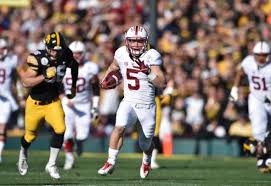 David Shaw looked both pumped and relaxed before the game. He seems to have comfortably settled in. And on the very first play, he played the very best card in the Cardinal deck.
All season, there has been one play has been extremely successful while still underused. It has almost gone unnoticed because Stanford never, as far as I could tell, used it more than once in a game. Hogan is in the shotgun, three receivers are fanned out, one TE/receiver is in the slot, and McCaffrey is in the backfield next to Hogan. With four receivers, the there aren’t a lot of defenders left to cover McCaffrey. McCaffrey swings around the line and finds himself involved with a single linebacker or safety. In most iterations of this play during the season, he has had a linebacker on him. He jukes like he is going outside, then cuts inside on a dime store 45 degree hypotenuse of heaven. The slickest slant on this side of the Sierras. Hogan fires a bullet, and McCaffrey is off in space. Usually a safety or other cornerback has been able to track McCaffrey down after 30 or 40 yards. But this time, the Iowa linebacker was slid over on the other side of the field, and the safety came up to cover him. No chance. On the first play of the Rose Bowl, the Iowa defenders might have been a little nervous or flat-footed. What a beautiful time for the that play and that call by Shaw. Fortunately, McCaffrey’s speed and angle allowed him to break through for a 75-yard touchdown. Pass the guacamole… and a clean pair of shorts.
On Iowa’s first play, it was whistled for a false start. And so the game went. McCaffrey gained 65 yards on the next touchdown drive to have 140 yards with about 8% of the game elapsed. And on Iowa’s next possession, Quenton Meeks took and interception to the house to give Stanford a 21-0 lead.
The defense shut down Iowa’s running game, limiting them to 48 yards on 38 attempts. Almost everyone played well, including Shaw, who made the seemingly-obvious but historically-troublesome decision to go for it in the 2nd quarter on 4th and 1 from Iowa’s 33. Remound Wright picked it up no problem. And Shaw then used a fake fumble, trick play for a touchdown pass on the next play.
2. Hogan’s Legacy
Hogan’s record as a starting quarterback: 36-10. He’s led Stanford to three conference championships. He has three bowl victories including two Rose Bowls. He’s no Andrew Luck, or John Elway, or Jim Plunkett, and he doesn’t need to be—he has a better Stanford record than all of them. Well, OK… Luck had a slightly better winning percentage as a starter, going 31-7. But no Rose Bowl wins. Perhaps the simplest way of summing up Kevin Hogan is in one word—winner.
3. McCaffrey & The Heisman Trophy
“What’s the statistic du jour?”
“It’s the statistic of the day.”
“Mmmm… that sounds good. I’ll have that.”
|
2015 Season |
#of Games with 350+ All-Purpose Yards |
|
Christian McCaffrey |
4 |
| All other FBS players |
0 |
What the hell is that? If it isn’t Ray Finkle, then it sure as hell is a Heisman-quality statistic. Well, he must have put up some of those numbers in meaningless games, right? The four opponents were: UCLA, California, USC (in the Pac-12 Championship game), and Iowa (in the Rose Bowl). Wow. All big-time games.
And he did this for the #3 team in the country. Of course, the Heisman winner, Derrick Henry, played for the #1 team in the country, Alabama. Should he get the edge for playing on the better team? In my opinion, the Heisman should go to the best player, not the best player on the best team. Henry already has a ring… that is his reward. Now if Stanford was the 40th best team in the country, you might give Henry a nudge, since he would be playing in bigger games with greater stakes. But you can’t differentiate between teams that are that close in quality.
Of course, Henry didn’t get the benefit of returning kicks and punts. So, let’s take return yardage out of the equation. McCaffrey averaged 7.0 yards/play from scrimmage. Henry averaged only 5.7 yards/play. That is a pretty significant difference for running backs. And statistics have played an important role in determining who wins the Heisman. Marcus Mariota (2014) and Jameis Winston (2013) both led the nation in passing yards per attempt. So what gives?
The racial discrimination explanation is probably insignificant and hard to quantify–though the number 43 is important. It has been 43 years since a white running back (John Cappelletti at Penn State) won the Heisman Trophy. So there might be a slight subconscious bias against white running backs.
I think the late kickoff time for east coast voters explanation doesn’t carry too much weight. In his Heisman season, Mariota played in 6 games that started at 9pm ET or later; McCaffrey played in 7.
I do think it is absurd that 15% of Heisman voters cast their ballots before the Pac12 Championship game, effectively ignoring one of the best college football single-game performances in history. That is part of the explanation why he didn’t win. As for the rest, I think that some people still just didn’t respect Stanford football enough. It is the only explanation for Stanford continuing to field the runner-up.
However, finally, as of this 2016 season, I think that there are now very few people left out there who don’t think Stanford players are as good as any players in the country. Stanford was picked by the media to win the Pac-12 conference for the first time ever, despite losing its four-year starting quarterback and a ton of talent on both sides of the ball. And it was slotted 8th in the preseason AP Poll. That is the kind of respect that teams like Alabama and USC are used to getting year after year. For the first time, the personnel losses didn’t matter; storylines didn’t matter; the name on the jersey is all that mattered, and that name is fully respected. That, for a long-time fan like myself, is nothing short of spectacular.
4. Up Next
What’s coming up?… A great matchup in the 2016 opener versus big purple: Kansas State. A quarterback situation that is to be determined. Lots of new faces (helmets) in the trenches.
Besides watching McCaffrey, I’m most looking forward to the defensive back play. In the past five seasons, Stanford has finished 102nd, 45th, 71st, 78th, and 106th in the FBS in interceptions per game. Look for this trend to change dramatically in the 2016 campaign.
 Football on the Farm
YES. Glad this is happening again this year!
I always thought the Heisman was awarded to the best college football player. When I was playing, a football player had to know how to block, tackle, kick, pass, catch, and run. Some, but not all of those skills require contact with the ball. Near as I could tell, Henry could run, I guess he could catch, and I imagine he could block. McCaffery could also run, catch and block. Only he could do it better. And he could also run back punts and kick-offs. I think he also threw a pass or two. And maybe he tackled somebody when Hogan threw one of his ill-timed passes to an opponent. I don’t believe Henry ever tackled anybody. Thus, given his overall superiority in the skills department, as well as his objective superiority in numbers, McCaffery should have won the Heisman. Race? Maybe. Bias against the West Coast, especially a West Coast school that has the top 3 number of Olympic medalists this year (Cal and SC are the other two)? Maybe. Early voting? No doubt. But clearly McCaffery got jobbed. Based on how Kansas State played him, his task this year is going to be harder, but he starts as the #2 or #3 candidate behind that guy from LSU. Don’t worry about Pumphrey; after all, he was running against Cal. So let’s see if he can win it this year, although I think that if you had to make a deal with the Devil, and he offered you a trip to the Final Four or the Heisman, you’d take the trip, wouldn’t you? I’d end with my traditional “Go Bears!” but the Bears ain’t going anywhere.
Good stuff Jon. Love the reminder about how McCaffrey is a good tackler–indeed back when he was on kickoff team he recorded three tackles in one game. And yes, I’d take ticket to the Playoff over a Heisman win.