
1. Perspective
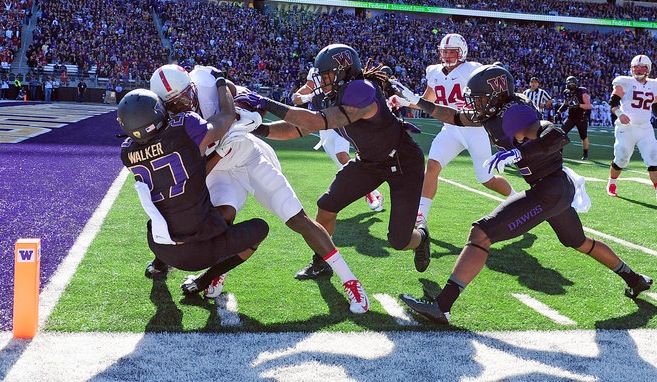 It was a familiar feeling during the end of a Stanford game. A slim lead. A cautious, simplified offense trying to run out the clock. A reliance on our defense. We’ve won a lot of games in the past couple of years this way. In the past three years, these are the games in which the defense was forced to make a final stand when Stanford led by one score (8 points) or less:
2012: San Jose State, USC, Notre Dame, Washington St, Oregon St, UCLA, Wisconsin
2013: Washington, Oregon St., Notre Dame
2014: Washington
The defense has sealed the deal on every one of those games except one: Notre Dame in 2012. In that game, it still kept Notre Dame out of the end zone and forced them to kick a game-tying field goal at the end of regulation. Since 2012, our defense has never allowed a late, 4th quarter touchdown that led to a loss. That is gutsy stuff from a hardworking, gutsy group of players.
The offense, of course, has not had nearly as much success in crucial, late-game situations. (Though, Hogan did lead a beautiful drive two years ago in Eugene.)
2. Offense: Is Ty Montgomery Our Best Running Back?
Hogan had 14 carries in this game. He is clearly trying to limit turnovers, which is great. But it also means he hasn’t gotten much better at finding the 2nd and 3rd options when the primary receiver is covered. Fortunately, three of those 14 carries were designed rollouts, and all of them worked beautifully. In the 1st quarter, it was a Hogan audible that took advantage of a mismatch as he rolled out to find Montgomery on a key 3rd down play. Montgomery brushed aside the Husky defenders and illegally-parked Fiats and collected his touchdown. Montgomery is our Tyler Gaffney. Stanford has too many good receivers anyways.
Montgomery should line up in the backfield about 10 times per game—enough times so that he doesn’t get the ball every time he is back there. Play action with Montgomery, then hit Rector downfield, or option to McCaffrey in the flat. Boom.
Hogan played a below average game. He missed two easy throws, one on a slant to Montgomery that would have gone for a touchdown on a drive that ended in a missed field goal. That was frustrating. If you already don’t think much of Hogan then you saw your own thoughts on that very play. While the interception wasn’t a terrible play by Hogan—Montgomery should have put up more of a fight for the ball—he should have suffered a pick 6 earlier in the game. I also don’t totally blame him on his red zone fumble—Shaw is crazy for calling a draw play needing 11 yards—but Hogan still fumbled. So, not a good game.
The running backs have been fine, but I wish one of them would have stood out by now. I agree with Rick Neuheisel and others that it hurts Stanford to rotate so many backs—it takes away the chance of a back spotting patterns and getting a good feel for the game. On Stanford’s first (short) drive, Kelsey Young was the primary back, but Remound Wright got a carry also. On the second drive, Barry Sanders got the carry on 1st down. On 2nd and 3, Wright was back in. But a false start caused Shaw to take out Wright before playing a down, and Young got the carry on 2nd and 8. That is a lot of substituting early in the game. When I think of rotating players, I think of at least letting one guy stay in for a series of consecutive plays so he can get into the flow of the game. I’m totally speculating here, of course. But Stanford’s rotation does seem a little over the top. There is value in keeping things simple.
The three turnovers hurt the Cardinal, as two of them directly caused a ten-point swing. It shows how powerful a team is when it can win a game in which it has a minus 3 turnover margin. Turnovers can be a fluke thing, and one of them was. But Stanford seems to have a little bit of an issue right now with turnovers, especially in the red zone. Stanford is 118th in red zone offense this year. It wasn’t long ago that in 2011, Stanford led the nation, scoring 53 touchdowns and 14 field goals on 69 trips—a 97% scoring rate. (David Lombardi covers this nicely here.)
3. Defense: Peter Kalambayi Offers to Host Reunion Party in the Backfield
Stanford is #1 in the country in scoring defense: 6.5 pts/game
Stanford is #1 in the country in total defense: 198 yds/game
Stanford is #1 in the country in pass defense: 74 yds/game
Stanford is #1 in the country in trips to the red zone allowed: 3
(Yes, we played Army and Davis, but USC and UW have good offenses. Against teams other than Stanford, USC is averaging 500 yards/game and UW is averaging 418 yds/game. )
The defense has swagger.
Plus, all three phases. All three mother-brothering phases! We can all sleep soundly at night knowing that Stanford has the best fake punt coverage defense in the history of mankind.
4. Coaching
UW coach Chris Peterson took a lot of heat for the fake punt call in the fourth. Some of that criticism is hindsight and of no value. In my opinion, the general decision to take a chance on 4th down was not flawed. The problem was that Stanford was not going to be fooled by a fake punt—it has already shown that this year. But a pass on that 4th and 9 play wouldn’t have been a horrible idea. Writers and analysts have discussed the missed opportunity to pin Stanford’s “inept” offense deep, but Stanford wasn’t having that much trouble moving the ball. It was having trouble scoring. In that sense, what difference does it make where Stanford takes over? The fake punt was a bad call, but the desire to take a chance on 4th down was not clearly wrong.
Shaw still isn’t doing anything interesting on 4th downs in opponent’s territory, which is one reason that Stanford is 114th in the nation in net punting, averaging about 33 net yards per punt. In the 1st quarter, we faced a 3rd and 4 from the Washington 40. Instead of attempting a pass and then punting, Shaw could be thinking that he has two downs to work with, so he can run the ball on 3rd down if he wants. Later, in the 3rd quarter, Stanford faced a 3rd and 2 at the UW 23, and again didn’t run the ball. Until it becomes obvious to opposing defenses and Hogan is forced to audible to a passing play, isn’t it obvious what we should be doing in those situations? We should run the ball—twice, right? Shaw called for a pass, Hogan was sacked, and we no longer could run on 4th down. So Williamson missed a field goal instead.
As much as I loved watching the great John Hopkins kick field goals, I am now very weary of attempting too many field goals. Two field goals aren’t enough to cover the points from one touchdown. So you need three scoring field goal drives to keep up with a touchdown. Keep in mind that Washington botched an extra point in the 1st half, which was the only reason Stanford wasn’t trailing by one the entire 2nd half. For Williamson to have a shot at making three field goals, he’ll need at least four attempts. That means that Stanford will need to attempt four field goals to keep pace with one touchdown. What does all this mean? Go for it. What’s the problem then? Why aren’t we doing that? Against USC, Shaw ran the ball on 4th and 1. He’s conservative, but he still goes for it sometimes. Why isn’t he doing it more? What else is going on? Well, it seems that the problem now goes beyond a conservative coaching approach, and Shaw may be working with a short stack of cards. So far this year, on 8 third and fourth down runs with 3 yards or less to go, we are averaging 0.25 yards/carry. Ouch. I knew it was bad, but I didn’t know it was that bad. For Stanford to establish a consistent offense, it has to be able to get short yardage on the ground.
How about Ty Montgomery dotting the “i” on third and short?
5. Up Next: Notre Dame
Adding to the drama of this game is the officiating fiasco in 2012, when officials erroneously ruled that Stepfan Taylor’s forward progress had stopped on the last play of Stanford’s OT loss. (Taylor was decidedly more “active” during that play than Remound Wright was against UW when he was stripped in the 2nd quarter on Saturday.) Anyhow, Stanford will likely be seeking revenge, and it will not be intimidated by the environment.
Against UW, Stanford surrendered its first completed pass of the season that went over the top of its backs and safeties. Jaydon Mickens blew by Zach Hoffpauir, who doesn’t have the speed to keep up. I’m slightly concerned that Notre Dame (4-0) will watch that tape and figure out how to exploit that weakness. Hoffpauir is a great tackler, but Notre Dame really has some serious speed at receiver.
Even against a Syracuse team that probably isn’t that physical, Notre Dame kept its offense working on the perimeter. Runs outside the tackles, wide receiver screens, swing passes, deep outs, curls to the sidelines—these were the plays Notre Dame was running. (It was these short, quick, sideways passes that allowed Golson to complete 25 in a row against Syracuse, almost setting an FBS record.) There were very few runs up the middle, and almost no passes into the middle of the field. And that was against Syracuse. Stanford has one of the best front sevens in the country. Notre Dame will try to beat us with speed along the sidelines. Can our defense backs keep up with the speed of Notre Dame? Can we fight off blockers on wide receiver screens and make tackles? Can we defend the deep ball? These are the keys to the game, in my opinion.
Josh Nunes was awful at QB two years ago in South Bend. Hogan is due for a good game. The weather forecast is for cold with a chance of rain—ominously, just the same environment as two years ago. But that was Nunes, not Hogan. Read up on Hogan’s “mudder” persona from coach Shaw’s 2012 post-game news conference after Stanford beat UCLA in late November, 2012: “when Coach Pep [Hamilton] brought the film in and we saw the wet, rainy conditions, [Kevin] seemed like he was the only guy not slipping. You saw athleticism, a strong arm, and a guy that made good decisions. You saw a guy that could run and challenge defenses. And he’s going to keep challenging defenses on the edge, right, Kevin?” (Hogan was sitting next to Shaw at the time.) Shaw continued, “But at the same time, those intangibles, those things that you can’t teach, those things are so valuable to an offense.”
Did you catch that nugget in there? Challenge the edges. Yes, indeed. Let’s keep Hogan moving on rollouts and bootlegs.
6. The Playoff Picture
Holy SEC West. At first glance, the records look great. But there are still a few losses mixed in there… because they had to play themselves! The SEC West is 25 – 0 when not playing itself. If it continues to beat up on nonconference opponents and on the SEC East, the SEC West will likely deserve two teams in the Playoff.
This week features the best slate of regular season games of the entire season. The playoff discussion will be a lot more interesting after this coming weekend. As for who is now at the heart of the playoff discussion, it remains the same as last week: many teams from the Pac-12 and the SEC, Oklahoma, Baylor, and Florida St. If Notre Dame beats Stanford, we’ll add them to the list.
7. The Playoff Picture (of Committee Member Barry Alvarez That Now Hangs on My Bedroom Wall)
Playoff committee member Barry Alvarez, interviewed by ESPN, offered some supremely nectary words of quantitative refreshment. “In other words, let’s say a team scores 50 points four games in a row, but the teams they’re playing give up an average of 45,” Alvarez said. “And then you’ve got someone who’s played a very difficult schedule and they’re averaging 21 points a game, but the teams they’re playing only give up an average of 10 points. There’s a huge difference there.
“I’ve got one of our statisticians helping me,” Alvarez said. “He works in our sports information office, and he’s a stat nut. We look at statistics, we watch film together, we sit down, and he and I talk about the games and put our things together.”
Now that this news is out there, other committee members should be motivated to have the same kind of conversations with statisticians. Fans should be glad to hear that there is more going on than the lazy eye test.
8. Barry Alvarez’s New Favorite Joke
Three statisticians go out deer hunting. The first one shoots about 5 inches too high. The second one takes aim, but misses 5 inches too low. The third one exclaims, “We got him!”
9. Around the Pac-12
Utah is 11-1 in nonconference games since joining the Pac-12. Each conference has to have some teams that go 2-7 in conference play. The conference should be glad to have one of its bottom dwellers win some games out of conference. I loved watching them dominate Michigan. (More on Michigan later.)
The Oregon lines looked vulnerable against WSU. That is good news for Stanford.
UCLA defensive backs held and interfered on almost every passing play against Arizona State. Seemed like it was a deliberate strategy, and it worked, since the officials only called a few of them.
Is it possible that Oregon State is actually the easiest opponent remaining on Stanford’s schedule? At this point, I’d choose to play them over Washington State. Not sure about Cal yet though.
10. Blast from the Past: San Jose State
Two weeks ago, San Jose State (1-3) lost to Minnesota, who was using a back-up quarterback and only completed one pass for seven yards in the entire game. It might be a good thing that Stanford doesn’t have SJSU scheduled for the time being. They would be a huge drag on strength of schedule. What a difference from two years ago when the Spartans went 11-2 and finished the year ranked #21.
11. Underrated Team of the Week
#12 Mississippi State Bulldogs (4-0). In my last post, I called out MSU for being overrated. They were. Since then, they recorded the most impressive victory of any team this season, winning at LSU. They controlled the line of scrimmage, gained more yards, and lead comfortably the entire game. It was no fluke. After years of mediocrity, the Bulldogs finally deserve some credit. In my opinion, this team should be ranked 5th. (Jon Wilner actually has them at #2.)
Either way, things will sort themselves out. Mississippi State faces Texas A&M on Saturday, and Auburn the following week.
12. Transitive Property Applications of the Week
Recently, it has become even clearer to me that applying the transitive property (x beat y, y beat z, so x > z) to rank college football teams is only of marginal use. I thought that if the margins of victory were great enough, that it might still makes sense to apply this logic. But there are way too many variables in a college football game, and obviously in a season, to think that the transitive property implies definitive, objective answers. However, just because it is not extremely meaningful doesn’t mean that it is meaningless—know what I mean? Analysis of results against common opponents is and should always be a piece of the puzzle that is the college football landscape. And, sometimes, it is just damn fun to apply.
Michigan (2-3) owns two of the worst wins in the FBS. It beat Miami of Ohio, which is 0-5, and Appalachian St, which holds no victories against FBS teams. Thus, we have the following inequality:
Most of FBS > Michigan > Miami of Ohio and Appalachian St.
Appalachian St. does own a clutch victory over FCS school Campbell, so let’s pick up that chain. Since it follows a bunch of teams with only one victory, the links of supposed superiority are easy to trace. Enjoy how Michigan can hold its lofty head above the underworld of college football:
Michigan > Appalachian St. > Campbell > Valparaiso > William Jewell > SW Baptist > Lincoln (MO).
Then, things get weird, as ESPN.com shows that Lincoln has two wins, including a 49-48 victory over Langston. A journey to the schools’ websites, though, reveals that Langston won the game 49-48, so Lincoln actually has only beaten Quincy. Quincy has two wins, but they are over NAIA schools: Haskell Indian Nation and Lindenwood. Haskell Indian Nation is 0-5, but Lindenwood has one victory over Missouri Baptist. And there lies the end of our Chain, as Missouri Baptist (0-5) is perhaps the worst NAIA team, having lost each game by over 30 points. Let’s string this out one more time from the beginning:
Michigan > Appalachian St. > Campbell > Valparaiso > William Jewell > SW Baptist > Lincoln (MO) > Quincy > Haskell Indian Nation and Lindenwood > Missouri Baptist.
If this was European league soccer, I’d say that Michigan should start familiarizing itself with its future FCS colleagues in 2015.
Even with three wins, Stanford almost suffers from a similar fate, since UC Davis and Army are so bad, and Washington has only beaten lousy teams. Fortunately, UW’s win over Illinois opens up a chain that unravels to the SEC and a lot of the college football world. Here’s an example:
Stanford > Washington > Illinois > Western Kentucky > Bowling Green > Indiana > Missouri > South Carolina > Georgia > lots of other teams.
Can you use this as an argument that #13 Georgia (3-1) should not be ahead of 14th ranked Stanford? Probably not. Everything will get sorted out anyway by next the time next week’s setlist comes out. Here’s a preview: Scarlet Begonias > Stanford > Fire on the Mountain > All Right Now > Touchdown Jesus > Boogie On Reggae Woman > Georgia on my Mind > Mind Left Body Jam. Mail me return postage and two blank cassette tapes if you want the recording. (The Stanford > Fire is really funky.)
 Football on the Farm
Love the setlist! Fascinated to see what goes down this week in South Bend.
Yep. Yesterday, Vicki even said she can’t wait to watch the game this week.
I’d like to see more of McCaffrey and I wonder why Michael Rector isn’t showing up in the passing game. Tough game against Notre Dame given their very mobile and talented QB.
McCaffrey looks like a natural every time he touches the ball. And I’d like to see Rector get a chance on some deep balls. Not sure why we haven’t seen him. Trojan and Owusu seem to be completely solid as well, so perhaps we just have too many good receivers.
Love this week’s transitive property analysis – and the inclusion of Valpo. My alma mater’s football team is finally receiving recognition from sportswriters.
Well, Kevin, they derserve it. That was a hard fought win at WIlliam Jewell, especially since they were down 22-7. I’m sure Devan Gadson’s 3rd quarter pick 6 got you screaming with joy at the internet radio.