1. Perspective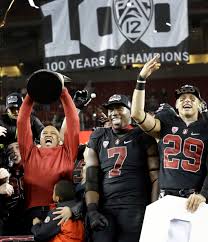
Since 1961, when the conference starting keeping track of a preseason media poll, Stanford has never been picked to win the title. On Saturday, Stanford earned its sixth Pac-12 championship in the past 50 years, and its third in the past four seasons.
Oregon or USC has led the preseason media poll the past 13 seasons. Despite the fact that Stanford has been a vastly better team than USC over the past six seasons, USC was again picked to win the conference this year. Furthermore, UCLA was also getting heaps of hype—ignoring the fact that it had lost to Stanford an astonishing seven (and now eight) consecutive times.
There was no faith in the dynasty. No respect. Of course, even most of the Stanford fans had left the bandwagon after the Northwestern game. I considered taking a year off from the blog! What an idiot.
Fortunately for us, Shaw rallied the troops and gave us a season that was supremely entertaining. And fortunately for me, my tailgate crew rallied as well and was 100% committed to going to Saturday’s championship game. Because of November home games and other obligations I have in December, I am spending basically every Saturday for two months driving hours away from Sebastopol. So I was prepared to watch the Pac12 championship on television in order to spend a rare weekend at home. But my comrades knew better, and they were right. It was a fun tailgate, an exciting game, and I was damn glad that I was there.
Stanford never went three and out, and only punted once. The offense was a pure joy to watch, and Stanford has now scored at least 30 points in 12 consecutive games. That is the longest active streak among Power 5 teams. Yep, you could make an argument that your Stanford Cardinal has the best offense in the country this season. Seriously. It isn’t a slam dunk case, but who else are you going to say is better?
Let’s lob in some facts that occurred in both the September game at USC and the Pac-12 championship game:
- Stanford committed no turnovers.
- Kevin Hogan completed at least 75% of his passes and averaged over 11 yards per attempt.
- Kevin Hogan had at least 30 rushing yards.
- Stanford had at least 35 minutes of possession.
- McCaffrey put up huge all-purpose numbers.
Yet, in September against USC, McCaffrey didn’t have a single play from scrimmage go for more than 19 yards. Umm… well, he had a few big ones in this game. McCaffrey’s 461 all-purpose yards was the 5th best in FBS history, and boosted his season total to 3,496 yards, crushing Barry Sanders’record. (We should note that he technically hasn’t beat Sanders’ record yet—he should have 30 yards more to go if it wasn’t for a ridiculous stats-keeping decision by the NCAA.)
McCaffrey might not win the Heisman, but he should. That is a special record that he is setting. McCaffrey has 61% more all-purpose yards than any other Power 5 conference player this season. He leads Jakeem Grant of Texas Tech by 1,329 yards! What!?!?! It isn’t even close. No player is more dynamic in college football. If McCaffrey played for Alabama, he would win the Heisman by a mile. Pretty pathetic how biased the award is, but what can you do… the Pac-12 hasn’t won a national championship in over ten years. That is the first thing that needs to change if we are to expect the attention and respect.
After the game, McCaffrey was asked about the fact that he had a passing touchdown, rushing touchdown, and receiving touchdown—all in the same game. He said it was cool, but immediately pointed out that Kevin Hogan did the exact same thing in the game. First of all, that might be the first time in the history of major college football that two players on the same team have accomplished that feat in the same game. Second, you got to love that McCaffrey’s immediate response was to shine the spotlight back on Hogan. That moment right there defines the character of Stanford football.
For more on McCaffrey’s case for the Heisman, including the stunning fact that “McCaffrey is averaging 8.3 yards per touch… the best mark in college football history,” read this article from David Lombardi. (Lombardi doesn’t qualify this stat though… there must be a minimum number of touches he is using for this stat, though I couldn’t find or verify it with some internet searches. Let me know if you can.)
McCaffrey’s 461 all-purpose yards is the 5th best in FBS history. The record is held by Emmett White of Utah State, who gained 578 yards against a New Mexico State defense that was ranked 95th in total defense. McCaffrey’s game is likely “better,” given the opponent and significance of the conference championship. But I can’t find out who holds the 2nd through 4th most all-purpose yards. Let me know if you can find the info. What I’m getting at is that McCaffrey’s numbers might actually be the best ever in a championship-caliber game involving good teams.
2. Spreading the Field with Three Receivers
Stanford came out hot, spreading the field and taking some shots downfield. But then, during the middle of the game, and especially in the red zone, Shaw went with a bit of jumbo and wildcat and less spread formations. The results were not good. For example, on its fourth drive, Stanford started with two plays in spread formation and picked up the first down. Then, close to goal line, the Cardinal ran all four plays without three wideouts and turned the ball over on downs.
My dad, next to whom I had the pleasure of sitting, noticed the trend during the game. We discussed it throughout the 2nd and 3rd quarter and were hoping to see the Cardinal return to the spread formation. Shaw and coaching staff delivered in a big way. They absolutely realized what was happening: McCaffrey was having more success running the ball when USC was forced to use 5 defensive backs (three corners on the three receivers and two safeties). On its key 10-play, 4th quarter drive, Shaw called for three receivers on 9 plays. The only other play still had two receivers spread wide. No jumbo. No wildcat. The Cardinal coaching staff came through in a big, big way. They recognized a key game trend and capitalized on it.
In fact, on its last 16 offensive plays, Stanford did not use a single jumbo package, and never had less than two receivers spread out in formation. This is the exact opposite of what we did the last time we played USC, and shows the versatility of the team and the coaching staff.
The data was clear. The following drive chart tracks the percentage of plays in each drive the Cardinal lined up with at least three receivers. Notice the strong correlation between successful drives and a spread formation.
STANFORD Drive Start Time
|
# of Plays with 3+ Wideouts
|
Total Plays in Drive
|
% of Plays with 3+ Wideouts
|
Yards Gained in Drive
|
Drive Result
|
| 1Q 15:00 |
8 |
12 |
67% |
55 |
FG |
| 1Q 6:43 |
8 |
13 |
62% |
78 |
TD |
| 2Q 13:34 |
1 |
8 |
13% |
59 |
FG |
| 2Q 7:31 |
2 |
6 |
33% |
13 |
Downs |
| 3Q 11:51 |
2 |
6 |
33% |
18 |
Punt |
| 3Q 5:28 |
3 |
4 |
75% |
78 |
TD |
| 4Q 12:29 |
9 |
10 |
90% |
75 |
TD |
| 4Q 4:24 |
4 |
6 |
67% |
37 |
TD |
3. Shaw, Trick Plays, and 4th Down
On Stanford’s 2nd drive, up 3-0, it faced a 4th and inches from the USC 13. Shaw made the call to go for it, and I reached for a clean pair of shorts. The correct call—without question. I’m not sure if anyone on staff is aware of just how automatic this decision should be. (I’m not sure if any reporters know either—ESPN’s Kevin Gemmel wrote an excellent article about Wright’s success picking up TDs and short yardage but didn’t mention this statistic.) Coming into the USC game, Remound Wright was 27 for 27 converting 3rd or 4th downs with one or two yards to go. Insane. Shaw might not know the stat, be he knew exactly what to do: give the ball to Wright. He picked up the first down, and Stanford finished the drive with a touchdown.
And what a beautiful touchdown is was. Hogan pitches to Wright who pitches to McCaffrey who throws back to Hogan. What an awesome play and a great call by Shaw.
On Stanford’s next drive, on 3rd and goal from the 1, Wright was stopped for the first time in 29 tries. It was the exact same play to the same side Stanford ran on the prior drive, but this time USC knew exactly where Wright was going, and brought all of its linebackers to the left side so there was one available defender to meet Wright mid-flight. OK, so that is the first time all year that has happened. We have a 10-0 lead, so we already have a two-score advantage. Time to take another swig from the kombucha bottle and get back after it. But Shaw made the wrong decision and sent in Ukropina.
On the next drive, leading 13-0, we decided to go for it on 4th and 1 from the one. Well, fine, but why leading 13-0 and not 10-0? It makes more sense to go for it leading 10-0. Shaw needs some coherent strategy here. But, at least, we are seeing more aggression and confidence on 4th down than we have in the past. And the late 4th quarter, 4th down pass to Cajuste was as tasty as a Bloody Mary on the morning of Jazzfest.
Shaw is happier and more comfortable than ever. There is no doubt about his ability to lead the team—Stanford is headed to the Rose Bowl for the 3rd time in 4 years. He’s the only Stanford coach in the post WWII era to accomplish that. He’s established a solid and growing legacy, a consistent turnstile of top recruits, and a drama-free and team-oriented group of men. And, as I’ve noted over the past three years, he still has a tiny bit of upside with game management. But he is a very solid coach—there can be no question about that. Stanford is lucky to have him. Fortunately, he knows how lucky he is to have Stanford as well.
4. Defensive MVP: Blake Martinez
Two things worth mentioning here. First, Martinez had the play of the game when he caused the Kessler fumble that was returned for a Stanford touchdown. Second, for the season, Martinez had more tackles than anyone else in the Pac-12 conference—by twenty. He had 129 tackles on the season, good for 9th nationally, and 20 more than anyone else in the conference. He was our anchor as our defense worked through injuries and growing pains all season long.
5. How Close Was Stanford to Making the Playoff?
We can name that tune in one note. It isn’t a Stanford play, though. Erasing those fumbles against Oregon or converting the two-point conversion would not yet have guaranteed the win. But there is one single play that, if it alone had gone differently, would have allowed Stanford to make the playoff.
On September 12th in Knoxville, Oklahoma scored 14 unanswered to push Tennessee to overtime. Tennessee got the ball first in overtime and scored a touchdown. Oklahoma needed to score a TD to stay alive. It faced a 4th and goal from the Tennessee 1. Baker Mayfield faked the handoff and kept it and found the endzone. Oklahoma went on to win the game in the 2nd overtime. If Mayfield had been stopped on that play, then Stanford would have made the College Football Playoff.
6. Pac-12 Bowl Matchups
I hate to admit it, but the Pac-12 bowl lineup is lacking luster. The Pac-12 is sending 10 teams to bowl games, but very few provide national intrigue. The Pac-12 has no clear underdog—8 teams are favored and Oregon and ASU are about even. There is little chance to make a national statement, unless of course the conference goes 9-1, which is statistically unlikely. There is a chance to lose face though… which is the difficult thing when you are favored against no-name teams.
Honestly, other than the obvious Rose Bowl matchup and the Alamo Bowl between Oregon and TCU, only one other game interests me: Washington State vs Miami in the Sun Bowl. That is a great matchup for the conference, and in my opinion is the only game other than the Rose Bowl in which the conference can make a real statement by simply winning the game. In the other games, a statement is going to have to come with a lopsided victory.
Well, maybe I’m being too harsh here. I suppose Utah-BYU should be fun, and USC-Wisconsin isn’t bad either. But the Pac-12 really needs to get a regular bowl game against the SEC. Until that happens, we’re stuck with too many games like Arizona vs New Mexico.
7. The Rose Bowl: vs Iowa (12-1)
Of course, most of us were hoping for a shot at Ohio State. Despite 6 years of playing football as good as anyone else in the country, we have never once faced a team that has won a national championship in that span: Ohio State, Florida State, Alabama, or Auburn. It would have been special to have played the defending champions. But, as the reality sinks in, I’m just fine with Iowa. Ohio State presented a huge chance to make a statement, but it would have come with a risk. Ezekiel Elliot could have walked over our defense. I don’t think Iowa will rush for 300 yards against us. Ohio State might have. Plus, Ohio State has the dual threat quarterback, with which Stanford has struggled. Iowa does not.
So, I like the matchup. I’m sure Iowa’s defense will be tough to run against, but that’s OK. They aren’t used to facing offenses as good as ours. And I think our defense might be able to handle Iowa’s offense. Consider this stat: Iowa didn’t run a single play in Michigan State territory in the entire 2nd half. Vegas seems to feel the same way, as Stanford opens as a six point favorite… which of course brings up the fact that the committee ranked Iowa #5, one spot ahead of Stanford. I didn’t like it at first, but I suppose I understand it. If you look at what happened against our common opponent, Northwestern, it makes it hard to make a clear case that Stanford should be ranked higher. And it doesn’t matter anyways. It will be settled on the field.
The story of the game should revolve around the career of Kevin Hogan. Come, hear, Uncle Hogan’s Band, playing in the Rose. Come with me, or go alone, he’s come to take his teammates home. It’s the same story that Shaw told me, it’s the only one he knows. Like the first quarter he comes, and like the wins he goes. Ain’t no time to hate, barely time to wait. Wo, oh, what I want to know, how far Kevin Hogan goes.
Go Cardinal.

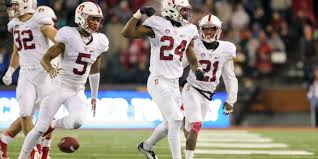
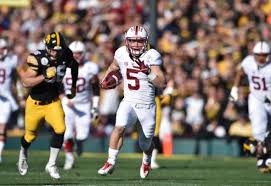 David Shaw looked both pumped and relaxed before the game. He seems to have comfortably settled in. And on the very first play, he played the very best card in the Cardinal deck.



 Football on the Farm