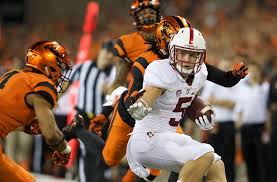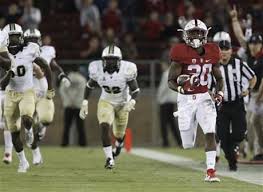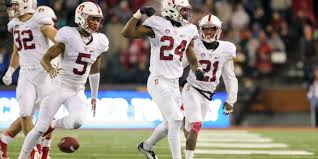
10/31: Stanford 30, WSU 28

1. PerspectiveUnknown

The night and game had a misty, eerie feeling from the get-go. Something about Halloween, in the cold and rain. And ESPN announcer Brock Huard always creeps me out. He started out referring to Stanford as “these Cardinals,” then next said, “these Cardinal,” before later in the first quarter settling in on “this Cardinal team.” Just horrible stuff to take on a Saturday night when I should have probably been dancing to Hot Buttered Rum at the Hopmonk in downtown Sebastopol rather than looking at Brock Huard’s porcelain mug and begging Hogan to complete a freaking pass. Jeez… it was a long night in front of the television, but like every visit to Green Tea massage parlor, it had a happy ending.

I wrote in my previous post that Stanford would need to keep the turnover margin even, at worst. By the time that Stanford had committed two turnovers, the game was slipping away. Stanford was still leading 3-0 at that point, but I sensed disaster. It was not its usual self., and Stanford was missing opportunities to build a lead. Fortunately, the ghost of freshman Quenton Meeks whisped past WSU receivers and stole the game for “these Stanford Cardinals.” (Freaking Brock f-ing Huard.)

Stanford was lucky—Washington State outgained Stanford by 130 yards and totally neutralized Stanford’s power run attack. And Hogan was having a terrible game through the air, reminiscent of the Notre Dame game in similar conditions last year. But Stanford escaped—for the first time all year. That perspective is important here—Stanford has not needed to get lucky yet. It won its previous six games in fairly convincing fashion. So in a way, it deserved to get lucky. And it was not as lucky as Michigan State against UM, or Mississippi against Alabama. It wasn’t a fluky victory, just a close game that went Stanford’s way.

Not only was it Stanford’s first victory in a close game this year, it was really its first victory in a close game in about two years! Here’s the data from Stanford’s last 22 games prior to its two-point win over WSU:

Margin of Victory         0-7 Points     8+ Points

Stanford’s Record (W-L)    1-4         14-3

Important to note is the fact that the sole victory by 7 points or less in the prior 22 games was Stanford’s 7 point win in 2014 against Washington. In that game, Stanford held UW to 179 total yards, but the final score was much closer than it should have been because Stanford lost the turnover battle 3-0, and one turnover was a fluke strip that was returned for a touchdown. Stanford really dominated that game. So, this Halloween treat was the first victory that wasn’t completely earned since the 2013 Washington game, 31 games ago. I’d say we were due for some good fortune, or at least a couple of dozen packs of Starburst left in an unmanned and well-lit doorway. Trick or treat? I’ll treat myself—thank you very little.

Remember the run at the end of 2012 in Hogan’s first year? We kept winning close games and ended up in the Rose Bowl. In Hogan’s first ten starts over the 2012-2013 seasons, Stanford went 5-0 in games decided by 7 points or less. That also puts the close losses of 2014 in some context. The law of averages is at work—you can fight it, but in the long run the coin is going to flip onto both sides (not at the same time, mind you—that would be weird… something like the Duke-Miami result, I suppose.) Overall, it was nice to see Stanford steal one for the first time in two seasons.

2. Defense: The Meek are Hungry for Pigskin

Quenton Meeks made one of the best defensive plays since Ed Reynolds made a pick and huge return against UCLA a few years ago. Meeks stepped in front to make a late 4th quarter pick (his second of the game) that set up Stanford’s go-ahead field goal. Without Meeks anticipatory insight and skilled hands, Stanford does not win the football game.

Couple things I want to mention are from a 4th quarter drive for WSU. WSU faced 4th and 1 from Stanford’s 12. They set up in the shotgun with four receivers. The Stanford cornerbacks were all set up 7 yards off the receivers! Falk saw this, threw a quick pass out to one receiver, and he lurched forward for the first down. On this play, it is obvious to an average fan that you must be right up on the receivers. What is the worst that can happen? You aren’t worried about them getting behind you. It was a major oversight that lead to a Cougar touchdown. Hopefully the coaches and players will catch this on the film and learn from it. On the flip side, Kodi Whitfield made a fantastical tackle on WSU’s two-point conversion attempt. Ended up being the difference in the game.

3. Offense and Coaching: To Adjust or Not To Adjust

It is hard to fault David Shaw for continuing to run McCaffrey up the middle. Even if WSU was loading the box and keying on him, I would have thought that Stanford could have overpowered the Cougars weak defense. But they just couldn’t do it. I think it was a combination of effort and scheme that was the difference for WSU. They really wanted this game badly, and their defense had only one goal: stop the Stanford running game. They played hard and were every bit as physical as Stanford.

Hogan could have gone off, had he been able to throw the ball before the century ends and land it within a city block of his receivers. I’d like to assume the weather had some effect, but Falk seemed to throw the ball OK. Hogan held the ball too long (sacks) or lost it too quickly (fumble).

But instead of simply just being one of those Hogan off-nights, it turned into Hogan boogie nights. Shaw credited Mike Bloomgren for getting some Hogan run plays into the mix and Hogan took full advantage. The defense was not at all expecting it. Hogan made them pay for keying on McCaffrey. Hogan had 117 yards rushing in the third quarter alone! As a woman in Bulgaria once told me when I asked her about the town’s Mexican restaurant: “Explosive!”

As always, I still get worried when Stanford is too predictable on offense. When it works, it feels like we have testicles the size of pumpkins. But when the defense is keying on our tendency and having success, we really need to shake things up. It was a problem last year with Ty Montgomery. On many plays, it was so completely obvious that we were going to Montgomery. After Montgomery got hurt, we had our three best games of the year.

Fortunately, we tried something we haven’t seen much of all year: Hogan on the move. It isn’t a coincidence that our first big play of the game, in the third quarter, was a 39-yard Hogan scamper that included a faked pitch to McCaffrey. The entire WSU defense, including the safety from the opposite site, crossed the field to pursue McCaffrey. Adjust. Adapt. Don’t die.

4. Mike Leach vs Christian McCaffrey

I would have cursed Leach most of the night for denying McCaffrey the chance to get his all purpose yards from kick returns, except that we kept getting the ball at the 40-45 yard line! Those pooch kicks were not smart. Nobody wins except Barry Sanders and his record. Even if McCaffrey takes one to the house I’m not sure that a bunch of touchbacks and one return TD is any worse than giving your opponent the ball around midfield on each possession.

Fortunately, McCaffrey still has a sizable lead in all-purpose yards and will lead the nation as long as other teams still kick the freaking football off. Unfortunately, McCaffrey’s average game against a poorly rated defense has derailed any hopes of the Heisman. If he wants to get back the race, he’s going to have a huge night back home in Colorado. The setting seems perfect. KLS has already early-called a huge game. Fingers crossed.

5. The Playoff Rankings

Credit the committee for its ranking so far. There is little with which to quibble. (First and last time I write that sentence.) One thing I like to compare the playoff rankings to is the College Football Rankings Composite complied by Massey. It averages the rankings of 112 different ranking systems (mostly computer… though it includes the human polls). Any one computer or human poll is inherently flawed, but an average of a ton of polls is an outstanding measure of team strength and performance. Indeed, Clemson is #1 in this composite poll—just like the committee rankings. In fact, no team in the Playoff Committee rankings top-20 is more than four spots away from its ranking in the Composite. Baylor is 6th in the Playoff rankings and 10th in the composite. I think Baylor is probably the most misranked team. I would like to see them down around 10th until they beat somebody. You can’t play nobody and let Lamar score 31 points against you and be #6. (Alright, alright… Lamar did put up 55 against Houston Baptsist and 66 against Bacone (Okla). Of course, if they keep winning, they can easily get to #1. So it isn’t a big deal right now. It’s a waste of time right now to debate the rankings and playoff scenarios. I’ll get to it in depth in a couple weeks.

For now, I’m fine with Stanford at #11—the same place it is in the Composite. And it is nice to see Notre Dame ranked #5. It is crucial that Notre Dame continue to win the next few games.

The only other team worth mentioning, I think, is USC. The composite rankings have USC (5-3) at #18. ESPN’s FPI has USC at #5. They Playoff Committee (and the AP poll) do not rank USC in the top-25. USC is clearly a good team. Stanford and Notre Dame had to play really well to beat USC. I think USC still has a strong chance to play in the Rose Bowl, and I believe it is a top-25 team.

6. Up Next: Colorado (4-5)

I haven’t seen them play this year, so don’t know what to expect. But I was surprised by how they played against UCLA last week. Plus it is an early kickoff. And it is on Pac12 networks, which I don’t get. Are more ominous forces at work? Stanford should be pumped though. They know they can’t sleepwalk through another one. The big question: can McCaffrey have a huge night in his home state?

10/24: Stanford 31, Washington 14

1. Perspective

UnknownSuch a bummer to not have time to dip the frothy fingers of Cardinal ponderings into the gooballs of another great football game. I am getting crushed at work and on the farm. Less time for The Farm. I expect that to change next week, as the first Playoff rankings will be released.

But I wish I had more time to expound on the glory of Coach David Shaw’s 4th down decision-making in this past game. Early in the 2nd quarter, facing a 4th and 3 from Washington’s 29, Shaw went to the power formation. Hogan killed or pretended to kill the first play option and then kept barking to try to draw the defense offside. For a second, I thought it was just a ploy that would end with a timeout and a field goal try. But then the center snapped the ball and Hogan pitched to McCaffrey. Got to love it. Give it to your best player in that situation. Beautiful call, and I’m going to go ahead and give credit to Shaw, Bloomgren, and/or Hogan for the decoy of lulling UW into thinking Stanford was just trying to catch the defense offside. That was a nice little twist.

In the 3rd quarter, on 4th and 1 from its own 46, Stanford again went for it. Mathematically, it is absolutely, without question, the correct call. Remound Wright picked up the first down without much trouble. I am very pleased to see Shaw make the correct call here, and it was against one of the best defenses in the conference. We’ll see if perhaps Shaw has seen the light on how to handle these 4th down situations.

I am completely loving Stanford’s offense. It has the power—sometimes boring—run game that brings a ton of satisfaction (and success) over the course of the game. But it also has a lot of fun and dynamic plays. It is complicated, and can be even more complicated, but the train is always moved down the tracks by the offensive line and the power run. It is a weird juxtaposition, and I am really enjoying it.

And we keep seeing new plays. There was a screen pass to fullback Daniel Marx that went for a nice gain. I’m pretty sure we haven’t seen that all year.

Of course, my favorite play is still when McCaffrey comes from the backfield or the near slot and goes one-on-one against a linebacker. There are four other receivers out downfield, so all the cornerbacks and safeties are tied up. One-on-one against a linebacker! As the ESPN announcer said, “That just isn’t fair.” He gets about five yards past the line of scrimmage then jukes the linebacker, usually slanting inside. It is unstoppable. On 2nd and 19, McCaffrey picked up 24 yards with this play. We have only seen it at most once per game. If we’re in a tight battle, we may need to use it a few more times.

2. Up Next: Washington State (5-2)

Walk me out in the cold, rain, and snow, my friends. Well, no snow, but it will be cold, wet, and windy. Got to think this favors Stanford. But it feels like a weird night, Halloween and all. You have to think Stanford will be able to move the pile, so I think this game might come down to turnovers. If Stanford can hold at least even on turnover margin, it has a nice chance to win the ball game.

10/15: Stanford 56, UCLA 35

1. PerspectiveUnknown

For some ungodly reason, Remound Wright held up his hands to keep Christian McCaffrey from returning the opening kickoff from three yards deep in the end zone. I don’t think Wright had received the memo—McCaffrey would have the green light all night long. It didn’t take long to fix Wright’s mistake. On the first play from scrimmage, McCaffrey took the handoff for 25 yards and the rest was history. He wouldn’t stop running until he had left his footprints in the record books.

Speaking of records, Stanford has some sweet nectar streaks going right now. That is 8 straight wins against UCLA. Pretty spectacular. Clearly this is not the same phenomenon as flipping a coin and getting eight straight heads. These odds are not equal.

Stanford has also won 25 consecutive home games played at night. That is prettier than a hot tub full of Guinness. I suppose I have no complaints then about the ongoing 7:30pm kickoffs.

Furthermore, Kevin Hogan is now solidly in first place as the winningest active quarterback. Who knew that the guy who would come in for Nunes for one play to specifically roll right and hit a receiver rolling with him would be such a great leader. Hogan-doubters are a rare breed nowadays. The kid is a winner.

2. Christian McCaffrey

I knew McCaffrey was having a huge game, but I had no idea he was running into the record books. I was shocked to hear in the 3rd quarter that McCaffrey had just set the single-game school rushing record. I think part of my shock was due to the fact that I knew that a big part of his big game was the 96 yard kickoff return. So I wasn’t thinking rushing record. Plus, he wasn’t getting a ton of carries. Of course, there were sequences of plays when it was obvious the ball was just going straight to him—wildcat or not. During a stretch in the 2nd and 3rd quarters, excluding Stanford taking a knee at the end of the half, McCaffrey touched the ball or was targeted on 17 of 18 plays. But he only had 25 carries on the day! 243 yards on 25 carries! The record McCaffrey broke was previously held by Toby Gerhart, who rushed for 223 yards against Oregon in 2009. But Gerhart had 38 carries! He only averaged 5.9 yards per carry. It was a special night for McCaffrey, and a wonderful article about it and him can be found here.

Going into the week, McCaffrey was second in all-purpose yards per game to Tyler Ervin from San Jose State. Inexplicably, Ervin only managed 45 all-purpose yards against San Diego State. And McCaffrey exploded for 369 yards against UCLA. So McCaffrey now holds a huge lead in all-purpose yards per game.

I’ve been wrong about a ton of things on this blog. Hell, even at the start of this year after the Northwestern game, I wrote: “What will be new and interesting this year? I honestly don’t know at this point.” I was panicking like an idiot, and McCaffrey has answered that question in a big way. After the third game (USC), I wrote: “You heard it here first: McCaffrey will lead the nation this year in all-purpose yards per game.” I’m going to go ahead and lock that statement in as fact. A few weeks ago I was looking at some stats and saw him in the 4th position in APY/game, but he was lacking breakout plays. It was a statistical improbability that he went three games without breaking off a huge gain. This is fact: he will lead the nation. He will not be caught. And there is still more upside! He is barely being used in the passing game. And he has had to fair catch almost all punts in the past two games. (And need I remind you… opening kickoff… Remound Wright… ‘ehem…)

Where is all this headed? To Barry Sanders, of course. Barry Sanders holds the FBS record for all-purpose yards in a season: 3,250. As long as Barry’s son doesn’t take up too many of the carries, McCaffrey has a shot at this. If Stanford plays 14 games, McCaffrey needs to average 232.1 yards per game. His current average? 253. Boom. Sizzle. Keep. Your. Eyes. On. This. If he stays on pace to break a record held by Barry Sanders… then just maybe… eh… fucking east coast Heisman voters… it’ll never happen.

3. Offense & Coaching

I short-circuited on the first drive, when Shaw punted on 4th and 2 from UCLA’s 42 yard line. I stammered in the crowd, “Shaw… you… fuck…shit… why are you throwing on 2nd and short if you’re not going to…. damn it… Teevens…. Harris…” Then I looked around at the people near me and had a glimpse of how—despite the huge annoyance of Shaw’s strategy—my behavior was a million times more obnoxious. We all make mistakes. I did. So did Shaw. Fortunately, it was Shaw’s first mistake in many games, and it didn’t end up mattering much.

It was a small fish in a sea of great coaching. Shaw threw in some sneaky calls. On first and goal from the four, after McCaffrey’s 96 yard kickoff return, Shaw let Hooper sneak into the corner for a TD pass. That was cool and unexpected. Also, on 2nd and 1, Hogan hit Cajuste on a quick slant for a touchdown. That should work most of the time, since almost always it is a run play in that situation. And the double reverse Hogan pass to Owusu was also a ton of fun, especially since Owusu made one of the greatest catches in football history. Even my partner, Vicki, said it was the coolest thing she’s ever seen. I showed it to her on tape on Sunday. Then, she thought back to Saturday morning and said, “Why the hell did Gameday not even show it in three hours of coverage?” Now that she mentioned it, it is insane. How did they not feature that catch on Gameday? Fortuntaely, Joe Tessitore did the call justice during the game. “You’re going to be seeing that next summer at the ESPYs… Not to smother this thing in hyperbole, but that is an instant all-timer.” Jesse Palmer added, “You could try that 500 times in practice and not catch a single one.” Compare this to the drabness of Sean McDonough and Chris Spielman calling the Michigan-MSU ending for ESPN—they totally failed to capture the ridiculously rare and historic drama of that final play. Quick note: MSU gained way more yards and Michigan defensive backs hold and commit PI on every play—MSU was (slightly) better that day.

Anyhow, amazing play by Owusu, and some fun calls by Shaw. Shaw still has some tricks, marbles, carrots, and slurpees. But, it was his decision to force the run game that really won this game. At the end of the first quarter, it wasn’t clear from where Stanford was going to get its offense. Hogan had found Hooper on some huge 3rd down plays, but Stanford was not moving the ball easily. Then, Shaw just decided to run up the middle. It was as if he just decided that it was time for Stanford to impose the run game. It didn’t feel like it was going to work, and it didn’t feel like Shaw cared. It seemed like Shaw was just deciding that we were going to keep running until we wore the defense down. And it totally blew the game open. It is so ballsy and so fun when it works. I just hope Shaw can readjust midgame whenever it isn’t working (i.e. Rose Bowl vs Michigan State.)

4. Defense

Elijah Holder really jumpstarted this game with his pick six on UCLA’s first drive. It was easily the most exciting defensive play of the season.

UCLA hurt itself with penalties and dropped passes. Even though Stanford was controlling the line of scrimmage, the game could have been closer. UCLA was outgaining Stanford for most of the game.

It will be interesting to see what the defense does the rest of the way. They don’t really have an identity yet. As a whole unit, it is solid, though not outstanding. The cornerbacks are playing well. The safeties maybe not as much. The line is pretty good. All in all, it is a very serviceable defense, and is performing about how we expected. After all, the defense lost eight starters last year.

5. Up Next: Washington (3-3)

I watched all of Washington vs Oregon. Washington has one guy who can keep them in the game: Myles Gaskin, a freshman running back. He has got some serious speed and shifty moves. He will be difficult to stop. We’ll need to stop the run and force UW to pass.

On the other side of the ball, UW has the 34th ranked run defense. Not bad. Statistically, it is the best run defense we’ve faced—even better than Northwestern. We might have to hit the tight-ends on play-action and get McCaffrey some screen passes. Hogan is due for a big game.

6. The Worst Play I’ve Ever Seen A Good Team Make

Utah returns a kickoff for minus two points.

7. Stanford’s Path to the Pac-12 Championship Game

It is still way too early to expect Stanford to make the College Football Playoff. But it is entirely reasonable to start thinking about a December matchup against Utah—a team that Stanford hasn’t beaten since 1995.

Because of Oregon’s decline and the parity in the Pac-12 North (excluding Oregon State), the division is now decidedly in Stanford’s hands. Stanford owns a two game lead on everyone except California and Washington State. But Cal and WSU each have six conference games remaining, and they are not easy games. Even if we give the teams an extremely generous—both teams will be underdogs in multiple games—average win percentage of (50%) for their remaining games, the chance that either team stays undefeated is 1.56%. So, using those probabilities, the chance that any Pac-12 North team besides Stanford finishes conference play with only one loss is about 3%. This is probably way too generous with respect to Washington State. ESPN’s FPI calculates “Win Out %” to the nearest tenth, and they have Washington State (64th in FPI) as having a Win Out % of 0.0%. So, even if their percent chance of winning out was 0.049%—the highest it could be without rounding down to 0.0%—then its average win percentage is more like 28%—0.00049^(1/6).

Basically, Stanford has a great shot at the Pac-12 Championship Game. It could lose any conference game and the Notre Dame game and with >97% certainty will be playing Utah in Levi’s Stadium in early December. It could even lose three of its last six games and make the Championship Game. If Stanford beats Cal, Washington State and say, Colorado, it is still highly likely that Stanford would win the Pac-12 North. To take the title from Stanford, Washington or Oregon would have to win out—both likelihoods that are now around 1%.

So, there is some room to spare. And the WSU game and the Cal game are currently more important than the Oregon and UW games. Amazing. I’m not ready to think about Stanford’s Playoff chances yet, but I am prepared to make tentative plans to be at Levi Stadium on December 5th.

10/3: Stanford 55, Arizona 17

1. Perspective56130839b9fd6.image

That was a fun football game to watch. Casually pleasant, with auspicious beginnings and hints of lingering success. We ran out of tortillas at the tailgate, but there was no shortage of Stanford offense as the Cardinal continued to wax.

Less satisfying is the amount of time I have to write this blog. Ideally, there would be an eighth day of the week that was called Sportsreflectionday. Wedge it in there between Sunday and Monday—even though I could care less what happens on Sunday. I could easily spend 10 hours on Sportsreflectionday at my home office pondering the past, present, and future of the pigskin. Instead, we do what we can. This week I just decided to push back until after Week 6 to be able to reflect on another slate of results. If you were waiting patiently for longer than you wanted, then please send me original material I can cut and paste in next week’s post. I’ll be happy to credit you for your work and send you 100% of the blog’s earnings. Hell, I’ll even tell Monroe to lay out your navy blue suit for the morning… Good God it’s a Lichtenstein!

2. Offense

Usually I poke around the box scores and play-by-play scripts to come up with some unseen stats, but this stat I read on a Lombari article for ESPN: “Hogan has become the only quarterback in the country to average over 11 yards per attempt in four consecutive games.” And this has happened on a bad ankle! Unbelievable play from Hogan: 17 for 19 for 217 yards and 2 TDs. Efficient, veteran play.

Since Hogan was injured for a few weeks, Chryst had been taking the first team snaps in practice. So it was great for him to get some clock in the 4th quarter to show us his command of the show. He is now 5 for 5 on the season and displays both great poise and accuracy. The Stanford offense is in great hands for the next few years.

It also has to be a satisfying time for Barry Sanders Jr. He has patiently played second or third fiddle for years, but he is finally start to break into the big time with three long touchdown runs in the past two games. I would like to see Sanders in the backfield more often with McCaffrey running routes out of the slot. I see no reason why they can’t both be on the field at the same time. It would give the defense more things to think about.

Finally, the false starts, illegal substitution penalties, and receiver drops that plagued Stanford at the beginning of the year seem to be long gone. Things are really rolling, and the tight ends aren’t even being used that much. Stanford only targeted a tight end on one pass play the entire game. I love the flexibility of the offense, and the fact that UCLA won’t know exactly what to expect.

3. Coaching

In my opinion, Shaw hasn’t made a single bad decision since the first quarter of the UCF game when he punted from UCF’s 33 yard line. He really hasn’t been put in a lot of tough spots. Against Arizona, Stanford only faced a 4th down play once in the entire game, and it was a 4th and 15 from its own 36. Shaw is clearly a good coach when it comes to keeping the team focused on itself, and focused on improving. As long as he stays out of tricky situations, it is smooth sailing for Shaw. He has even looked like he is having more fun on the sidelines, cracking big smiles and throwing around more high fives.

4. A Coaching Blunder: Steve Sarkisian

I have no interest discussing Sarkisian’s alcohol and/or painkiller addiction. My only feeling about his and other’s addictive behavior is just a general and mild sadness. But I do feel the need to discuss his decision to kick a field goal on 4th and 9 from Washington’s 28 yard line while trailing 17-12 with 3:44 remaining in the game and only one time out. It was a shockingly poor strategic decision. Steve Sarkisian’s salary is $4.5 million dollars per year. I think it is safe to say that if about $50,000 of that was for being a good role model and mentor for young adults (at which he has also failed), then the remaining $4,450,000 is mostly for winning football games. One of the most important things you can do at the end of a football game is to make good strategic decisions that optimize your chances of winning. You should never kick a field goal on a late drive when you are trailing by 4-8 points. David Shaw has made this mistake before, and it helped Stanford lose the Rose Bowl at the end of the 2013 season.

The math is pretty simple. Down 5 points, USC needed the following to happen if they:

  1. Tried a field goal: made a field goal, recovered onside kick or stopped Washington on three plays, driven down the field, made another field goal.
  2. Went for it on 4th and 9: converted the first down, gained about 15 more yards and scored a touchdown.

Do we see how much shorter the list is for option #2? Yes, we are ignoring many things and not even assigning probabilities to each event, but come on, even football lifers who hate statistics know that a field goal was not the correct play.

The alcoholism is one thing, but if I was an AD with any football knowledge, I would have fired him simply for that field goal attempt.

5. Up Next: UCLA (4-1)

UCLA got hammered by ASU a few weeks ago. They have also lost seven consecutive games to Stanford. They should be mad and motivated. Hopefully a healed Stanford defense can put some pressure on Rosen. Thursday night kickoff on ESPN—good chance for Stanford to take another big step forward.

6. Rankings & The Playoff Picture

I think it is safe to say that Ohio State is not the best team in college football. I do believe in the idea that the undefeated defending champ should be number one, but Ohio State just isn’t as good as…. drumroll please…. Michigan! Holy Harbaughs. We all knew that Harbaugh would be successful at turning the program around, but these results are completely ridiculous. Michigan just became the first FBS team in 20 years to record three consecutive shutouts! And they were all power conference games including one ranked and unbeaten team (Northwestern). Voters and fans ignore margin of victory too much, but more important than a 28-point win like Baylor’s recent 63-35 win over Texas Tech is complete dominance in a football game. Nothing is more dominant than a shutout—assuming your offense is still scoring touchdowns. And Michigan has all three phases, including bonus phase four: a fighting Harbaugh. Michigan is dominant, just like the 2010 Stanford team was, and Michigan is the best team in the country right now. One more comparison: Michigan shutout Maryland at Maryland, and Ohio State let Maryland score 28 points in Columbus. Furthermore, in the seven quarters of football Michigan played before this three game run, they only allowed one touchdown. If I was an AP voter, I would vote Michigan #1—except for the fact that they lost to an undefeated Utah team. So then, Utah is #1, and Michigan is #2. I’m not joking—that is how I would vote. No one else has been dominant. I’d feel a little bit better about my ranking if Utah had beaten Cal more easily. But the only team who has been dominant in all its games is Baylor, and they still haven’t played enough decent teams (Kansas, Lamar, Rice, and SMU are all worse than Michigan’s opponent’s such as Oregon State, BYU, and Maryland). However, the AP voters are still scared of the little number: one. Yep, Michigan has one loss, so all of the voters are afraid to rank them too high with so many undefeated teams. The highest Michigan was ranked by any voter was #4.

Yardage statistics should also be weighed heavily with victories, as many teams squeak by with fortunate wins. In other words, a few turnovers and 3rd down conversions can have a radical impact on a game. Consider undefeated Temple (5-0). Temple beat a good Cincinnati team 34-26 despite being outgained 557 to 296! Cincinnati had 34 first downs compared to Temple’s 13. Cincinnati is a much better team than Temple, but it committed 5 turnovers in the game and lost. Fortunately, Temple is still not ranked right now. It is 5-0, but it hasn’t looked that good.

How you win should matter, just like who you play should matter. And that is exactly why it is so difficult to come up with a dominant team or a clear #1 at this point in the year. Not a single one of the 16 currently undefeated teams have outgained its opponent by more than 50 yards in all of its games. Teams are winning, but no team has been dominant in every game.

It isn’t always that way. In 2011, for example, Stanford was 5-0 at this point in the year, and had outgained all five opponents by at least 99 yards. Alabama was also 5-0 in 2011, and it had outgained all its opponents by well over 100 yards. I didn’t even bother checking other teams that year. I’m sure there were a few more examples of teams that had dominated all of its games. This year there simply are not any such teams. Even Utah, which has looked as good as any other team and owns some big victories, was outgained against Utah State by 46 yards. Utah State committed 3 turnovers compared to zero by Utah. There you go—game, set, match: Utah.

There is only one team that is in the top-20 of both offensive yards-per-pay and defensive yards-allowed-per-play: Ohio State. Damn. I was hoping it was either no one or Stanford. OK, well, then I revise my rankings. #1 Ohio State. #2 Utah. #3 Michigan. #4 Baylor. These are NOT my playoff picks in any way, shape, or form. Just my ranking of the top four teams. It is good that the Playoff Committee waits as long as it does to make its first ranking—there is simply no good way to pick a final four at this point in the season. Week 7 should help clarify some things though—including Stanford vs UCLA, 10 of the top-25 teams are in action against each other. Should be a great weekend. I’m glad Stanford plays Thursday night so I can watch other games all day on Saturday.

9/25 Stanford 42, OSU 24

1. PerspectiveUnknown

Late, short, and sweet with the blog this week. This week was busier than Christian McCaffrey’s feet. Apologies to those loyal readers who might have needed just one more diversion in the middle of their work week. How many readers are there, you ask? Usually on any given week about 50 people, but when the link gets posted to other Cardinal sports sites or forums that number spikes up to around 1,000. I’ll lay a large bet that this week’s write-up is posted nowhere as it is more likely to make you feel like you took a wrong turn down a dead-end street in an abandoned development somewhere near the Salton Sea. Smells like dead fish? You’re welcome.

Speaking of numbers, Stanford now has a 75% win percentage, and they play 75% of their remaining games at home. That all sounds pretty good. People are starting to compare us to Ohio State last year, which seems a bit too optimistic. Way too early. Although who knows, is Chryst the baller that is Cardale Jones? Maybe. There are some similarities with the run game coming around. Nobody could stop Elliot, and McCaffrey is trying to develop that kind of dominance. He can’t run over people, but he is super shifty, always decisive, and has a very underrated stiff arm to shake people off. Last week I called for him to lead the nation in all-purpose yards. He rose to the challenge: 303 all-purpose yards against Oregon State. He’s going to need more punt and kick return yards though if he is going to take the title.

There were a lot of potential turning points in this game. Some turnovers that swayed momemtum, missed catches (Rector), amazing catches that shouldn’t have happened (Rector). Ultimately, the big plays and breaks evened out, and the better team won. On the road after a battle against USC, it was a very nice win for Stanford.

2. Up Next: Arizona (3-1)

Blake Martinez had 9 tackles against OSU, as well as some solid rushes on the passer on 3rd down. He was initially snubbed by Mike Stoops in his prep days in Tuscon, and ended up committing to Stanford. Look for a big game by Martinez.

The defense will be key in this game. I’m not saying they have to play perfect for us to win. I’m just saying it will be interesting to watch. Oregon State used some tempo and some read option, and at times we looked slow when trying to stop the run game. Arizona will be trying to run in all directions, from all positions, especially quarterback. Expect us to do what we did in the second half of the last couple of games: more pressure up front and more run game support. I’ll take our chances in the secondary if we can shut down the run game.

On the other side of the ball, Arizona is only 65th in the nation in run defense, and they will be missing at least one key player. I would expect to see more of the ground and pound, punctuated by the occasional shot downfield.

My favorite play that we have, however, is with McCaffrey in the slot with a lot of other receivers. It puts him in single coverage, and he can juke left or right. This play hit for 38 yards last Saturday. They’ve never used this more than once per game… Shaw seems very focused on using these plays as surprising outliers rather than regulars. But I wouldn’t mind seeing that play-call bumped up from 1 to 2 per game.

3. Next Week:

Expect a long, discursively cogent, bravely humble, and blindingly astute blog post replete with lots of stats analysis and a full top-25 breakdown.

9/19: Stanford 41, USC 31

1. Perspectiveb99579506z.1_20150919234932_000_g0ecl620.1-0

When ABC opened its broadcast at 5pm on Saturday, it quickly focused on Cody Kessler. Then, the announcers discussed Kevin Hogan, noting how he often hurts himself with bad mechanics and footwork.

Hogan seems to be always on the verge of being, at best, ignored, and at worst, criticized. To be fair, Kessler has better numbers than Hogan. Since the start of last year, Kessler has 49 TD passes and 5 interceptions. But before ABC cut to commercial break, they slipped in this fact: only Andrew Luck has won more games than Kevin Hogan as quarterback for Stanford. And this fact is only temporary—when Hogan finishes the year, he will be Stanford’s winningest quarterback of all-time.

Stanford’s 41-31 point win on Saturday was full of dramatic catches and 3rd down converstions. It was perhaps Hogan’s finest moment.

2. Offense: I’ll Have a Hogan’s Hero on Dark Rye

It wasn’t Hogan’s best game—that would be the basically flawless performance at UCLA where every ball and decision was perfect. It wasn’t the biggest win—that would have to be the Rose Bowl victory or the win at Oregon his freshman season. But this was his finest hour in the heat of battle. In all of Hogan’s victories over the past four seasons, he has always had tremendous help or the comfort of a lead. Either the defense was stout and held opponents to few points, or he was supported by special teams touchdowns and a powerful running game. Not a single one of Hogan’s 26 prior victories as Stanford’s starting quarterback was won in an offensive shootout. In fact, Stanford had not won a game with Hogan under center while giving up more than 30 points. And in the few games where Stanford needed 30 to win, special teams, turnovers, and the run game always helped Stanford put points on the board.

Against USC, Stanford had no big plays from its special teams (other than some beautiful field goals from Ukropina). It forced no turnovers. And its defense was full of holes. Yet Hogan led the offense to a thrilling victory, while playing almost half of the game with a significant injury (which I’ll discuss later). Hogan was clutch, and Stanford picked up 8 or 12 third down attempts. Hogan still had plenty of help, however. After dropping passes in previous games, Stanford receivers made some beautiful catches. Besides Cajuste dropping a touchdown pass and McCaffrey letting a floater slip off his fingertips, the receivers played as well as receivers can possibly play.

Irwin had some huge third down catches. Love gave some shake and bake in the flat. Hooper was absolutely unstoppable. Owusu caught a deep ball with a defender all over him. Shultz caught some delicate balls in traffic. Wright slid open over the middle.

Once the big passing plays got us the lead, the big boys up front took over. It was very satisfying to see the offense wind down the game clock and squeeze USC out of possessions. (Stanford held the ball for twice as long as USC.) The run game has room to mature, and maybe this 2nd half performance was a turning point that catalyzes them to reach their potential.

Furthermore, Christian McCaffrey is 4th in the nation in all-purpose yards per game! I didn’t realize how rare it is nowadays to have someone play these four roles: running back, receiver, punt returner, and kick returner. McCaffrey is the only player in the country to have at least 24 rush yards, receiving yards, punt return yards, and kickoff return yards. (As a math teacher, I should disclose that this is a cherry picked statistic—if we set the bar at 20+ yards, there would be a second dude.) So he’s fourth in the nation, but he hasn’t even gone off yet! He has not had a single big yardage play all season:

Play                                    Longest Gain This Season

Rush                                    27

Reception                        25

Punt Return                        16

Kickoff Return            28

You heard it here first: McCaffrey will lead the country this year in all-purpose yards per game.

3. Defense: Success is Relative

The defense kept USC’s offense to 26 points under its season average. So hey, the defense played OK, right? It was scary to watch USC run the ball so easily on that first drive. But the defense did just enough to win. And honestly, the offense really owed the defense a game like this. The Stanford defense has carried the team for the past few years, and it is pretty tough to stop guys named Juju. Is there reason to worry about Cal and Oregon putting up 50? Maybe. But I think USC has a really strong offense—probably as good of an offense as either Cal or Oregon. So I’m hoping the defense can hold them to… I don’t know… 31 points or so?

4. Coaching: David Shaw’s Finest Game?

I thought this was one of Shaw’s best games. I first took notice in the 2nd quarter when we saw a new play: McCaffrey took a handoff and faked a pitch like he was running the option. But the real turning point for me was the way Shaw handled the end of the first half. Instead of conservatively hoping to run out the clock, Shaw used a timeout before USC faced 3rd and 15 with 1:40 remaining. It surprised me a bit. On the one hand, USC needed 15 yards, but I wasn’t confident we could stop them. Plus, even if we did, they were near midfield—we were likely to get the ball back with bad field position. Fortunately, the defense sacked Kessler, and Shaw used another timeout. Still, when we fair caught the punt, we were 78 yards from the endzone with 1:26 on the clock and one timeout. USC still had three timeouts. I was more worried about a three-and-out and USC getting another shot to score. But Shaw was on the offensive. (Yes, he did call two runs up the middle on this drive, but that is just Stanford football.) Shaw had the correct mindset—not because it worked, but because we were in an offensive shootout. On 2nd down, Hogan made a brilliant and elusive move to avoid a sack and find Hooper for a big gain. Eventually, Stanford had 8 second left, with one timeout, from USC’s 17. Shaw made a great call: get Hogan on the move. If necessary, he can throw the ball away. But Cajuste broke free, Hogan threw a perfect pass as he normally does when he rolls right, and Stanford was in it to win it.

Once Stanford had the lead, Shaw went to the run game. I didn’t think it would work. It worked. From the 3rd quarter until the final snap, Stanford ran the ball on 16 consecutive 1st and 2nd down plays. Astonishing. There was little to no deception—except on 3rd down, when the calls were brilliant. My favorite play of the year thus far came on 3rd and 7 from the Stanford 46 while leading 38-31 with 4:47 remaining. Hogan used Love coming across for a screen as a decoy, then turned the other way to toss it to McCaffrey for a big gain. Misdirection. Deceit. Sugar and spice and everything nice. That play put the nail in place, and Ukropina dropped the hammer.

5. A Surprising Statistic

So far this year, Stanford is averaging 5.9 yards/play, 44th in the country. Oregon averages 5.8 yards/play. Crazy, especially considering the 3.9 yards/play performance against Northwestern and the conservative 2nd half run plays against USC. Yardage stats will never look great for Stanford since it is a ball control style of offense. But yards per play is a good statistic to gauge Stanford’s success, and it is finally starting to show signs of success.

6. Up Next: Oregon State (2-1)

Oregon State has wins over San Jose State and Weber State. It got crushed by Michigan 35-7. Stanford is a big favorite, though there are uncertainties. Hogan’s ankle sprain against USC was significant, and he will stay out of practice all week. He will be a game time decision. There are a couple ways to play it here. Shaw could start Chryst and see how he does. If Stanford can control the game, Hogan can heal his ankle. Or, Shaw could give Hogan the start so he can continue his streak of consecutive starts, hope to get the lead early, then pull him for the rest of the game. It is a tough call. Hogan obviously is a tough kid. He wants to play so badly that I would guess that Shaw will let him test out the ankle at the beginning of the game. Ideally, though, Hogan needs to fully heal. We need his mobility in the running game in the coming weeks.

We are still looking for a big special teams play or defensive touchdown. Keep your eyes peeled and quartered.

7. The Pac-12

It baffles me to see the Pac-12 South taking more of the spotlight. I still think Oregon and Stanford are the two best teams in the conference. Furthermore, it is insane that California is ranked ahead of Stanford in conference power rankings (ESPN). It is all just hype at this point. Cal is 0-8 against Oregon, UCLA, Stanford, and USC in the past two seasons. I love that Cal is getting good, but shouldn’t they have to actually beat somebody to leapfrog Stanford in the rankings?

8. Rankings: Print Out the Polls And Use To Wipe Down Your Toilet Bowls

Speaking of rankings… USC is still ranked ahead of Stanford in both polls. What a travesty. There is zero justification for this; it just shows absolute incompetency on the part of voters. If USC owned a big win against a ranked team this year, it would be conceivable. If Northwestern was a horrible team, it might make sense. If Stanford had gotten lucky and benefitted from a +4 turnover margin to beat USC by a point, I could accept the ranking order. But not based on results so far. Northwestern deserves to be ahead of Stanford, and Stanford deserves to be ahead of USC.

9. UCF, Northwestern, and Notre Dame

I think Northwestern (3-0) is good but not great. They beat a good Duke team on the road, and it looks like they have a great defense, but not much else. Hopefully they can continue to win games. It is a bummer that UCF (0-3) is flaming out. UCF was a great schedule by the AD and should have helped our strength of schedule, but it lost again, this time to Furman! Just bad luck for Stanford. Fortunately, Notre Dame (3-0) is off to a good start. Keep rooting for the Irish to win until it visits Palo Alto in November.

9/12: Stanford 31, UCF 7

1. Perspective

UnknownStanford picked up right where it left off against Northwestern: execution problems (drops, bad passes) and penalties. The penalties really hindered Stanford’s ability to put points on the board early—costing us first downs and a big punt return. As the first half went on, Stanford fans were feeling very discouraged. In almost 90 minutes of football this season, we had scored no touchdowns. I found myself daydreaming about other things… champagne with my wife, a bubble bath, a platter of assorted dessert tarts. Shaw was coloring between the lines in similar shades of dullness. But just when I was about to leave at halftime for Whole Foods to buy eucalyptus ginger bath salts, the Stanford defense recovered its first fumble of the season. Soon after, with one flick of the flea, the offense flamed to life. It was for the best, I suppose. Technically speaking, I don’t have a wife or a bathtub.

2. Coaching & Play-calling

I was extremely critical of Shaw’s play-calling against Northwestern. Not surprisingly, I felt mostly pleased with Shaw’s play-calling as I was walking out of Stanford Stadium late Saturday night. It felt like there was more diversity to the offense, but was there really? Was Shaw correct that the problems against Northwestern were all about execution? Perhaps I was just biased by the results? I decided to watch both games again so I could quantitatively compare play-calling. For both games, I noted any plays that were different than your generic run or pass plays. Here’s the breakdown of plays I deemed more dynamic than your standard plays.

Play Type # in NW Game # in UCF Game
WR Jet Sweep 2 2
WR Screen 1 2
Designed RB or TE Screen 2 3
Deep Ball 1 4
TE 20+ Yards over middle 1 1
Wildcat 0 3
Flea Flicker 0 1
TOTAL 7 16

The data is clear. The play-calling was definitely more geared towards dynamic plays against UCF. Shaw had a good game against UCF! When McCaffrey runs and basic passes weren’t working, Shaw mixed it up. I just wish Shaw would admit that he—as well as the players—had a bad game against Northwestern. I don’t mind a coach who has a bad game occasionally. I just can’t stand the insecurity disguised as denial and the lack of self-awareness.

As long as Shaw continues to mix up the play-calling, I really only have one outstanding issue with his game management: 4th down strategy. Clearly, I am not alone. There was a chorus of boos echoing throughout the stadium when Shaw punted from UCF’s 33 yard-line in the 1st quarter. Exposing his own lack of coherent strategy for these situations, Shaw let Ukropina try a kick from two yards further away later in the 2nd quarter. Ukropina made the 52-yard field goal with plenty of room to spare. If it is 4th and short from past midfield, we should go for it. If it is 4th and long and we are in inside the 40, we should try a field goal. Punting has been mathematically proven to be a poor strategy, and Shaw is still in the dark on this one. Though he shows signs of seeing the light occasionally. He did go for it on 4th and 1 from the 44 in the 2nd quarter. He also went for it on 4th and 3 from the UCF 4 yard-line in the 4th quarter. Both were good calls. In the 4th, Stanford was up 17-0—a field goal still keeps it a three score game. I doubt that Shaw was thinking numerically, but either way, I’m happy to see any signs of aggressive offensive strategy.

3. Offense

Bryce Love has arrived! Last week I wrote that I wasn’t sure what was going to be new this year. I now have an answer to that question. Bryce Love has both ankle-breaking moves and track star speed.

I was wrong about Francis Owusu. I thought he was going to have a breakout year. Instead, he has looked slow and he dropped a pass against Northwestern. Shaw seems to realize this and is developing other options like Love and Irwin.

I didn’t realize this until after the game when I saw the box score: McCaffrey was really shut down in the rushing game. He had 20 carries for 58 yards. Not a great sign for him and the offensive line. McCaffrey seems like he is going to be more effective catching passes out of the slot. He has great hands just like his father. I’d like to see him line up there more and have Remound Wright take some of the carries in the backfield.

We finally got to see Keller Chryst, who completed a 20 yard pass in the 4th quarter and now owns a 268 passer rating. I’d like to see him more—sooner rather than later.

4. Defense

I don’t remember watching an entire game when I never once registered a name, number, or skill of a single player on the opposing team. I didn’t even notice that UCF had played three different quarterbacks. The defense was so dominant that there was almost no point trying to discern what UCF was trying to do on offense. Nothing worked.

Shout out goes true freshman Quenton Meeks (#24) who made one of the best defensive plays in recent memory. UCF went for a 4th and 9 conversion in the 1st quarter, and Meeks stepped in front of the tight end to break up the pass. Stanford defensive backs have always been solid, but rarely do we see them step in front of a receiver. Meeks and the rest of the secondary are playing well so far this year.

5. Officiating

UCF had two penalties for 19 yards. Stanford was penalized 12 times for 137 yards. I’ve never seen such a lopsided game. Most of the penalties were self-inflicted, but a 12 men in the huddle penalty was phantom, and the officials erroneously waived off a UCF holding flag on an Irwin deep route. The fact that Stanford still dominated despite the penalty discrepancy shows how much more talented it was.

6. Up Next: USC (2-0)

Every USC game for the past 5 years has been epic. I’m hoping for more of the same. If the Stanford secondary can limit big plays, it should be a close game. USC has two blowouts, but Idaho is horrible and Arkansas State gained over 400 yards—4 turnovers helped turn that game one-sided. So we really don’t know too much about USC yet. And we still don’t know what Stanford can do. We’ll know a lot more after this Saturday’s game.

9/5: Stanford 6, Northwestern 16

1. Perspective

Unknown

The first drive started out with the fresh aromas of a new fall breeze. Things were moving, and McCaffrey and others even displayed new numbers on their jerseys. The leaves were seemingly turning cardinal colors. And then—the red zone. Settling for a field goal after the ease of the first drive was ominous, and all too familiar.

Afterwards, things just got worse, and Stanford lost its opening game for the first time since 2007.

We saw this same game before. Last year against Utah. Last year against Arizona State. Last year against Notre Dame. We’ve seen the combination of ridiculously bad execution from the players and poor decisions from the coaches.

I’m not sure how I’m going to find the energy for the blog this year. It isn’t entirely bandwagon related—my teaching schedule has increased and it is going to be tough for me to find the time. But I’m also just wondering what there will be to write about. What will be new and interesting this year? I honestly don’t know at this point.

2. Coaching: Stubborn Is As Stubborn Does

David Shaw is still too—I don’t know…what is a word that means the exact opposite of dynamic?—to be in charge of offensive in-game decisions. Nothing changes for him during the game. When the offense is struggling, you might think we would roll out some different looks, or take a few shots downfield, or take some risks on 4th down. Not with Shaw. 3rd and 14? Let’s get five yards of field position with a run play. 4th and 5 from Northwestern’s 37, while trailing 10-3? Eh… punt. 17 yards of field position! What about a long pass attempt? We only threw one long pass all game. (Rector dropped a sure touchdown pass from Hogan.)

I tuned in for a bit of the UCLA-Virginia game. I wanted to root for the Pac-12 in a few games and I also wanted to see UCLA’s true freshman quarterback Josh Rosen. On UCLA’s first offensive play, Jim Mora let Rosen drop back and air out a 50-yard pass downfield. It was a thing of beauty, only to be dropped by an inexperienced receiver. But Rosen got many more opportunities to throw the long ball, and the UCLA offense had a great day. Jim Harbaugh used to let Andrew Luck open the game with a deep bomb. I still remember a beauty to Chris Owusu against Oregon State in 2009. (Strangely enough, Owusu dropped it also.)

Shaw needs to accept the fact that our run game is nothing like it was a few years ago. For that matter, our defense isn’t as good either. Stanford needs to adapt. Our team does not fit into the same molds made from guys like Tyler Gaffney and Shayne Skov. We need to evolve.

After the game, Jon Wilner of the San Jose Mercury News asked Shaw if he was holding plays back for future games. Shaw rattled off some formations Stanford used, then said, “Tell me what you think I should run, and I’ll get it in next week’s game plan.”

Here is a short-list put together in about ten seconds: misdirection plays, wheel routes, stop-and-go routes, lots more deep routes, screens to tight ends, screens to McCaffrey, Hogan roll-outs, a Ryan Burns or Keller Chryst series, a halfback pass, a run on 3rd and 5 to set up another run on 4th and short, a surprise onside kick… anything… just something to keep us awake at least.

3. Defense: Another Solid Performance

Northwestern gained 225 yards on the ground, but took 54 attempts to do so. Stanford’s 4.2 yards allowed per rush was actually about average among games played between FBS teams. The real number here is that Stanford allowed only 16 points in a road game. Only 16 points—despite getting no turnovers and dropping two potential interceptions in the end zone. The defense played their hearts out and gave us a chance to win.

4. Offense: Fundamentals Are Important

Don’t drop passes. Don’t throw the ball out-of-bounds. Eat organic brown rice and wash down with Guinness. Fundamentals, people.

5. Up Next: UCF (0-1)

UCF lost to at home to Florida International last week. Time for a good tailgate on Saturday—the main event is not a hot ticket right now.

12/30 Foster Farms Bowl: Stanford 45, Maryland 21

1. PerspectiveUnknown

The weather around Levi’s Stadium in Santa Clara resembled Finland in late fall. Scarves and beanies were necessities rather than fashion statements. But Kevin Hogan warmed our bellies with a smattering of flying chicharrones served with a spicy Christian McCaffrey jumping bean sauce. Stanford was smooth in the face of a rugged and icy wind, on the heels of a rugged and varied season.

With Ty Montgomery out, Hogan had no trouble sharing the ball. 10 receivers caught passes and the tight ends were dancing across the middle in strides unseen since the days of Coby Fleener. If a “bad” season can still end like this, the bandwagon shouldn’t be getting much lighter—Stanford is still a very relevant football team.

2. The 2014-2015 Bowl Season

Oregon once again invited us all to the wedding and then bailed during the middle of the ceremony. How have I ever decided to root for them in non-Pac 12 games? It was fun watching them whoop Florida State, but another national title defeat? I suppose Ohio State was just too good. Who knew? I sure didn’t. But that is the beauty of the Playoff. You can’t fake your way through two straight games against great teams. Ohio State clearly earned it and was playing the best football at the end of the year.

Still, the Pac-12 had a nice showing: 6-2 in bowl games was the best win percentage among major conferences.

3. Looking Ahead to 2015

I don’t think we have the power on the lines or the coaching acumen to compete for a national championship. I’m not sure if I’m more concerned with running the ball or stopping the run. Either way, success on the lines is going to require existing starters to improve dramatically or new bodies to step up to fill some big departures. Stanford will need at least one of the lines to be dominant if it is going to contend for the Pac-12 title. Also, keep an eye out for any signs of evolution from David Shaw. I’d still like to see some clear evidence that Shaw has finally learned that some of his stubborn and conservative strategies—like punting from the opponent’s 32 yard line—are wrong, outdated, and boring. In the 2nd quarter of the Foster Farms Bowl, Stanford ran up the middle on 4th and 1 from Maryland’s 45 yard line. It picked up the first down without any fuss. Stanford was leading 21-7 though, so I think Shaw was feeling relaxed and confident. I’m not concerned about Shaw’s thinking and strategy when he is feeling relaxed and confident. It is when we are struggling that we also need to take risks—when we are facing teams that might be better than us, or when our defense can’t hold a team under 14 points like it could a few years ago.

I’m not leaving the tree trunk when I say to expect big things from McCaffrey. However, I’ll put a little dangle on a limb and say that Francis Owusu is going to have a big year at receiver. Yes, the tight ends will have more of the spotlight, but Owusu is my sleeper pick on offense. On defense, Kevin Anderson, Blake Martinez, and Peter Kalambayi are primed for all-conference seasons.

I love the Northwestern matchup to start the year. Five years ago on a trip to watch Stanford in South Bend, my buddies and I had some time to kill in Chicago. We went through Northwestern and happened to waltz through an open gate and onto the football field. Some field crew guy walked over and was not amused by our explanation—”we just wanted to check it out.” He escorted us out. I’m not sure what that anecdote means or why I’m bothering to share it. It seems to be a tremendous leap of faith to assume that those moments on the field: 1. constitute an anecdote, and 2. will have anything to do with the outcome of Stanford’s September 5th game @ Northwestern. However, I am a tremendous faith leaper. The swords of innocuous curiosity versus empty field protection were drawn that day, and purple blood must spill. Go Cardinal!

11/28 Stanford 31, UCLA 10

1. PerspectiveMDOQIXVIHBBKTBV.20141128223227

Stanford saved its best for last. That was pretty close to a perfect game. Of course, there have been more dominant victories in the past few years, but no 21-point victories on the road against top-10 teams. It was a complete game, and it was the 7th consecutive win over UCLA, who was still in the running for making the Playoff. UCLA has never suffered a longer run of defeats against a single opponent in the history of its program.

There’s a guy who sits a few rows behind us at home games who usually wears a shirt that says, “All three phases!” He must have been very pleased with Stanford’s performance.

2. Hogan

Hogan played the best game of his career. He turned water into ice and sunshine into touchdowns. He completed 16 of 19 passes for 234 yards and had 7 runs for 46 yards. Hogan’s three incompletions were all nicely thrown balls that hit the hands of his receivers. My favorite of all of his passes was a deep ball to Rector in the 2nd quarter. This pass was perfect. Unfortunately, Rector only put one hand out to catch it when he could have grabbed it with both. Hogan was so good throwing the deep ball last year, but has been inconsistent at best this year. In this game, every pass he threw was either perfect or good enough. And he took zero sacks and threw zero interceptions. (Stanford had zero turnovers for the first time all season.) Hogan had an almost flawless game. His ESPN adjusted QBR for the game was higher than any of Marcus Mariota’s game QBRs all season. When Hogan plays like that, Stanford can keep pace with anyone in the country.

3. Was Ty Montgomery a Cardinal (Red) Herring?

I knew that Owusu, Trojan, and others would easily fill in for Montgomery. But why has our passing offense been so successful these past two games? Could our offense be better without Montgomery? As crazy as it sounds, I think it is possible. Unlikely, but possible. Perhaps Hogan (and the play-calling) targeted Montgomery too much, especially when he was double covered. Many crucial sacks and interceptions resulted from Hogan staring down a covered Montgomery. I don’t really buy into this theory, but I don’t see a clear way of disproving it either. More likely, though, the offense line is just playing better in the past two games. There has been more balance to open up the pass, and Hogan has had more time to throw. And against UCLA, Hogan just played like up to his capability.

4. Defense

I haven’t written much about the defense this year. Since they have been so consistent, it is less interesting to write about them. The Stanford defense finished the season ranked 5th in total defense (287 yards/game) and 2nd in scoring defense (16 points/game). You could make an argument that the Stanford defense is the best in the country. However, Stanford ranks 100th in turnovers gained, an important defensive measure. So I wouldn’t say that we have the best defense in the country, but certainly one of the best. Remember, this was supposed to be a rebuilding year on defense. We lost some great players and our defensive coordinator, Derek Mason. Current defensive coordinate Lance Anderson and the seniors who provide leadership deserve a ton of credit. We lose a lot of talent again after this year, but it looks like the system is in place to produce powerful defenses.

5. Coaching

I have really enjoyed watching Shaw let Hogan pick up key yardage with his legs. On a crucial 3rd and 3 in the first quarter, Hogan faked a handoff to McCaffrey and then ran right for the first down. Hogan has good instincts for finding a seam that will allow him a few yards. The play also adds an extra blocker, since McCaffrey peeled off and blocked the weak-side pursuer. Hogan’s 7 carries for 46 yards included five designed running plays.

I’ve gotten a good laugh at coaches trying fake plays against us. Haven’t they seen film? Don’t they know that our guys are always playing the fake? I like Mora’s decision to try to pick up the first down on 4th and 5 from the Stanford 30 while trailing 28-10 late in the 3rd quarter, but you only needed 5 yards! Do you really have a greater chance of getting 5 yards with a fake field goal rather than a well-designed offensive play?

6. Up Next: Royal Purple Las Vegas Bowl? Foster Farms Bowl?

Jon Wilner of the Mercury News thinks that Stanford will be chosen—ahead of Pac-12 teams with better records—by the Foster Farms Bowl (Dec 30th), which is the Bay Area bowl game, now played at Levi Stadium in Santa Clara. If this is true, Stanford would face an opponent from a power conference, the Big-10. Unfortunately, it would probably be a team like Rutgers. Still, we should be rooting for this option, since the alternative is playing a Mountain West team (most likely Colorado State) in the Royal Purple Bowl in Las Vegas.

7. The top-4 of the Playoff Rankings

Mississippi State drops out of the running, but the rest of the hierarchy of admission to the four-team Playoff remains the same:

  1. Alabama (SEC Champion)
  2. Oregon (PAC-12 Champion)
  3. Florida State (ACC Champion)
  4. Baylor or TCU (Big-12 Champion)

TCU has no chance of losing to Iowa State, so if Baylor loses to Kansas State, TCU will take one of the Playoff spots. I don’t think the committee should take both Baylor and TCU. Both teams lack big-nonconference wins, and the Big-12 as a whole lacks big non-conference victories. Assuming Minnesota falls out of the top-25, which it obviously should, then the Big-12 has exactly zero nonconference victories against the top-25. It also lacks a championship game. For these reasons, there is no way that both Baylor and TCU should make the Playoff. So, the Big-12 is guaranteed one of the three spots, and there are up to three spots available if Alabama, Oregon, and/or Florida State lose.

If any of those three do lose, then the committee is going to face controversy—serious drama and outrage will ensue. I just spent a half hour constructing a statistical and transitive argument for why Georgia Tech (if it beats FSU) would have a better case than Ohio State, Wisconsin, or Missouri. It wasn’t a bad argument, but then I just deleted it all. Why? There just aren’t clean arguments to be made. The fact of the matter is this: it is utterly impossible for humans to do a consistent, defensible job of ranking football teams. As I’ve noted before, there are too many variables. The only way the committee can get out of this process unscathed by justifiable criticism is if the best team from each of the best four conferences actually wins its conference championship. Amazingly, for this first season of the Playoff, this is still possible. The committee still has a chance to sneak out the selection room door and back to their much more important jobs. But if Ohio State gets in, or Arizona beats Oregon but is left out, or Missouri wins but the best conference—the SEC—is shut out of the Playoffs… oh man… grab a water gun filled with whiskey and head into the woods, my friends. It will not be pretty.

In my opinion, as long as we are stuck with a four team Playoff, the only reasonable selection method is to have a committee meet with a bunch of programmers and statisticians and devise an algorithm that ranks the teams according to desired criteria. Then, make the formula public knowledge. That is the only reasonable way to do it. Would it take the fun and human-drama out of it? I don’t think so. In fact, I would get even more giddy each week to watch the rankings show on ESPN if I knew that it was coming from an objective and unbiased source. Instead, judgments come from a room of mostly (white) men trying to sound sage and making decisions involving a lot of power and money—a perfectly American phenomenon, I suppose. Just like football.