
1. Perspective & Defense
The following numbers tell a certain story:
| Stanford | Oregon | |
| Time of Possession | 42 min | 18 min |
| Total Yards | 506 | 436 |
| Number of Offensive Plays | 86 | 48 |
| First Downs | 32 | 19 |
| Punts | 1 | 4 |
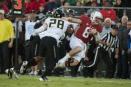
On paper, it looks like a one-sided game, though Oregon’s 400+ yards are slightly alarming. But in the end, only two statistics mattered: Oregon had 9.1 yards/play, and Stanford turned the ball over three times. That was it—Oregon made big plays, and Stanford made mistakes. Other than about three plays of each side of the ball, Stanford played a great game.
On Sunday, my friend Peter texted a group of us, “If you were considering re-watching the fourth quarter—don’t! I just did and it was incredibly painful. We move the ball with complete ease on three drives only to fumble twice like we haven’t fumbled all season. And then also don’t watch the two-point conversion. I have no idea what #77 [right tackle Casey Tucker] was thinking… it is as if he never even saw Coleman even though he was two feet away from him.”
I had mostly gotten over the game by the time I read his text, but I agreed with Peter about one thing: I really didn’t want to watch the tape of the game. As it turns out, it took me six days to finally get enough emotional distance from it to sit and watch it.
It was a great battle. If you are an Oregon fan, then you think that the Ducks did enough to deserve to win the game. Your offense was unstoppable, and you made plays when it mattered. If you are a Stanford fan, then you gave the game away with three fluke turnovers. Which team is better? Which team deserved to win? I mean this in as unbiased of a way as possible, but I think Stanford is a slightly better team. Think of it this way: if you are a huge fan of both teams, and you get a free ticket to send Oregon or Stanford into the playoff, which team would you send? There is no way you would send Oregon’s defense against the best in the land.
The reality is, however, that you really wouldn’t want to watch Stanford’s defense face Alabama’s offense either. The Stanford defense isn’t good enough for Stanford to have really contended for a national title. And that is fine. It has been a wonderful season so far, but keep in mind that it was supposed to be and apparently is indeed a rebuilding year on defense. And next year may be another rebuilding year as well. Our defense is young. I’m reasonably happy with the way they have played this year. Oregon is a powerful offense. And they didn’t make any mistakes. The one big defensive play that we did make was earned, and Kevin Anderson almost took it back for a game-changing touchdown. But he was barely nudged by a fast piece of celery and tumbled to the turf. I immediately sensed the importance of that moment—and was deflated when we had to settle for a field goal. Ironically, it was a similar moment to the 2012 Stanford-Oregon game when Marcus Mariota broke free for what should have been about a 90 yard touchdown run but was tackled from behind by Devon Carrington around the 10 yard line. D’Anthony Thomas was running with Mariota the whole way, and instead of focusing on blocking, he ran ahead of Mariota as if celebrating the moment and his own speed.
But Thomas let Carrington catch Mariota, and Oregon ended up coming away with no points. Check out the play here. In a game like this, those little opportunities must not be squandered.
2. Offense & Coaching
The first drive started out well, easily reaching the red zone. On a 2nd down and 3, Shaw called for McCaffrey to throw a pass back to Hogan. It should have worked easily, but the pass was a bit low and Hogan dropped it. Then, on 3rd down, McCaffrey ran right for the first down, but it was called back on a holding penalty on Hooper. Hogan kept the rock on third and long and got back to 4th down and 3. Shaw sent in the field goal team. Ominous start. Stanford moved the ball easily, but its own mistakes stalled the drive. As it turned out, that would be the theme of the night.
The decision to kick isn’t surprising, but field goals are really, really bad if you are in an offensive shootout. We weren’t yet, but what did we expect? Oregon has a monster offense, and we knew it was going to be a high scoring game. So, is the correct play to actually go for it on 4th down? If we use the data just from the first 11 plays of that initial drive, Stanford gained three or more yards on 9 of those 11 plays. From that perspective (82% chance of 3+ yards), you could make a strong case that the correct strategy would have been to go for it.
In the 3rd quarter, on 4th and 2 from the 26, Shaw definitely made the wrong decision to attempt a field goal. Stanford was down 5 points, and the Oregon offense was rolling. Can’t settle for field goals. And why should we! Our offense was rolling too! The only way you can justify sending in the field goal team in that situation is if we are down exactly 3 or 10 points. This was Shaw’s only clearly bad decision of the game, and the mathematical football gods of karma punished him for it—Ukropina missed his first kick of the game.
Our only punt of the game came on our next possession, and it was primarily self inflicted by a holding penalty on 1st down.
Then, we really had to go to the passing game. And Rector and the other receivers had a fantastic game. They made some huge catches in traffic. The Stanford offense was virtually unstoppable. I find it interesting how easy it was for Hogan to move the offense with the passing game in the second half, considering that we hardly ever pass two plays in a row. Our entire offense is mostly premised on moving the ball slowly. We don’t go after many big plays. When we sense we are in a shootout, I think we need to throw the ball earlier in the game. More play action with some shots downfield. We don’t need to see the jumbo package on 2nd or 3rd and short when we are losing. Save it for fourth down.
You can’t second-guess the fact that the alternate, jumbo package center was in the game when the final fumble happened. Caspers has been snapping the ball to Hogan all year in the jumbo package and we haven’t seen a fumble yet. So we can’t fault anyone for that. Just a fluke play at a horrible moment.
But Tucker sure blew it on the two-point conversion attempt at the end of the game. It is hard to imagine what he was thinking or where he was looking. He completely missed the block, and Hogan had to force out the throw to Hooper a bit early. I love the play call by Shaw. Hooper was breaking open and if Hogan had another half second it would have been an easy conversion. But the missed block blew it up, and Oregon escaped. Yeah, they earned it with some slick waterslides of offensive fun. But just as clearly, they escaped.
3. The Playoff Rankings
I was pleasantly surprised to see Stanford sitting at #11, four spots higher than it is in other polls. It is pretty amazing to see our program get that kind of respect in a committee room. I think the football guys really respect the way Stanford plays football. And it is clearly willing to overlook the Northwestern loss. If you really consider that game to be a core part of Stanford’s resume, then there is no way that it can be ranked that high. Stanford owns only one win against a top-25 team (#24 USC), and has two losses. But it is really nice to see the committee consider what teams are powerful, on both sides of the ball, at this moment as the season comes to a close. It makes for a better playoff.
I also generally agree with almost all of the Playoff committee rankings. Never was I able to say this last year. But this year things have been good. The committee is really focusing on strength of schedule, and teams like #10 Baylor and #18 TCU are being punished for having zero wins against the top-25. In fact, Baylor and TCU’s best win is over either Texas Tech (6-5) or West Virginia (5-4). And TCU is certainly being downgraded for beating a horrible Kansas (0-10) team at home by only six points. They are possibly also being docked for their fluke last-second win against Texas Tech. I absolutely love how low TCU is ranked.
Speaking of Baylor and TCU, Jon Wilner of the San Jose Mercury News left Baylor off of his top-25 ballot. He justified it with the same logic of my previous paragraph—they haven’t beaten anybody good. But here is the problem—Wilner has TCU ranked #18, and TCU clearly has a similar or worse resume than Baylor. So, by his logic, TCU shouldn’t be ranked either. I’m not opposed to that idea… teams should have to prove themselves…. but at some point you have to select teams for the bottom portion of the poll. In his #22 spot he has Wisconsin, which owns zero wins over teams with winning records. And slotting in at #25, Wilner voted: Air Force! Oh God. Air Force (8-3) is going bowling, and eight wins is nice and all, but take a good clean look at the shape of your toilet bowl to know how many victories Air Force has over teams with winning records: 0. Wow. Wilner really fucked this up. I usually love how he votes and looks to justify some unusual rankings, and he often does a great job ranking some teams that he analyzes deeply. But then he completely fails to apply his same logic to other teams. People out there are pissed off at Wilner—Baylor fans especially. In this case, I think they have a point. He’s tied himself up in a pretzel of inconsistency.
The only other team that is a bit tricky to rank is #3 Ohio State. Ohio State has not played a ranked team all season. Even worse, OSU hasn’t played anyone in the top 35 of most rankings. Penn State (#42 realtimerpi, #39 Sagarin, #37 Massey Composite) is Ohio State’s strongest opponent to date. So why is Ohio State ranked so high? I can only presume that it is because they are the defending champions. And that makes sense to me. We aren’t suppose to use last year’s results when we are this deep in the season, but the fact that Ohio State hasn’t lost in over 20 games should mean something. I am very comfortable with Ohio State at #3 despite the fact that its toughest games are still ahead of them.
4. Up Next: California (6-4)
The Big Game has BIG CONSEQUENCES. A shot at the Rose Bowl is on the line, and the game is under the lights! Stanford has won five in a row. Will this one be different? For that matter, will it be any different than the Oregon game? It will all come down to Stanford’s ability to limit big plays and avoid turnovers and field goals.
 Football on the Farm
Stanford has won seven in a row. Will this one be any different? No, except that the seven will turn into an eight. Cal’s defense is the deciding factor. That will be the difference. Good luck guys.
Thanks for writing these articles. I look forward to reading them after each game (especially after the W’s).
Two corrections: 1) Stanford has won 5 Big Games in a row, losing the 2009 game when Harbaugh and Shaw decided not to let Toby finish off the Bears and Andrew was intercepted by Mike Mohamed; and, 2) It was D’Anthony Thomas, not LMJ, ineffectively escorting MM when he was caught from behind.
Glad you are reading the blog! I updated the post with both of your corrections… clearly I didn’t do my due diligence this week! I realized the Big Game streak mistake at the game yesterday, but I was not at all going to catch the DAT (not LMJ) fact. So thanks! -Jason