
1. Perspective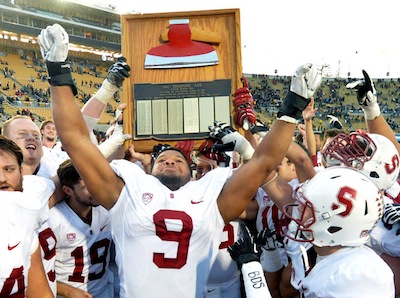
Stanford won the Big Game for the 5th consecutive time. As so many amazing Stanford statistical streaks have ended this season, the Big Game streak might just be the best one we still have going. That, and a 6th consecutive bowl game.
Currently sitting at 6-5, Stanford is closer to being 9-2 than 5-6. In other words, Stanford gave one to USC and lost some coin flips to Notre Dame and Utah. But in its six wins, Stanford has won fairly easily. The win over Cal wasn’t a dominant performance as some people have incorrectly noted, since the turnovers, replays, and penalties certainly catalyzed the Stanford victory. But it was smooth. Stanford smooth. 16 consecutive running plays kind of smooth.
The potential bowl matchup for Stanford isn’t looking so velvety, however. Various projections include an opponent like Arkansas State, Temple, or Boise State. Stanford is not going to face a top-25 team in its bowl game. So, this Friday’s game at UCLA is Stanford’s last chance to beat a great team. If Stanford loses, it will end the season 0-6 against ranked teams.
2. Offense
There were multiple plays when Hogan checked down to find his second or third target. He had plenty of time to throw and looked very comfortable. Hogan also did a nice job lobbing the screen pass when Cal sent pressure. Stanford was much better in the red zone, though two pass interference penalties by Cal turned field goal attempts into touchdowns. So, Stanford and Hogan had some help, but Hogan probably could have thrown for 400 yards if Shaw didn’t let the run game take over. Hogan attempted zero passes in the last 24 minutes of the game. That’s 40% of the game—no Hogan passes. Amazing. In the second quarter, Stanford ran on 16 consecutive plays, then Crower tried a third down pass, then Stanford ran (or took a knee) 5 more times.
Remound Wright showed an ability to fight through tackles, something that we haven’t seen from Stanford running backs very much this year. (I’ve felt like Wright should have been the primary back for a few months now.) But Cal is not a good tackling team. 38 points and about 400 yards is exactly what one might expect from an average offense when playing Cal. Stanford still isn’t hitting the deep ball or breaking off long touchdown runs. It is still going to be a challenge to get the ball in the end zone in the next two games.
3. Ty Montgomery and Stanford Wide Receiver Depth
Francis Owusu and Christian McCaffrey made some great catches in tight spots. Owusu has been under the radar for two years now. He is fast and catches everything, and this year his biceps are starting to look more like Montgomery’s. It remains to be seen how serious Montgomery’s injury is, but Stanford has guys with great hands that are ready to play. Cajuste and Rector should both be back next year as well.
If I was coach, and Montgomery had another year of eligibility, I would move him to running back. If he didn’t want to, for purposes of being an NFL prospect, then I would have him split time at running back and at receiver. Should Shaw have considered this before the year? No way. There was no way to anticipate how much we could have used him at running back. And you can’t move his full-time position near the end of the year. Shaw has done a decent job gradually trying to get him more touches in the backfield as the year went on. Anyhow, my main point here is that there is little drop-off after Montgomery leaves. Stanford will be loaded at receiver again next year.
4. Defense
Stanford had only two turnovers in conference play coming into the Big Game. The turnovers were long overdue and were the reason that Stanford won this game easily. (There could have even been more interceptions.) The pass rush and pass defense did a great job against Goff. Kalambayi, Vaughters, Richards, and Martinez made some huge plays. Martinez had a break-out game: 11 tackles, two interceptions, and one forced fumble. Stanford is losing so much talent on defense, but Martinez is someone who will be back next year.
The run defense, however, still leaves something to be desired. Cal gained 5 yds/rush. Stanford had trouble defending Lasco and Rubenzer on the ground. This leaves me a bit concerned about Hundley scrambling in the next game.
5. Coaching
Shaw called a nice game. There were some misdirection, fakes, and Hogan keepers that worked nicely. He kept things conservative, which he likes to do when Stanford has a lead. Stanford’s fourth quarter TD drive was 78 yards on 9 consecutive running plays. They kept possession and kept the clock moving. The fact that we ran every play seems conservative, but it was anything but perpendicular bisectors of the Jumbo line (segment). Shaw’s plays were unpredictable and exciting. It was one of the best drives of the year.
Besides controlling clock, I also think he wants the running game and run blocking to get as much practice as possible. This seems like a good idea—the run unit needs to build some confidence.
Shaw also did the right thing by taking a knee at the end of the game.
I’m not sure why Sonny Dykes went away from Goff and Lasco. Lasco averaged 5.7 yds/carry, and Rubenzer looked awful throwing the ball. But I’ll let the Cal blogs ponder that one.
6. Up Next: UCLA (9-2)
This is going to be tough. Stanford has won the last six, but this is going to be a battle. The Stanford run defense needs to have a dominant game if Stanford is going to win. I haven’t seen UCLA play much this year, so I have no idea what to expect.
7. Samaje Perine and Melvin Gordon
Two weeks ago, Melvin Gordon carved up Nebraska for 408 yards. Once Gordon had gotten the FBS single-game rushing record (by the 3rd quarter), he received no more carries. This past Saturday, Oklahoma’s Samaje Perine went for 427 yards against Kansas. Once Perine had the record, he also was pulled from the game. Both coaches should be complimented for chasing the record but not padding the stats in a blowout. And both Gordon and Perine flashed huge smiles and gave thanks to the people around them. When Gordon was interviewed about his record only standing for a week, he smiled and congratulated Perine. It’s nice to see success go to humble, kind people.
8. SEC Games This Week
The Pac-12 didn’t get to face the SEC this year, and likely won’t unless Oregon meets an SEC team in the Playoff. The ACC, however, has an exciting lineup of games against the SEC East this coming Saturday. For Georgia or Missouri—the potential SEC East champions—to have a chance to make the Playoff, the SEC East will need to perform well against the ACC this weekend. If Georgia beats Georgia Tech, Georgia will own two big wins over good ACC teams, while Ohio State still has a loss to a horrible ACC team. And Missouri plays Arkansas, the hottest team in the country. (More on Arkansas later.)
9. The Playoff Rankings: Line Up In Order of Number of Losses, Please
In prior weeks, I’ve thought the committee has done a good job with the rankings. In the first rankings, it was clear the committee was using head-to-head and strength of schedule. And with the exception of Ohio State, I generally still accept the top of the rankings as reasonable. But as wins and losses have piled up, the committee has shuffled teams up and down just like the token coaches poll. As SEC West teams face a ridiculously hard schedule, they are being punished way too much for losses. At this point, the committee seems to be ranking by number of losses more than anything else.
Here is the list of the number of losses for the Playoff Committee’s ranking of teams 1-22: 1,1,0,1,1,1,1,2,2,2,2,2,2,2,3,2,2,3,3,3,3,3. Holy crap. It seems the committee has received the following task from its kindergarten teacher: please put the teams in order according to number of losses. Let’s look at some instances where the committee is ignoring its core criteria: head-to-head and schedule strength.
#12 Kansas State (8-2) and #15 Auburn (8-3). The committee says that it will only use the head-to-head criterion when the resumes are similar. Well, I guess the fact that Auburn won at Kansas State earlier in the year does not matter because the “bodies-of-work” are not the same. The committee is correct. The resumes are not the same. One team has four wins against FBS teams with winning records and the other team has six. One team has one victory over a currently-ranked team and the other team has two. One team has played three games against teams in Sagarin’s top-20 and the other has played six. So, you see, the resumes aren’t that similar—Auburn clearly has a better resume. Wait…. wasn’t that supposed to be Kansas State? Oops… Umm… but didn’t Auburn get blown out by Georgia? Yes, but Kansas State got also crushed by TCU. These two teams are misranked. Auburn owns much better victories (Arkansas, LSU, Ole Miss, Kansas State) than Kansas State (Oklahoma). The only conceivable reason that Auburn could be ranked behind Kansas State is because it has a higher number in the loss column. If that is the only criterion that the committee can handle, the committee members should just let their grandchildren do the ranking.
#18 Minnesota (8-3) and unranked Nebraska (8-3). Minnesota is grossly over-rated, and Nebraska has been over-rated the entire season. Neither one of these teams owns a win against a ranked team. Combine that stat with the fact that Minnesota lost to Illinois (and almost lost at home against Purdue), and we have absolutely no reason to rank Minnesota. Because Minnesota is totally over-rated, TCU and Ohio State are being over-rated as well. I have absolutely no idea how Minnesota is in the rankings when teams like Arkansas and LSU are unranked. Hopefully Minnesota will get exposed at Wisconsin this weekend.
#6 Ohio State (10-1) and #9 Georgia (9-2). Ohio State has played only one team in Sagarin’s top-30. Georgia has played six, and plays another this weekend. So what if we try to match up their schedules. Let’s take away Ohio State’s wins against Minnesota, Maryland, Cincinnati, Penn State, and Rutgers (the 2nd through 6th hardest opponents on Ohio State’s schedule) and replace them with games against Georgia’s 2nd through 6th hardest opponents: Arkansas, Missouri, Clemson, Florida, South Carolina. Would Ohio State win four out of five of those games? They would have to if they were as good as Georgia. OK, that math is fuzzy, and those SEC teams aren’t the most daunting, so let’s go a bit further and look at the Arkansas Razorbacks.
10. Making Sense of How Schedule Strength Affects Losses: the Case of Arkansas (6-5)
Arkansas just shut out ranked SEC West opponents in back-to-back weeks: 17-0 over LSU and 30-0 over Ole Miss. Unbelievable. Outside of Alabama and Oregon, Arkansas is playing the best football of anyone in the country. And they are not ranked, because they have five losses. Obviously they are playing top-10 football right now, so is there a case to be made for ranking them?
Besides the SEC West division opponents, Arkansas drew the toughest two opponents from the SEC East: Georgia and Missouri. That means that they have played seven opponents who, at one point this year, have been ranked in the AP top-5. That is a stunning statistic.
For the following analysis, we are going to use Sagarin’s ratings, because it lists records against the top-30. Let’s assume Arkansas is an average top-30 team.
- When it plays other top-30 teams, it has a 50% chance of winning.
- Against teams ranked 31-60, top-30 teams are 59-15, winning 79.73% of the games.
- Against teams ranked 61-100, top-30 teams are 59-2, winning 96.72% of the games.
- Against teams ranked 101+, top-30 teams are 60-0, winning 100% of the games.
I was slightly surprised how few dramatic upsets there are, but it makes sense. Upsets are more common early in the year, because a big underdog might actually be a much-improved team. But by the end of the year, it is extremely rare that a team like Indiana has so many awful results yet owns a win against a team like Missouri.
Since Ohio State also seems like an average top-30 team, let’s look at what this means for Arkansas and Ohio State. Let’s also assume that Arkansas beats Missouri and Ohio State beats Michigan, so we see the full regular season’s results.
Arkansas vs teams ranked: 1-30 31-60 61-100 101+
# of Games 8 0 2 2
Probability of Winning 50% 79.73% 96.72% 100%
Expected # of Wins 4 0 1.9 2
Ohio State vs teams ranked: 1-30 31-60 61-100 101+
# of Games 1 5 5 1
Probability of Winning 50% 79.73% 96.72% 100%
Expected # of Wins 0.5 4.0 4.8 1
After wins this weekend, Arkansas would be (7-5) and expected to have 7.9 wins, while Ohio State would be (11-1) and expected to have 10.3 wins. So, perhaps Ohio State has performed slightly better and deserves to be ranked just above 15th (average top-30 team), and Arkansas maybe just below 15th. But the analysis ignores the fact that Arkansas was not playing average top-30 teams. Arkansas was playing the best of the best: Alabama, Mississippi St, Georgia, Auburn, Ole Miss, LSU… Considering that, one could make a case that Arkansas should be ranked right around the same place as Ohio State, maybe just a few spots below. I would have Ohio State about 14th and Arkansas roughly 18th or 20th.
I’ll be the first to admit that the logic above isn’t clean analysis. It doesn’t prove a point beyond a shadow of a doubt. But it is indeed very revealing. I find it shocking that people in charge of ranking teams still don’t offer any quantitative analysis to reconcile a harder schedule with a worse record. There are better ways to do it than my method above, and I would like to see them.
 Football on the Farm
I’m not sure why Sonny went away from Goff and Lasco either, except that maybe he felt Cal wouldn’t win the game if it lasted 8 quarters, and let’s give someone else some play time. I have no doubt that if Cal had made the game close and there was a lot of time left on the clock, Hogan would have returned to the pass, with deadly effect since Cal defends passes not so goodly (And to think that I’m a teacher). I’m writing this after Stanford’s smashing victory over UCLA, and I have one question. Where was THAT Stanford team all year, and why couldn’t you have played that well against USC? See you in Vegas. Or Santa Clara.
Maybe it’s two questions.