
1. Perspective
In the first quarter of each of Stanford’s two previous victories against Oregon, the defense made a crucial 4th down stop. This year, the tipping point again came early—on Oregon’s first drive. On 3rd and 8 from Stanford’s 43, Helfrich called a conservative run for Freeman, knowing that they were in four down territory. There was no “difficult” decision to make on 4th down. No time out was needed to think it over. The Ducks were going for it. Stanford pressured Mariota as he dropped back to pass on 4th and 5, but he wormed out of the pocket and slipped downfield for the first down. That play told you all you needed to know about this game: Oregon was going to outcoach Stanford and Mariota was going to outplay everyone else on the field.
Obviously, Stanford is in a new era. That was clear to me after the Arizona State game. Before we consider our future and the cost of Royal Purple Las Vegas Bowl tickets, I want to take one last glance over the shoulder. In all of the plays from 2010-2013, I want one play back. It is from 2010, the year Stanford beat UCLA, Washington, and Oregon State by a combined 114-0 and took a 45-0 lead against Cal into the 4th quarter. 2010 is the year Stanford could have made history, and Oregon ruined it. In the 2010 Stanford @ Oregon game, Stanford went up 21-3, and Oregon scored in the second quarter to make it 21-10. Then, Oregon tried an onside kick. I wish Stanford would have recovered that kick. That’s it. That is the one play I want back—that onside kick. It was a huge momentum swing in Oregon’s favor and Oregon went on to win. Stanford didn’t lose another game that entire season, and I believe that Stanford could have beaten Auburn in the BCS championship game.
OK. It’s all out of my system. That’s all in the past now. Now I can properly refocus in the here and now, and also look to the future. Anyone up for a roadtrip to El Paso for the Sun Bowl?
2. Mariota
On the Friday night before the game, I saw Foreverland, a 14-piece Michael Jackson tribute band, at Eugene’s historic McDonald Theater. (Foreverland is also playing this Friday, the 14th, in Redwood City.) At the start of the third song of the second set, after hearing two notes of music, Steve S. turned to me and said, “Dirty Diana.” Wow. Talk about being in the moment. He was dissecting the music at a deeply subconscious level, and his reactions (and trans-dimensional dance moves) were lightening fast and highly accurate.
Similarly, Marcus Mariota was the smoothest of criminals against Stanford, and he responded flawlessly to Stanford’s pressures and coverages. On multiple 3rd and 4th downs, Mariota slipped from the pocket and picked up key yardage with his legs. He had every answer. In a 3rd quarter drive, Stanford sent pressure on two consecutive plays, and both times Mariota tossed screens to Freeman for 15 and 30 yard gains. Mariota was too fast and talented to handle, and he’ll likely be handling the Heisman a few weeks from now.
3. Controlling the Line of Scrimmage
If the Arizona State game was the bookend to a beautiful series of years of great Stanford offenses, then this game at Autzen Stadium was the bookend for the defense. Oregon and Marcus Mariota could not be stopped. The Stanford run defense put in its worst performance in years. The defense definitely doesn’t have the same kind of depth it has had in recent years, and a few injuries have really taken their toll.
It should not come as a surprise that Stanford couldn’t control the line on the other side of the ball. The Stanford run game was ineffective. Wright and Sanders combined for 2.1 yds/carry. For some reason, though, Stanford kept trying to establish the run. Stanford ran 39 times and threw 33 times. In the third quarter, already trailing, Stanford ran the ball 11 times and passed 7 times. Some of these runs were Hogan scampers, plays that I generally like. Still, Shaw called a few too many running plays. For example, Stanford ran the ball on the first play of all of its possessions in the first three quarters.
4. Coaching and 4th Down Calls
I like Oregon coach Mark Helfrich. He seems like a nice guy, and he smiles in a natural manner. He also goes for it on 4th down. Shaw has no coherent strategy for making in-game decisions, especially when it comes to 4th down. He wastes time-outs to talk himself into going for it, and then runs plays that are so obviously going to Montgomery that half of the opponent’s defense is waiting for Hogan to throw it to him.
Furthermore, we can’t afford field goal attempts against Oregon. Last year, we attempted five field goals against Oregon, and if the game would have been ten minutes longer we would have lost. You can’t beat good teams with field goals. Some nights, a good defense may bail you out and you may think your field goals were good enough. In the long run, too many field goals will lead to too many losses.
5. Autzen Stadium
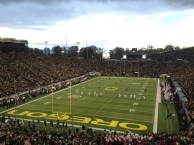
The walk to the stadium is a serene saunter through fall foliage and across rivers and streams. It puts you in the right mood for something like a Bob Marley concert. But inside the stadium, the tone is focused and serious. It is loud, and almost everyone in the stadium cheers. The Stanford section is tiny—only a few hundred Stanford fans seemed to be there. You can’t even hear yourself as you whisper reminders that if we score here we are only one score down and then, well, you never know, of course… and… whoops… there goes Mariota.
6. Was This A Close Game?
Hogan and the Stanford offense moved the ball pretty well. Stanford didn’t punt until the 4th quarter. If a couple 4th down plays go differently and Hogan doesn’t turn the ball over, this game would have gone down to the wire. However, the team that runs the ball better is the team that has the advantage in the red zone. And the team that owns the red zone is the team that is going to win. In a dramatic shift from last year’s game, Oregon dominated the running game. The 29-point loss is definitely misleading, but Oregon was definitely the better team.
7. Up Next: Utah (6-3)
A lot on the line for both teams. If Stanford can win out, it still might get a decent bowl matchup. If Stanford can’t draw up enough screen plays to deal with Utah’s pass rush, it will be at risk for a losing season. It’s the last home game for the seniors. I expect the Cardinal to play well. Plus, the 3pm kickoff time is the best we’ve seen all year. Should be a glorious day.
8. The Playoff Rankings
I was completely surprised when the first rankings came out two weeks ago. The committee actually did what it said it was going to do! It valued strength-of-schedule and head-to-head results. While some ESPN pundits, such as Tom Luginbill, insist that Alabama is the best team because of the freaking “eye test,” the committee made rankings based on who had actually beaten who. I watched a College Football Daily on ESPN a couple weeks ago in which Luginbill argued that Alabama should be the top seed in the Playoff rankings. He just knew Alabama was better than Ole Miss even though Ole Miss had beaten them. Then, he posed the question, “Imagine you are the opposing coach in the playoff, who would you definitely not want to play?” Brett McMurphy and Kevin Carter answered, “Well, probably Alabama.” Luginbill sat back and smiled like he had just earned the last bite of a scrumptious, family-style platter of Rocky Mountain oysters. Not only did Luginbill and Matt Millen have no idea what criteria the committee was actually going to use, they hardly cared about actual results. Their argument for Alabama was no different than this: the Washington Nationals seemed better than the San Francisco Giants and did better in other games, so even though the Giants beat them in the NLDS, the Nats should actually move on to the NLCS because they are, um, “better.”
I am so happy that the committee has taken these idiotic, subjective arguments out of its ranking process. Instead, the committee is focusing on criteria that humans can actually evaluate with a decent amount of objectivity. From the Playoff website: “The selection committee will choose the four teams for the playoff based on strength of schedule, head-to-head results, comparison of results against common opponents, championships won and other factors.” It is clear so far that the committee is valuing the criteria that is set forth on its website.
Results from the past weekend hurt the SEC’s chances of getting two teams into the Playoff. Barring any major upsets, the playoff is going to consist of the following:
- SEC Champion (two losses or less)
- Florida State (undefeated only)
- Oregon or Arizona State (one-loss only)
- Baylor (one-loss only), or TCU (one-loss only) if Baylor loses
Nothing can change the above scenario unless one of the above five teams (excluding the SEC) wins its conference but has more than its current number of losses. The selection committee has shown that it is going to stick to its stated criteria, and conference championships won is explicitly listed as a major criterion. While TCU is getting a lot of love in the polls, Baylor will get the edge over TCU because of the head-to-head victory and its status as the conference champion.
For a second SEC team or Ohio State to make the Playoff, the ACC champion would need to have one loss, or the Pac-12 or Big-12 champion would need to have two losses. I don’t see this happening unless Florida State loses to Miami or Florida. Oregon and TCU will be solid favorites in their remaining games. ASU faces a tough test at Arizona. Baylor faces Kansas State at home. There are some speed bumps out there, but it looks very possible that the inaugural Playoff will consist of the champions of the four best conferences. If that scenario comes true, it is going to make for a fantastic Playoff.
9. Rooting For Oregon
Arizona State clobbered Notre Dame and Oregon beat Utah—both important results for the Pac-12. Once Stanford is eliminated from the conference title race, I root for the Pac-12’s best team to win it all. This year, that means rooting for Oregon. This is partly geographical: I like the northwestern states. (If Oregon, Northern California, and Southern California had to be made into two states, I would definitely have Southern California be on its own. This has little to do with people and more to do with landscapes and watersheds.) I also enjoy watching Oregon’s offense and respect Mariota and Helfrich. However, the primary reason I root for Oregon is because I love Stanford football. I want Stanford to get as much coverage as possible in the national media. If Oregon can win the national championship, that just makes next year’s Pac-12 North race and the Oregon-Stanford game that much more special.
Normally on Saturday morning, I love getting up early and watching ESPN’s College Gameday. This year, however, the coverage of the Pac-12 has been sparse. Part of that is probably due to television contracts, but either way, I’m getting tired of hearing about Florida State and the SEC. Gameday hasn’t even been to a Pac-12 conference game the entire season. If Oregon can win the national title, Stanford football is more relevant and more fun. I just hope Oregon doesn’t blow it and lose to the SEC again.
 Football on the Farm
JS,
I’ve really enjoyed your blog since Alan mentioned it. We are totally aligned on the rationale for rooting for Oregon now (as the Pac-12 banner carrier), … because it helps Stanford in the long run and gets more eye balls and recruits thinking about the Pac-12, for games and for their college careers.
I always root for Pac-12 teams in out of conference, including Cal – I find the reflexive hatred of Cal when they aren’t playing us – short sighted. I want Cal and the Pac-12 to do well because it means our beating them or losing to them is put in the context of the Pac-12 being really deep, loaded with talent. As for Cal, after Stanford, I want academically-inclined institutions to show up football factories. I want smart recruits to choose us because they believe they can have it all. A competitive Cal and Stanford is important for that.
~Steve