
1. Perspective
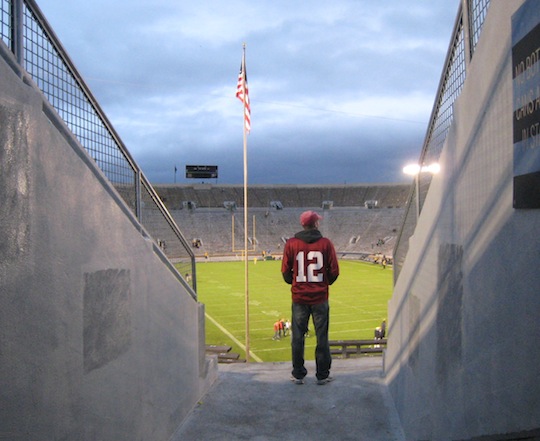 It is tempting to think that Stanford should have won. After all, we were only a mistake on 4th and 11 away from victory. But if you are a Notre Dame fan, you were probably really frustrated all game and felt like you almost lost one that you deserved. Considering this, I don’t think it is fair to feel like Stanford should have won this game. Yes, it almost won, but not because it earned it. Notre Dame made just as many mistakes, if not more, than Stanford. In the end, Notre Dame outgained Stanford by 165 yards. Notre Dame was the better team on Saturday.
I just don’t have the heart this week to dissect the game that much. For a great recap, click here. Normally, after a loss, I feel even more compelled to write, explain, and question. Instead, I was more motivated to break down rankings and polls.
2. Offense & Defense
It was ugly. Our running game got worse. Hogan played worse. And, the inconceivable—our trusty receivers dropped passes. Yeah, it was raining. But man, it was an ugly one to watch.
The defense didn’t play that well, especially Wayne Lyons. But this loss is all on the offense. 2.47 yards/play is atrocious.
3. Coaching
Shaw did a few interesting things with some play calls. There was a very surprising (and successful) run call on 3rd and Goal from the 11. There was a sprinkling of the usual variety of runs, screens, and formations. This was especially evident in Stanford’s 3rd drive, halfway through the first quarter. On the first two drives, Hogan looked awful when dropping back to pass from the pocket. So, on first down to start its third drive, Stanford rolled Hogan out and he hit Cajuste for 17 yards. On the next play, Montgomery dotted the “I” for 5 yards. Then, Montgomery ran for 6 more out of the Wildcat. Next, Hogan tossed a screen pass to Skov for 16 yards. The offense was moving. What was the secret? None of those plays involved Hogan passing downfield from the pocket. For the first time all year, I thought to myself, “Alright, we’ve got our identity this year.” Keep Hogan on the move, or get the ball out of his hands quickly. I even texted some friends, “I think Shaw might figure things out here. No more dropping back to pass from the pocket.” What a load of bologna that turned out to be. Immediately following those four beautiful plays, Hogan dropped back to pass from the pocket on each of the next three plays. Two incompletions, then an interception.
I don’t understand why Shaw doesn’t do more of what works. If something is working, do it again and again. Don’t just assume you have to show a variety of looks to keep the defense honest. Make the defense adjust and stop what you are doing. There were exceptions, of course, but the play-calling generally kept Hogan passing from the pocket the rest of the game. Considering the rain and Hogan’s struggles, this was a mistake.
4. Officiating
9 penalties against Stanford. 1 penalty against Notre Dame. There were clear pass interference infractions by Notre Dame that were not called. Furthermore, the replay booth was ridiculously quick in reviewing (or deciding not to review) a few plays that went in Notre Dame’s favor. On Notre Dame’s first 4th quarter scoring drive, a crucial 3rd down pass was erroneously ruled complete, and Notre Dame later kicked a go-ahead field goal. Mistakes from the field referees happen, but mistakes from the replay booth are unacceptable.
5. Around the Pac-12
The supposed top-4 teams in the Pac-12 (Oregon, Stanford, USC, and UCLA) all lost this past week, and every game was close. All five Pac-12 games were decided by one score or less. All five road teams won. And, another Hail Mary to win a game! (ASU over USC.) Lots of great drama.
Sweat-pant enthusiast Danny B. and leather football helmet model Karl L.S. posed the following question amid sagacious verses of texts: “Who is the best team in the Pac-12?” They arrived at the following answer: “It all comes down to match-ups.” They might have the only reasonable answer to that question. Stanford has beaten Oregon twice in a row. Oregon has beaten UCLA five times in a row. UCLA has beaten USC twice. USC has beaten Stanford twice. That chain right there, among the four better teams in the conference, shows the problem with determining the best team. More recent ownership of match-ups: UCLA has beaten Arizona twice in a row. Arizona has beaten Oregon twice. Stanford has beaten Arizona St twice. Arizona St has beaten USC twice. Stanford has beaten UCLA six times in a row. Stranger still, in the past season and a half, Washington State is 4-0 against Utah, Arizona, and USC.
So, it depends on the matchup. But when it comes down to it, the winner of the Stanford-Oregon game has won the conference championship every year since the Pac-12 started. Until that changes or one team falls way off, you can still make an objective case that Stanford and Oregon are a notch above the rest of the league.
I will also say this: Stanford and Oregon are a combined 11-0 against UCLA in the past eleven games. It was ridiculous for pundits to ever rank UCLA above them earlier in the year. And it all adds a bit of drama to the Oregon-UCLA game this coming Saturday.
6. Up Next: Washington St
Well, if it depends on the match up, then Stanford should be in good shape. It hasn’t lost to Washington State in seven years. However, Connor Halliday just set the all-time NCAA passing record, throwing for 734 yards against Cal—in a 60-59 loss! So who really knows what is going to happen… last weekend’s results showed that this entire Pac-12 season is going to be wild and unpredictable.
7. The Playoff Picture
Results. And data. For the first time all year, there is now plenty of data to make objective attempts at ranking teams. When considering a multitude of data from an entire season, it should be obvious that computer programs do a better job of applying and synthesizing the criteria that people normally use to analyze teams: record, strength of schedule, margin of victory, home/away/neutral location, yards gained differential, etc. Humans can’t deal well with so much information. The most obvious way to rank teams objectively would be to create a committee—who would create a computer program that combines the important and most accepted aspects of existing computer polls, and then publicly release the formula. So why did we leave the computer rankings behind? Why would people think that humans do a better job?
First off, humans can account for things like bad officiating and lucky plays. This makes sense, but there is still a major problem: what qualifies as bad officiating? There are too many bad and lucky calls throughout the year for humans to consistently make adjustments.
Perhaps humans don’t trust the way a computer program would handle an undefeated team with a soft schedule. Certainly one camp would want this team to have a chance to play for a national championship, while the power conference leaders would scoff at this idea. At least with a human committee making the decision, we can vocalize our opinionated, self-serving despair at other human beings rather than computers. People can influence other people. Once a computer program is written, it can’t be influenced. Many people get really frustrated when their opinions aren’t heard. They want to hold on to the belief that they can—to whatever tiny extent—influence the system. I think this is the primary reason why computer rankings are no longer used.
However, there is actually one ranking criterion that humans can handle better than computer programs. Human polls can account for head-to-head results, and to a lesser degree results against a common opponent. I don’t think a computer program could do this very well. Let’s look at a simple example. Sagarin’s current ratings yield: #6 Texas A&M (5-1), #7 TCU (4-0), #8 Mississippi St (5-0). Well, obviously this is problematic, because Mississippi St is undefeated and just crushed Texas A&M on Saturday. If there were just a few isolated head-to-head results, one might be able to write a computer program that would do the following: after spitting out the rankings, if a team was, for example, within two or three spots of a team that it beat, then it gets bumped up one spot ahead of the loser. But, it simply can’t work. The program would lose functionality when there were too many of these head-to-head results clustered together. Furthermore, what about the team(s) in the middle of teams that have head-to-head results? In the example above, what would happen with TCU? Would the rankings get changed to TCU > MSU > TA&M, or MSU > TA&M, TCU? There is no way for a computer program to handle this properly.
So, despite the wrath of human bias, which is probably philosophically impossible for human minds to avoid, the human polls can do one thing better than computer polls: account for head-to-head results. As we discussed earlier, this is really the only thing it can do better (besides the related aspect of common opponents). So, when a human, or a playoff committee, looks to rank teams, he might basically glance at a statistically-driven set of computer rankings to get a feel for things, and then adjust based on head-to-head results.
Unfortunately, the polls usually just reflect an incremental shifting of teams in somewhat prescribed amounts from their position in the preseason poll. Preseason bias ruins the entire poll. People don’t make radical adjustments based on results. Jon Wilner on the Mercury News is one voter who does carefully consider head-to-head results, as well as quality wins. (Of course, he takes a lot of heat from a lot of idiots who aren’t smart enough to realize how he tries to rationalize his poll.) If we are going to bother to look at human polls instead of computer polls, then head-to-head results must be weighed heavily.
People who say that last year’s results shouldn’t matter are completely naive. The entire shape of the poll is based on the preseason poll, which is based on last year’s results! You can’t escape last year’s results, so instead of letting them subconsciously muddle the rankings, they should be used. Early in the year, a poll should use last year’s results by analyzing head-to-head results, especially if a team is difficult to slot because it has not yet played other teams in its vicinity in the rankings.
However, if a team is undefeated and already has a quality win this year, there is no reason to look at last year’s results. Barring an officiating error or series of fluke plays, an undefeated team must—absolutely must—be ranked ahead of a team it has beaten. Especially if it won on the road. In the Coaches Poll, Oklahoma is still above undefeated TCU, and Oregon is still above undefeated Arizona. If USA Today had any shred of respectability, it would stop publishing this poll immediately.
8. A Reasonable, Human-Created, Results-Driven, College Football Poll
First, a short overview of what I think should be important criteria:
- The poll is meant to reflect results. It is not meant to be predictive.
- Head-to-head results matter a lot.
- Quality wins matter a lot. Scoring margin matters, but not as much as quality wins. Beating a good team by a few points is much more important than beating a mediocre team by a few dozen points.
- Computer polls should be considered, as they take in enormous amounts of info.
- Undefeated teams must be ranked ahead of teams that they have beaten.
- There should be clumps of teams from single conferences. Non-conference results are more often used to slot groups of teams from a same conference.
- If considering any results from last year, Bowl games are given more weight than games earlier in the season.
For the first time in my life, I threw a bunch of hours down the wormhole and tried to make an objective top-25. Here it is. (References to top-40 or top-20 are from Realtime-RPI current or season-ending rankings.)
1. Florida St. (5-0). Beat #19 OSU. Beat #24 Clemson. Beat #2 Auburn in national championship. 21 consecutive wins. 21 consecutive wins.
2. Auburn (5-0). Won 14 of last 15 games, losing only to #1 FSU in national championship last year.
3. Mississippi St (5-0). Beat #17 Texas A&M. Won at LSU, which gets them the nod over #4 MSU, which has no quality road wins.
4. Mississippi (5-0). Beat #7 Alabama.
5. TCU (4-0). Beat #6 Oklahoma.
6. Oklahoma (4-1). Lost to #5 TCU. Beat #7 Alabama in Sugar Bowl.
7. Alabama (4-1). Lost to #4 Ole Miss. Lost to #6 Oklahoma in Sugar Bowl. Lost to #2 Auburn last year. Won 15 consecutive games before that, including national championship.
8. Arizona (5-0). Beat #9 Oregon.
9. Oregon (4-1). Lost to #8 Arizona. Beat #11 MSU.
10. Notre Dame (5-0). Beat #16 Stanford. Lost to #6 Oklahoma last year. Beat #11 MSU last year.
11. Michigan St (4-1). Lost to #9 Oregon. Beat #16 Stanford in the Rose Bowl.
I’m confident that this top-11 is solid and about as objective as a human poll can be. You could argue against FSU at the top—I will agree they aren’t the best team in the country this year—but 21 straight wins! The point of a poll is rendered useless if reigning champion with the nation’s longest winning streak isn’t ranked first. Perhaps you could say Arizona or TCU are too high, but then you would be letting your bias affect what has actually happened on the field. And anyways, if Arizona and TCU prove to be one-hit wonders, they will fall in subsequent polls. It is an absolute joke that Michigan St is ranked above Oregon and Arizona in the AP Poll. (Wilner has his order correct: Arizona (8th) > Oregon (9th) > MSU (14th).)
After the top-11, there are some clumps of teams that are harder to slot.
12. Utah (4-1). Beat #13 UCLA. Because it lost to WSU, it seems strange to put Utah at the top of this list of Pac-12 teams. But none of the teams below have played WSU. Furthermore, Utah beat UCLA on the road. And it dominated Fresno State just like USC.
13. UCLA (4-1). Lost to #12 Utah. Beat #14 ASU.
14. Arizona St (4-1). Lost to #13 UCLA. Beat #15 USC.
15. USC (4-2). Lost to #14 ASU. Beat #16 Stanford.
16. Stanford (3-2). Lost to #10 Notre Dame. Lost to #15 USC. Stanford owns 7 top-40 wins since 2013, as many as any other team except Auburn. Stanford also outgained USC by 122 yards.
I’m not sure the above Pac-12 teams should be above the four teams below. None of the four teams below have played a Pac-12 team this year or last year. Baylor’s win against Texas looks more impressive on the scoreboard than UCLA’s win, but it really isn’t. Still, you could probably justify these next four teams at #s 12-15.
17. Texas A&M (5-1). Lost to #3 MSU. Tough team to rank. Was totally over-ranked after beating a now-average South Carolina in Week 1. Texas A&M’s best win in the past two seasons was a fortunate 52-48 comeback win over Duke in the Belk Bowl. They get the edge over Missouri because they beat South Carolina by 24. Missouri won by 1. We’ll say that trumps Missouri’s 7 pt win over Texas A&M last year.
18. Missouri (4-1). No big wins this year, and lost to Indiana. But, had a great season last year, including a win over #19 OSU in the Cotton Bowl.
19. Oklahoma St (4-1). Lost close game to #1 FSU. Lost to #18 Missouri in Cotton Bowl. No big wins this year, but been consistently good for years. Beat #20 Baylor by 32 pts last year.
20. Baylor (4-0). Hardest team to rank since it hasn’t played a team with a winning record. Computer polls say top-10. I say give it more time. Lost to #19 OSU last year. Clobbered Oklahoma last year, but also lost to UCF in the Fiesta Bowl, so I’m downgrading the Oklahoma win from earlier last year. Also, Oklahoma had a different quarterback then. One might also compare Baylor with UCLA using the common opponent of Texas. Baylor won by more points, but it benefitted from lucky special teams plays. UCLA outgained Texas by 121 yards with a backup QB. Baylor outgained Texas by 55 yards. Ultimately, Baylor has zero wins against top-40 teams.
Then it feels like there is a drop-off from here. While you could flip Texas A&M, Missouri, Oklahoma St, and Baylor above the clump of Pac-12 schools, I don’t see how the group of teams below could possibly be ranked any higher.
21. Georgia (4-1). Beat #24 Clemson. Lost 5 games last year.
22. Marshall (4-0). No wins over top-40, but beat #23 ECU by 31 near the end of last year. Ranked because of its consistent margins of victory this year.
23. East Carolina (4-1). Easily beat Virginia Tech, who easily won at #25 OSU. Lost to South Carolina, but gained more yards. Beat UNC by 29, whereas #24 Clemson beat UNC by 15.
24. Clemson. (3-2). Lost to #21 Georgia. Lost close game to #1 FSU. Beat #25 OSU in Orange Bowl.
25. Ohio State (4-1). Lost to #24 Clemson in Orange Bowl. Lost to #11 MSU last year. Lost to every top-20 team it has played for the past three seasons.
Why these lurking teams haven’t earned a ranking:
- Georgia Tech (5-0). No wins against top-40 teams this year. Small margins of victory. 6 losses last year.
- LSU (4-2). Committed zero turnovers but still lost to Auburn by 34. Losing that badly trumps the reasons why LSU should be ranked. The 34-pt loss explains why it is ranked differently than a similar two-loss Stanford. Out of conference, LSU barely beat Wisconsin and beat a measly Iowa by 7 in the Outback Bowl. Not enough to offset the 34 pt loss.
- Kansas State (4-1). It has a good loss against Auburn. They played Auburn tough. Wilner has them ranked #17. Not unreasonable. But Kansas St has not beaten a team in the top-40 for two years.
- California (4-1). Cal also has an unlucky, resume-building loss. But just because Cal should have beaten Arizona on the road does not mean Cal should be ranked. Cal still hasn’t beaten team that is anywhere near the top-25 in two years.
- Nebraska (5-1). Beat Georgia in the Gator Bowl. But Georgia was a 5-loss team. Anyhow, Georgia looked like the better team, gained 111 more yards, and handed Nebraska the 5-pt win after scoring 1 TD in 7 red zone trips. Nebraska isn’t good. Outside of the Georgia win, it has zero wins against the top-40 in the past two seasons.
And there goes a perfectly sunny day spent breaking down the 2014 Gator Bowl and deliberating the impossible task of ranking football teams. Dagger. Tomorrow I’m going to drink beer in a hammock instead.
 Football on the Farm
Yes! I’ve been waiting for you to do your own Top 25. Love it. I wouldn’t have thought of the conference clumping as criteria, but it makes sense given the weight put on head-to-head matchups. Does conference strength come into play ordering those clumps (if no inter conference games have been played between the two)?
As usual, Kev, you smell terrific. You’re right, the clumping shouldn’t really be mandated criteria, it is just an expected outcome. Conference strength should definitely help to move the clumps around. The only problem is sometimes these computerized conference rankings are hard to interpret (SEC is 33.59 and Pac-12 is 27.51, for example–what does that mean other than the SEC is better?), and I have no idea how these rankings are weighted.
Cal may not deserve its #24 ranking for the reason you give, not defeating any team in the Top 98 for the last two years. However, when you and I woke up Sunday morning, there was Cal, in first place in the Pac 12 North. Read that again…Cal is in FIRST PLACE in the Pac 12 North. I’m mentioning this unbelievable fact now because Washington may shatter Cal’s dreams. If not Washington, then any other Pac 12 quarterback Cal faces after Washington. Given that Cal has absolutely no defense against the pass, UCLA, OSU, USC, Oregon, and Stanford should feast off of the Cal defensive backfield. However, if Cal can run up 50 or so points against these teams, we stand a chance. So here is my suggestion. If we combine the Immovable Object, the Stanford defense, with the Irresistable Force, the Cal offense, together we can strike the fear of God into any team in Mississippi.
I’m down for a swap. It must be fun to be a Cal fan right now. If football teams are supposed to be entertaining, then Cal is #1 in the country. The Stanford defense is pretty entertaining when pitching a shutout, but clearly Cal fans are having more fun right now than Stanford fans.